
- All
- Product Name
- Product Keyword
- Product Model
- Product Summary
- Product Description
- Multi Field Search
 English




| Quantity: | |
|---|---|


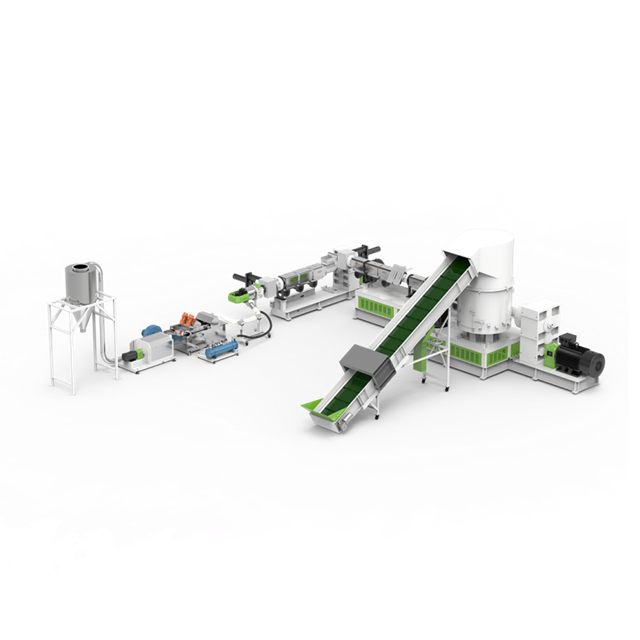
The JWP Pelletizing Line with Cutter Compactor combines feed preparation and single-screw extrusion for prepared plastic waste. Five model rows identify compactor and extruder specifications.
The cutter-compactor is the central selection angle for lightweight plastic feed. Film and similar prepared waste require a feeding discussion that differs from rigid flakes, so compactor dimensions and motor data belong beside the extrusion specification. Five paired sizes provide a range of capacity bands, with configuration choices for material delivery, filtration, degassing and pellet cutting. Buyers should decide how the actual feed reaches the compactor before selecting conveyor or roll equipment. Washed material may also need a separately defined water-removal route, because the line should not be assumed to contain every cleaning operation. A complete proposal connects prepared feed, compaction, extrusion and pellet collection. The intended polymer, incoming material form and required pellet condition give those choices a practical basis beyond screw diameter or nominal output alone.
JWP Pelletizing Line With Cutter Compactor
The material list includes HDPE, LDPE, PP and several film types, with other polymers also identified. Review each intended feed separately. Film source, moisture, printing and contamination affect the preparation required before the material enters the pelletizing route.
Describe whether the prepared material arrives as loose film, rolls or another lightweight form. Identify cleanliness and moisture condition as well as polymer. This gives the feeding review a practical starting point and helps distinguish the line's pelletizing duty from any upstream washing or water-removal requirement.
The cutter compactor is paired with a single-screw extruder in the system composition. Its diameter rises from 900 to 1600 mm across the model range. Match compactor duty and extrusion capacity to the feed's bulk form.
Compactor and extruder data should be compared together because they describe linked parts of the route. The compactor diameter and motor address feed preparation, while the extrusion screw and motor describe the next processing stage. Keep both selected specifications visible rather than reducing the line comparison to one screw size.
JWP90 lists 200-350 kg/h and JWP200 lists 1000-1500 kg/h. Each row also separates compactor and extruder power. This makes the model table useful for comparing feed preparation and extrusion together.
The paired range should be reviewed on a consistent feed basis. Specify the material condition used to discuss output and the desired collected pellets. This connects the capacity band to the project and avoids assuming that every flexible waste form provides the same rate through a given configuration.
Target Recycled Material | HDPE, LDPE, PP, BOPP, CPP, OPP, PA,PET,BOPET | |||||
System composition | Belt Conveyor, Cutter Compactor, Single Screw Extruder, Screen changer, Water Cooling Device, dryer, pelletizer, vibration screen, blowing collection | |||||
Feeding Device | Belt Conveyor (Standard), Roll Hauling off device (Optional) | |||||
Material of screw | 38CrMoAlA,40Cr,etc | |||||
Heater of barrel | Ceramic heater , Far-infrared heater, Electromagnetic induction heater | |||||
Vacuum deashing exhaust | double-zone vacuum degassing | |||||
Pelletizing type | strand cutting, water ring cutting, underwater strand cutting, underwater pelletizing | |||||
Model | Compactor | Extruder | ||||
diameter(mm) | motor power(kw) | Screw diameter(mm) | L/D | motor power(kw) | capacity(kg/h) | |
JWP90 | 900 | 55 | 90 | 36 | 75-90 | 200-350 |
JWP120 | 1100 | 90 | 120 | 36 | 110-132 | 300-500 |
JWP150 | 1200 | 110 | 150 | 36 | 160-200 | 450-700 |
JWP180 | 1400 | 160 | 180 | 36 | 250-315 | 800-1200 |
JWP200 | 1600 | 200 | 200 | 36 | 280-415 | 1000-1500 |
A belt conveyor is listed as standard and roll haul-off as optional. Choose between feed arrangements according to loose waste or roll material. The optional device should be specified only where it serves the actual incoming format.
Conveyor and roll devices address different ways of presenting material. Select the arrangement that matches the actual supply form, and identify any optional detection or additive feeding separately. The availability of several feed choices should not be written as a guarantee that all are included in every line.
The configuration identifies a screen changer and double-zone vacuum degassing. Agree the filtration duty and venting requirements for the recovered feed. These functions do not replace the necessary upstream cleaning of contaminated material.
Melt filtration and vacuum degassing belong to separate selected functions in the proposal. Review them with contamination and preparation condition, then identify the actual equipment arrangement. This makes the processing scope clearer than a list of features without their relationship to the intended feed.
Strand, water-ring, underwater-strand and underwater pelletizing appear as listed alternatives. Define the chosen method alongside cooling, drying and collection. The final line should have a clear cutting arrangement matched to polymer and pellet requirements.
The chosen cutting method should define the associated cooling, drying and collection route. Ask for that equipment sequence to be identified in the scope. Buyers can then compare complete pellet output arrangements rather than treating several available cutting alternatives as one standard system supplied together.
The film and woven bag washing line covers upstream flexible-waste cleaning. The JWH fiber recycling line provides a fiber-focused compactor route. Select the process around material form rather than assuming all compactor lines have the same feed duty.
Fiber preparation and film washing address related but distinct feed conditions. The comparison should start with material form and treatment already completed. Any separate washing or water-removal machinery should have its own scope and interface, avoiding the assumption that cutter-compactor pelletizing includes a complete cleaning plant.
Give DYUN's compactor-line team feed photographs, polymer, moisture condition and intended pellet application. Add the desired rate and incoming format. Confirm upstream preparation, the chosen cutting type and the complete installed electrical load.
A project review should identify the entry condition at the compactor and the desired output at pellet collection. Add the required feed equipment, selected processing choices and available plant space. These details make the paired model comparison useful for ordering instead of leaving the actual line arrangement unresolved.
DYUN's recycling machinery profile explains its business within JWELL. A JWP project should distinguish the cutter-compactor pelletizing system from any required upstream washing and establish a material-specific feeding and cutting configuration.
A cutter-compactor project benefits from a manufacturer discussion that begins with the actual feed form. The selected delivery device, compactor-extruder pair and pellet-handling route should be identified together. Upstream washing and water removal remain separate scope questions where the material condition requires them.
Lightweight feed preparation and extrusion are linked duties. The table pairs compactor dimensions and motor data with screw and extruder ratings. Review both parts together and state how the film is supplied, rather than selecting only from screw diameter.
The five bands extend from 200–350 to 1000–1500 kg/h. Assess the selected band with polymer, feed form and preparation condition. A catalogue range should not be treated as identical performance for all loose films, rolls or other lightweight waste.
A belt conveyor is listed as standard and roll feeding as optional. The actual choice should follow the material form. Confirm the supplied arrangement and any additional detection or additive equipment individually in the proposal.
The identified route pairs compaction with extrusion and pellet handling. Upstream washing and water removal should be defined separately where needed. A broad recycling description should not be used to assume that every cleaning machine is part of the pelletizing line.
Provide polymer, feed photographs, supply form, moisture and contamination details. State the required pellet output and preferred feeding and cutting route. Separate existing preparation machinery from equipment to be supplied so the quotation has clear process boundaries.
Compare the paired compactor and extruder, selected feed device, filtration, degassing and complete pellet-handling scope. Use the same representative material and output requirement. This avoids comparing an extrusion package with a more complete installation as though they were equivalent.


