
- All
- Product Name
- Product Keyword
- Product Model
- Product Summary
- Product Description
- Multi Field Search
 English




| Quantity: | |
|---|---|


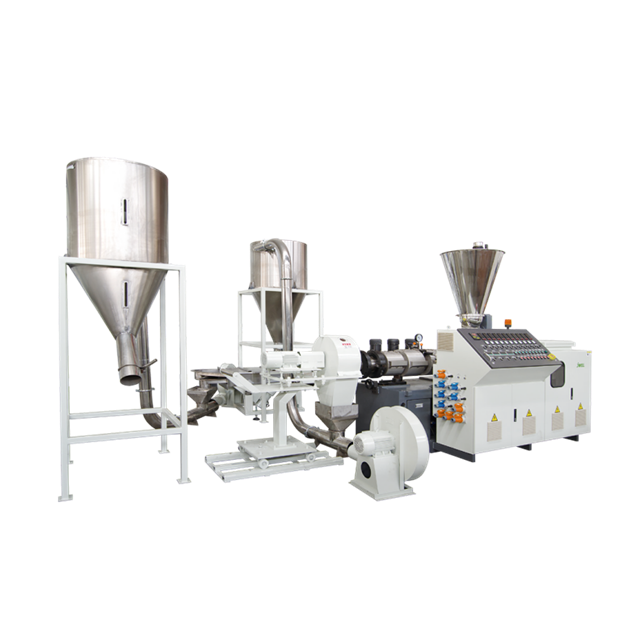
The SJZ PVC Conical Twin-Screw Pelletizing Line processes PVC material into compounded or recycled pellets. Four model rows list paired screw diameters, main motor power and capacity.
The conical twin-screw structure is the starting point for PVC formulation processing. Buyers should review the paired screw diameters together with motor and capacity data, then define the required feed and pellet properties. The described downstream route uses die-face cutting followed by air cooling, cyclone separation and vibration-related handling. This equipment sequence distinguishes the line from a generic pelletizer description and gives the purchase scope clear points for comparison. Four listed configurations support an initial size review, while the selected arrangement still needs to match the intended PVC formulation. Material handling before extrusion and pellet collection afterwards should remain visible in the proposal. A useful enquiry therefore combines formulation details, the required production duty and the complete cooling and cutting route without inventing universal temperature settings or processing guarantees.
SJZ PVC Conical Twin Screw Pelletizing Line
The line targets PVC raw or waste material. Define whether the project involves a new compound or prepared recovered PVC. Additive content, feed form and the intended product should be supplied before choosing the extrusion and cutting configuration.
PVC formulation should be described through the actual ingredients and required pellet properties. Identify the feed form and any existing preparation equipment. This gives the extrusion discussion a defined entry condition and avoids treating a general PVC label as enough information to select a complete processing arrangement.
The conical arrangement provides a larger feed-end volume and a smaller discharge-end structure. The product describes this as supporting feeding, mixing and extrusion pressure. Review the selected screw geometry around the actual PVC formulation.
The conical geometry is shown through two diameter values for each listed screw arrangement. These paired dimensions provide a useful way to compare the four sizes with their motors and capacity bands. A formulation-specific review should consider that complete set of data together with the prepared feed and the required pellet-handling route.
SJZ55 lists 55/110 mm screw diameter, while the largest published row lists 92/188 mm. These paired dimensions describe the conical screw specification. They should not be interpreted as alternative single-screw choices.
Paired dimensional data need to remain paired in the specification. Compare the listed values directly and request confirmation of the selected equipment labels where source characters are unclear. The ordering document should use confirmed dimensions and identifiers instead of silently deriving a screw arrangement from a model name.
Model | Screw Dia.(mm) | Main Motor Power KW | Capacity KG/H |
SJZ55 | 55/110 | 22 | 100-120 |
S]Z65 | 65/132 | 37 | 220-260 |
S]Z80 | 80/156 | 55 | 320-450 |
S]Z92 | 92/188 | 110 | 650-800 |
The main motor entries range from 22 to 110 kW. Listed capacity bands extend from 100-120 to 650-800 kg/h. Choose a row based on formulation and required production rate, keeping the model-specific data together.
The capacity and motor entries provide initial comparison points across four sizes. Review them with the intended formulation and output condition on a consistent basis. The selected motor should be identified for site planning, while any cooling, cutting and handling loads require their own equipment information.
The product identifies die-face cutting with precision knives and adjustable cutting speed. Define the pellet size and processing requirements before selecting the cutting arrangement. Knife design should be reviewed with the material and selected extrusion duty.
Die-face cutting forms a specific downstream process choice. The proposal should describe its connection to extrusion and identify the associated pellet-handling equipment. This makes the line scope more useful than a general statement that pellets are produced, and helps separate the selected route from other cutting alternatives.
Air delivery, cyclone separation and vibration separation are described for downstream handling. Agree the required cooling and collection equipment in the proposal. The final arrangement should match the selected capacity and pellet condition.
Air cooling, cyclone separation and vibration handling should be considered as a connected sequence after cutting. Define how pellets will be collected and the condition required at that point. The named equipment functions do not establish one universal pellet temperature or size without a project-specific specification.
The PVC centralized feeding system addresses raw-material delivery. The CJWH twin-screw compounding line offers another formulation-focused extrusion discussion. Feeding, extrusion and pellet handling should be selected as a coordinated process.
Feeding and formulation handling are separate from the extrusion and cutting stages. Identify storage and delivery requirements and any existing plant equipment. A coordinated project should show the material interface into the pelletizing line without assuming that central distribution machinery is included simply because it is related to PVC processing.
Provide DYUN's PVC processing team formulation details, feed form and desired pellet output. Include the required cooling method and utility supply. Confirm the exact model designation for the rows printed as S]Z65, S]Z80 and S]Z92.
Provide formulation information, feed condition and required pellet output alongside the available installation space. Ask for the selected screw, motor and cooling-cutting route to be identified. These inputs establish a practical scope for equipment review and keep operating conditions tied to the actual material rather than an invented generic recipe.
The DYUN company profile explains its recycling machinery activities. PVC pelletizing proposals should make the formulation, exact model identifier and die-face cutting and cooling arrangement clear before selecting a capacity band.
PVC pelletizing proposals should link formulation requirements to the selected conical screw arrangement and downstream cutting route. The manufacturer discussion should identify cooling, separation and collection scope while confirming exact dimensional and equipment data. This makes the purchase specification more concrete than a general PVC-processing description.
The line uses a conical twin-screw structure with paired screw diameters, followed by the described die-face cutting and air-cooling route. Selection should connect those functions with the intended PVC formulation and required pellet output.
The four paired entries are 55/110, 65/132, 80/156 and 92/188 mm. Preserve both dimensions when comparing configurations. Confirm the selected equipment identifier and dimensions directly in the technical proposal before they are used for ordering.
The bands span 100–120 to 650–800 kg/h. Review them with the corresponding motor and paired screw data, then assess the intended formulation. They are selection references rather than one guaranteed rate for every PVC compound.
The described route includes air cooling, cyclone separation and vibration-related handling before collection. The selected equipment sequence and required pellet condition should be specified together. These stages should not be converted into unverified universal cooling or pellet-size guarantees.
Provide the PVC formulation, ingredient forms, preparation already performed and required pellet properties. State the desired output and collection arrangement. Identify any feeding equipment that must be supplied so the quotation covers a defined processing route.
Confirm screw dimensions, motor selection, cooling and cutting scope and the exact equipment identifiers. Some source labels contain unclear characters, so the proposal should resolve them directly. Include site utilities and installation requirements for the selected complete arrangement.


