
- All
- Product Name
- Product Keyword
- Product Model
- Product Summary
- Product Description
- Multi Field Search
 English

Views: 0 Author: Site Editor Publish Time: 2026-07-28 Origin: Site


Extrusion instability in a high-capacity plastic pelletizing line wrecks production schedules and destroys profit margins. Minor pressure fluctuations at the die head translate directly into inconsistent pellet geometry, severe material degradation, and unplanned downtime. When you run variable feedstocks—especially post-consumer recyclables with fluctuating moisture and contamination levels—holding a stable melt pressure and uniform temperature profile becomes a massive engineering hurdle. Continuous extrusion is a highly synchronized sequence of feeding, melting, filtration, and cutting. A bottleneck in the feed throat or a pressure drop at the screen changer instantly destabilizes the entire operation. Achieving uninterrupted, high-yield output requires a hard look at the complete mechanical architecture, from the initial melt preparation down to the final cooling bath. This guide breaks down the technical framework needed to assess equipment capabilities, stabilize melt flow, and select the right plastic pelletizing machine manufacturer for long-term reliability.
A stable continuous extrusion process relies on strict, measurable baseline metrics. You cannot manage what you do not measure. Operators must monitor consistent melt pressure, uniform pellet dimensions, and zero unplanned line stoppages over a standard 24-hour production cycle. Pressure variance at the die head should remain within a tight +/- 2 to 5 bar limit depending on the polymer. Anything outside this window indicates a systemic issue upstream.
Pressure and flow instability introduce severe operational risks that directly impact the bottom line. Die swell, strand breakage, and bridging in the feed throat disrupt production and generate massive amounts of scrap material. When pressure drops, strands thin out and break, forcing operators to manually re-string the line. When pressure spikes, you risk blowing a rupture disk or forcing polymer past the die plate seals. Maintaining exact metrics ensures the final product meets the required bulk density and flow characteristics demanded by injection molders.
| Operational Metric | Stable Baseline Target | Symptoms of Instability |
|---|---|---|
| Melt Pressure Variance | +/- 2 to 5 Bar | Strand breakage, die swell, inconsistent pellet weight |
| Melt Temperature | +/- 1°C to 2°C of setpoint | Material degradation, black specks, poor degassing |
| Extruder Motor Load | Steady amp draw (fluctuation < 5%) | Surging, feed throat bridging, unmelted particles |
| Pellet Geometry | Uniform cylinder or sphere | Tails, fines, dog-bones, agglomeration |
A modern plastic pelletizing line combines feeding, melting, filtration, and cutting into a single continuous operation. Every stage must work in perfect synchronization. The feed rate must match the melting capacity, the filtration system must handle the exact output of the extruder without creating a bottleneck, and the pelletizer must pull the strands at the exact speed they exit the die.
A bottleneck in one stage immediately propagates downstream. If the feed throat bridges due to lightweight fluff, the screw starves. This causes a sudden drop in melt pressure at the die head, leading to strand breakage. Harmonizing these stages requires advanced control logic and properly sized mechanical components to prevent surges and ensure a steady output volume.
Variations in bulk density, moisture content, and melt flow index (MFI) of the input material disrupt the extrusion process. Post-consumer resins often contain mixed materials, making it difficult to maintain a stable melt viscosity. A sudden influx of high-moisture material will cause foaming and pressure spikes as the water turns to steam inside the barrel. Similarly, a shift from a fractional melt material to a high-flow injection grade will drastically alter the backpressure.
Operators must set the correct extruder temperature profile to handle mixed-MFI resins, often utilizing a reverse temperature profile if shear heating becomes excessive. Utilizing consistent material feeding systems, such as gravimetric dosing or crammer feeders for low bulk density films, maintains a steady baseline. Proper material preparation, including pre-drying and aggressive blending, stabilizes the melt flow before it ever enters the extruder.
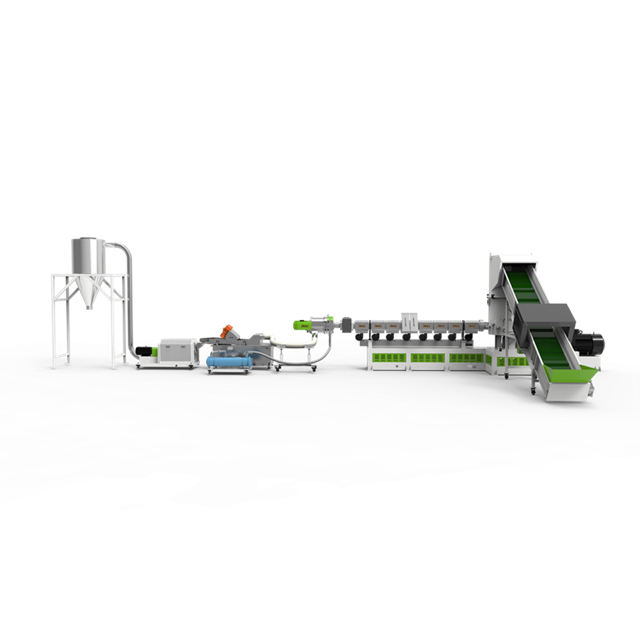
The design of the screw and barrel ensures homogeneous melting and plasticization. The screw geometry must match the specific polymer being processed. A barrier flight design is often necessary for polyolefins to separate the melt pool from the solid bed, ensuring complete plasticization without excessive shear. Proper design prevents unmelted particles from reaching the screen changer and blinding the mesh.
Feed zone temperature optimization prevents premature melting and blockages. If the feed zone is too hot, the material melts and sticks to the feed throat, causing a bridge that stops the flow entirely. This requires a grooved feed bush with aggressive water cooling to maintain a solid conveying zone. Precise temperature control in this initial zone ensures a consistent feed rate into the compression section of the screw.
Gear pumps installed between the extruder and the die head act as a critical surge buffer. They isolate the die head from pressure variations occurring inside the extruder barrel. Extruders are excellent at melting and mixing, but they are inherently poor pumps. The screw pushes material forward, but variations in feed or polymer viscosity cause the output pressure to surge.
Melt pumps absorb these pressure surges from the extruder screw. They utilize precision-machined counter-rotating gears to deliver a mathematically precise, continuous volume of plastic melt to the die. By taking over the pressure-building function, the melt pump allows the extruder to run at a lower head pressure, reducing shear heat and saving energy. This precise delivery ensures uniform pellet dimensions and prevents the strand breakage associated with pressure dips.
Filtration systems remove impurities from the melt stream, but they also represent the largest source of pressure variation in the line. Manual screen changers require stopping the line completely, causing significant downtime and generating scrap during startup. Hydraulic slide-plate screen changers offer faster changes but still cause minor pressure drops and brief flow interruptions as the breaker plate shifts.
Continuous, backflush-capable filtration systems are mandatory for processing highly contaminated post-consumer resins. These systems utilize dual pistons with multiple screen cavities. When one screen clogs, the system routes a small portion of the clean melt backwards through the dirty screen, flushing the contaminants out a discharge port. They maintain stable pressure and prevent flow disruptions by cleaning the screens without halting the forward melt flow. This continuous operation maximizes production uptime and keeps the die pressure rock solid.
The engineering of the die head forms consistent strands. The die holes must be precisely machined and polished to ensure uniform flow distribution across the entire face of the plate. Any variation in hole size, land length, or flow path causes uneven strand thickness. A strand exiting the center of the die might flow faster than a strand at the edge if the internal geometry is flawed.
Uniform flow channel design, such as coat-hanger or radial distribution designs, prevents dead spots. Polymer degrades rapidly in dead spots, leading to cross-linking, flow disruptions, and black specks in the final product. A well-designed die head ensures a clean, consistent melt flow, with equal pressure and velocity at every single orifice.
Precise, multi-zone PID temperature controllers maintain the exact processing temperature of specific polymers. Each zone along the barrel requires independent control to manage the melting profile accurately. This control prevents overheating and degradation. Ceramic heater bands provide the heat, while high-capacity blowers or closed-loop water systems provide the cooling.
Operators must balance shear heating generated by the screw with external heating and cooling bands. For high-viscosity materials, the mechanical energy of the screw generates more heat than the polymer requires. In these cases, the heater bands rarely turn on, and the cooling system must work aggressively to extract the excess heat. Proper zoned control ensures the melt remains stable, preventing viscosity drops that lead to pressure loss at the die.
Trapped gases, moisture, and ink volatiles cause voids, foaming, and pressure spikes. If these volatiles remain in the melt, the final pellets will be defective, lightweight, and prone to breaking apart. Vacuum degassing systems extract these gases through a vent port in the barrel before the melt reaches the die head.
Single vacuum degassing zones work for lightly contaminated materials or clean industrial scrap. Double vacuum degassing zones are necessary for heavily printed films, washed agricultural plastics, or high-moisture materials. The screw design must feature a decompression zone under the vent port to expose the maximum surface area of the melt to the vacuum without pulling polymer up into the vacuum stuffer. Effective degassing maintains a dense, stable melt and prevents pressure fluctuations.
Cooling systems depend entirely on the polymer type and the chosen pelletizing method. Water baths cool extruded strands before they enter the pelletizer rotor. The length of the bath and the temperature of the water dictate how much heat is removed. Water-ring and underwater pelletizing systems cut the melt directly at the die face and use a high-volume water flow to cool the pellets immediately.
Rapid-cooling requirements are critical for PVC, TPU, and other temperature-sensitive or highly tacky plastics. They must be cooled quickly and evenly to maintain their shape and prevent them from agglomerating into massive clumps. Advanced cooling systems utilize chilled water circuits and precise flow controls to ensure the pellets solidify correctly without deforming or sticking to the equipment.
Integrating drying equipment requires careful maintenance planning. Water penetration in vertical centrifugal dryers causes premature wear on bottom bearings and motors. The high-speed rotor flings water off the pellets, and if the lower seals fail, that water drains directly into the bearing housing. Advanced sealing technology, air purges, and external bearing mounts mitigate this risk and extend the lifespan of the drying equipment.
PLC-based control systems automatically adjust screw speed and melt pump RPM based on real-time pressure feedback from transducers mounted in the melt stream. These automated systems provide a high ROI by minimizing human error and maintaining consistent production parameters. If the pressure before the screen changer rises, the PLC can automatically slow the extruder slightly while maintaining the melt pump speed, keeping the die pressure constant. They react faster to pressure changes than manual operators ever could.
However, over-engineering introduces unnecessary maintenance complexities. Automated systems must be user-friendly and reliable. Complex systems with dozens of proprietary sensors that frequently fail cause more downtime than manual operations. A robust plastic pelletizing system balances advanced control logic with rugged, off-the-shelf industrial components that maintenance teams can actually troubleshoot and replace.
A well-engineered line should be easily upgraded as production demands change. Modular designs allow operators to add a secondary degassing unit, swap a standard screw for a high-mixing profile, or transition from a manual to an automatic screen changer without replacing the entire line. This flexibility extends the useful life of the equipment and protects the initial capital investment.
Upgrading the cutting system from a strand pelletizer to an underwater system improves capabilities as material profiles change toward higher melt-flow resins. A scalable design ensures the system remains relevant and profitable for years to come, allowing processors to adapt to new market demands and changing feedstock qualities.
Evaluating a plastic pelletizing machine manufacturer requires analyzing their in-house machining capabilities. Do they cut their own screws or outsource them? Metallurgical expertise ensures screw and barrel wear resistance. Processing abrasive materials like glass-filled nylon or heavily contaminated agricultural film requires bimetallic alloys and tungsten carbide coatings. Standard nitrided barrels will wear out in months under these conditions.
Global availability of critical replacement parts is essential for minimizing downtime. A reliable plastic pelletizing machine supplier provides rapid support, remote PLC troubleshooting, and fast spare parts delivery to keep your production running smoothly. You are buying a long-term partnership, not just a piece of steel.
Buyers must demand critical tests during Factory Acceptance Testing (FAT). Do not accept a dry run. Running the exact target material at maximum capacity verifies pressure stability, degassing efficiency, and cooling capacity. This testing proves the machine meets the required specifications before it ever leaves the manufacturer's floor.
Comprehensive, hands-on operator training provided by the supplier mitigates human-error-induced instability. Proper training ensures operators understand the control systems, the PID tuning parameters, and the preventative maintenance procedures, maximizing equipment uptime and preventing catastrophic failures caused by simple operational mistakes.
A: Pressure fluctuations stem from inconsistent feeding, variable material bulk density, and screen blockages. Inadequate temperature control also causes viscosity changes, leading to unstable melt pressure, surging, and flow disruptions at the die head.
A: A melt pump acts as a mechanical buffer, absorbing extruder surges. It utilizes precision gears to push a constant, mathematically precise volume of melt through the die head, minimizing pellet size variation and preventing strand breakage.
A: Continuous filtration allows for the removal of solid impurities without stopping the line. It prevents massive pressure drops, ensures continuous output, and prevents strand breakage when processing highly contaminated post-consumer resins.
A: Temperature-sensitive plastics require rapid, uniform cooling to prevent pellet deformation and sticking. Specialized chilled water baths, water-ring systems, or air cooling systems are used to solidify the pellets quickly and evenly.
A: Vertical centrifuges are vulnerable to water penetration at the bottom bearings and motors due to gravity and high-speed rotation. This requires strict maintenance schedules or alternative dryer designs with superior sealing technology to prevent premature failure.
A: Emphasize transparent Factory Acceptance Testing (FAT) with your actual materials, metallurgical quality of wear parts like bimetallic barrels, and responsive after-sales technical support. Ensure they offer comprehensive operator training and readily available replacement parts.


