
- All
- Product Name
- Product Keyword
- Product Model
- Product Summary
- Product Description
- Multi Field Search
 English

Views: 0 Author: Site Editor Publish Time: 2026-07-29 Origin: Site


In industrial compounding and recycling, the profitability of a high-volume operation hinges on Overall Equipment Effectiveness (OEE). Intermittent downtime for maintenance, screen changes, or thermal instability rapidly destroys the ROI of high-throughput equipment. Historically, operating a pelletizing setup was treated as an art, dependent on operator intuition, imprecise manual adjustments, and a subjective feel for the melt. For a modern high capacity plastic pelletizing line, this approach is a failure vector. Success requires transitioning from operator-dependent compounding to a highly repeatable, data-driven science. Scaling up throughput is not as simple as increasing extruder RPM or motor size. Pushing a poorly configured system to high capacities leads to uneven pellet geometry, thermal degradation of the polymer, and catastrophic equipment wear. To achieve true continuous, stable industrial operation, facilities must engineer a synchronized configuration from feedstock preparation to final classification. This guide breaks down the technical requirements, process controls, and evaluation criteria for specifying a continuous high-output system.
Operators must define the operational difference between a machine's theoretical maximum throughput and its realistic 24/7 sustained yield. Peak capacity often looks impressive on a specification sheet, but sustained output accounts for real-world variables like screen changes, material inconsistencies, and minor maintenance pauses. A true high-capacity system delivers consistent tonnage over a 30-day continuous run, not just a one-hour sprint under perfect laboratory conditions. When evaluating equipment, plant managers must look at the guaranteed output over a standard shift, factoring in the inevitable fluctuations in bulk density and ambient plant temperatures.
Establishing baseline success criteria for continuous runs is essential. This includes acceptable percentages of fines, longs, and agglomerates. High throughput means nothing if the resulting pellets fail quality control checks and require reprocessing. Industry-standard uptime expectations for continuous industrial compounding and recycling lines typically exceed 85-90%. Achieving this requires robust equipment design, wear-resistant metallurgy, and proactive maintenance protocols that address component degradation before it causes a line stoppage.
| Metric | Theoretical Target | Realistic Operational Target | Impact on Production |
|---|---|---|---|
| Overall Equipment Effectiveness (OEE) | 99% | 85% - 90% | Determines actual yield and facility profitability. |
| Pellet Uniformity (On-Spec) | 100% | >98.5% | Reduces waste and eliminates the need for secondary sorting. |
| Screen Change Downtime | 0 minutes | 0 minutes (with continuous changers) | Maintains melt pressure and prevents thermal degradation during shifts. |
| Specific Energy Consumption | 0.15 kWh/kg | 0.20 - 0.25 kWh/kg | Directly impacts operational expenditure and utility overhead. |
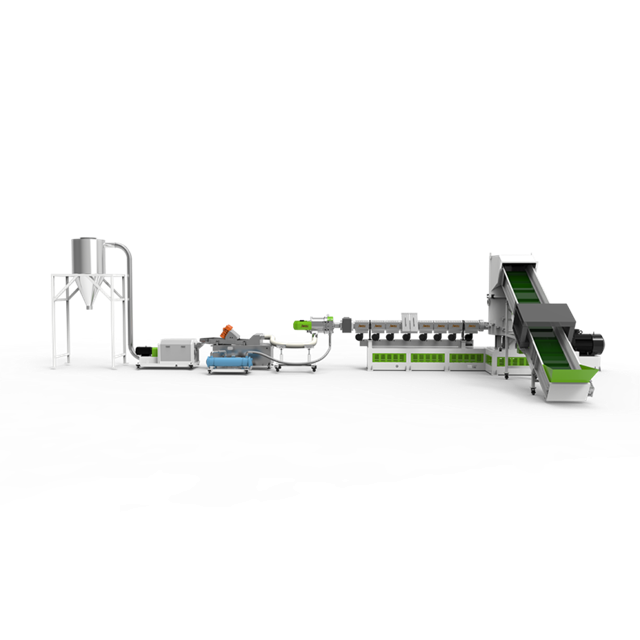
Bulk density variation significantly impacts throughput. Integrated shredding or crushing configurations are necessary to feed the extruder a uniform particle size. When feedstock size varies wildly, extruder feeding becomes erratic, leading to surging and inconsistent melt pressure. Consistent particle size ensures stable feeding and uniform melting. Facilities processing post-consumer scrap or industrial off-cuts must implement heavy-duty size reduction equipment directly tied to the extruder feed throat via closed-loop conveyors.
Moisture in the raw feedstock causes hydrolysis and severe outgassing during extrusion. Integrating continuous desiccant or infrared drying systems upstream of the feed throat mitigates this issue. Loss-in-weight gravimetric feeders are necessary to ensure precise, continuous material dosing without starvation or overfeeding at high speeds. These feeders adjust in real-time to maintain a constant mass flow rate into the extruder, compensating for any slight variations in material bulk density.
Twin-screw co-rotating extruders generally offer superior mixing and degassing capabilities compared to single-screw architectures, making them ideal for high-capacity compounding. The Length to Diameter (L/D) ratio must be carefully selected to provide adequate residence time for melting, degassing, and intensive mixing at high throughputs without causing thermal degradation. For highly contaminated or moisture-heavy materials, L/D ratios of 44:1 or higher are often required to accommodate multiple atmospheric and vacuum venting zones.
Continuous melt filtration is vital for maintaining output. Continuous screen changers, such as dual-bolt or continuous rotary designs, allow for backflushing and screen replacement without halting melt flow or dropping pressure. This continuous operation is a cornerstone of high-output processing, preventing costly downtime associated with manual screen changes. Rotary systems, in particular, offer a constant pressure profile, which is necessary for maintaining uniform pellet weight at the die face.
Underwater pelletizing systems are the industry standard for high-capacity, continuous operations. They offer superior cooling capacity, excel at handling low-viscosity melts, and feature automated start-up sequences. The water flow immediately quenches the melt as it exits the die plate, preventing agglomeration and ensuring uniform spherical pellets. This method is highly favored for polyolefins, thermoplastic elastomers, and hot-melt adhesives where rapid cooling is required to prevent the pellets from sticking together.
Water-ring and strand pelletizing have specific use-cases but face limitations at high capacities. Strand systems are mechanically sensitive to strand breakage, which can disrupt continuous operation and require manual re-stringing by operators. Dry-cut configurations are evaluated for thermally sensitive compounds where direct temperature control at the die face is required to support stable processing without degradation. Water-ring systems offer a middle ground, providing good cooling for medium-viscosity polymers without the complexity of a fully submerged underwater system.
High-volume moisture removal requires centrifugal dryers and agglomerate catchers sized to handle high water flow rates without bottlenecking the line. If the dryer cannot keep up with the pelletizer's output, the entire system must slow down. The rotor design within the centrifugal dryer must aggressively strip surface moisture while minimizing impact damage to the pellets. High-capacity lines often utilize dual-dryer setups or oversized units with integrated pre-dewatering chutes.
Continuous vibratory sieves isolate off-spec pellets, such as fines or twins, before packaging, ensuring final product quality meets strict specifications. These classifiers use multi-deck screens to separate oversized agglomerates and undersized dust from the prime product. Integrating these sieves directly into the pneumatic conveying line ensures that only perfectly sized pellets reach the storage silos or bagging stations.
High-accuracy sensors eliminate operator-dependent guesswork by translating melt temperature, melt pressure, and motor torque into real-time, quantifiable variables. The integration of melt pressure transducers and thermocouples at the die head detects viscosity shifts and prevents die freeze or pressure spikes. Modern PLCs tie the cutter speed directly to the extruder screw speed and melt pressure to guarantee uniform pellet weight and geometry. When the extruder surges slightly, the cutter automatically adjusts its RPM to maintain a consistent cut length.
Modern industrial Ethernet protocols support remote system monitoring, multi-plant KPI tracking, and seamless data exchange for international manufacturing operations. Automated lubrication systems pump measured amounts of grease into mill and extruder bearings at regular, pre-programmed intervals, eliminating manual intervention and bearing failure. This level of automation ensures that the mechanical components receive exact lubrication volumes, preventing both dry-running and over-packing of the bearing housings.
Evaluate the energy efficiency of the system using Specific Energy Consumption (SEC) metrics, measured in kilowatt-hours per kilogram (kWh/kg). High capacity must not come at the cost of exponential energy waste. A well-designed plastic pelletizing system balances motor power with optimized screw geometries to maximize output per kilowatt. Drive systems utilizing permanent magnet synchronous motors (PMSM) offer significant energy savings over traditional AC induction motors, especially in high-torque applications.
Consider layout trade-offs carefully. Compact designs save floor space but can increase downtime if technicians cannot easily access wear parts like screws, die plates, and cutter blades. Maintenance accessibility must be prioritized during the facility design phase. Analyze how spending more upfront on wear-resistant metallurgy, such as tungsten carbide die plates and bimetallic extruder barrels, reduces long-term operational expenditure in high-output scenarios. Cheaper components wear out faster, leading to frequent replacements and unacceptable downtime.
A common failure point occurs when downstream packaging or upstream material handling cannot keep pace with the extrusion line. Conduct a holistic facility mass-balance audit before installation to ensure all components are matched in capacity. If the extruder can push 3,000 kg/hr but the bagging station maxes out at 2,500 kg/hr, the entire line is bottlenecked. Upgrading silos, rotary valves, and pneumatic blowers is often necessary to support a new high-capacity extruder.
High-capacity extrusion generates significant shear heat, risking polymer degradation. Specify advanced barrel cooling systems and optimized screw profiles that balance shear with distributive mixing. Highly automated lines require advanced troubleshooting capabilities. Mandate comprehensive operator training and remote-access diagnostic support in the procurement contract to address operator skill gaps effectively. When an alarm triggers, operators must know how to interpret the HMI data rather than just resetting the machine and hoping the problem resolves itself.
Evaluate a manufacturer based on in-house metallurgy expertise, custom screw design capabilities, and proprietary die-face technology. Buyers should look for a plastic pelletizing machine manufacturer that designs the entire line from feeding to packaging, avoiding integration conflicts between mismatched third-party components. Single-source responsibility ensures that the PLC programming, mechanical interfaces, and safety interlocks function seamlessly as a unified system.
A rigorous Factory Acceptance Testing (FAT) protocol involves running the buyer's actual material at contracted capacity for a sustained period before shipment. Do not accept tests run with generic prime resins if your facility processes highly contaminated post-consumer regrind. Evaluate the plastic pelletizing machine supplier based on their global footprint, spare parts inventory availability, and guaranteed response times for field service technicians. A machine that sits idle for weeks waiting for a proprietary replacement part is a massive liability.
Continuous high-output pelletizing is a function of system-wide synchronization, not just raw extruder power. Continuous filtration, precise thermal management, and robust automation are the pillars of success. Shortlist suppliers who offer transparent SEC data, verifiable OEE track records, and comprehensive FAT capabilities. To move forward with upgrading or installing a high-capacity line, follow these immediate steps:
A: Output ranges typically from 1,000 kg/hr to over 10,000 kg/hr depending on the polymer type, bulk density, and specific system configuration.
A: They use a dual-piston or rotary mechanism that keeps melt flowing through one active cavity while the other cavity is exposed for manual screen replacement.
A: It provides rapid, uniform cooling, features automated start-up capabilities, and easily handles high volumes of low-viscosity melts without the risk of strand breakage.
A: Automated grease distribution prevents bearing failure by delivering precise amounts of lubricant at exact intervals, eliminating the need to stop the machine for routine manual greasing.
A: Focus on proven engineering expertise, turnkey system configuration capabilities, robust FAT protocols, wear-resistant metallurgy, and guaranteed spare parts availability.
A: Yes, provided the system is configured with aggressive upstream degassing, heavy-duty continuous melt filtration, and robust wear-resistant barrel linings.
A: Integration into industrial networks allows centralized engineering teams to monitor machine parameters, track OEE, and troubleshoot lines across multiple global facilities in real-time.


