
- All
- Product Name
- Product Keyword
- Product Model
- Product Summary
- Product Description
- Multi Field Search
 English

Views: 0 Author: Site Editor Publish Time: 2026-07-28 Origin: Site


In plastic recycling, the efficiency of the washing line is predetermined at the size reduction stage; improper shred sizing creates a cascading failure of either high contaminant retention or catastrophic yield loss. Plant operators frequently struggle with downstream bottlenecks—such as clogged filtration systems, excessive chemical consumption in hot washers, or poor sink-float separation—often misdiagnosing these as washing equipment failures rather than upstream particle size inconsistencies. Optimizing downstream washing requires treating size reduction and washing as a coupled system. This guide breaks down the technical relationship between shred size and washing efficacy, providing a framework for evaluating and selecting the right plastic shredder for recycling plant operations to maximize clean flake yield.
Establishing the baseline requirements for clean flake involves measuring acceptable parts per million (ppm) of organic contaminants, paper, and glue. Particle geometry heavily influences these metrics. If flakes are too large, friction washers cannot effectively scrub the inner surfaces. If flakes are too small, they behave unpredictably in fluid dynamics, leading to material loss. Operators must define exact specifications for their end product before adjusting upstream equipment. A rigid HDPE recycling line targeting food-grade applications requires vastly different particle geometries than an agricultural film line producing low-grade pellets. The success of the entire operation hinges on hitting a specific dimensional sweet spot where mechanical agitation and chemical treatments can perform optimally.
When evaluating flake quality, plant managers look at the distribution curve of the shredded material. A tight bell curve indicates that the vast majority of the material falls within the target size range. Outliers on either end of this curve represent operational inefficiencies. Large outliers carry contaminants through the system, while small outliers represent lost yield and increased wastewater treatment burden. Controlling this curve starts at the primary reduction stage.
Smaller flakes increase the surface area available for detergents and mechanical agitation to strip away surface contaminants. In hot wash systems, chemical penetration relies on a specific surface area to volume ratio. When flakes are cut to uniform dimensions, caustic agents dissolve adhesives evenly across the batch. Irregular thickness or excessive diameter prevents detergents from reaching embedded dirt, resulting in rejected batches. The mathematical reality of chemical penetration dictates that a 12mm flake will wash significantly faster and more thoroughly than a 25mm flake, assuming the thickness remains constant.
However, pushing for maximum surface area has limits. If the material is shredded too finely, the surface area increases exponentially, but the structural integrity of the flake diminishes. This leads to material degradation during aggressive mechanical washing. The goal is to find the exact point where surface area is maximized for chemical exposure without compromising the physical strength needed to withstand friction washer paddles and thermal stress.
Irregular particle size distributions alter the chemical draw rate and dosing requirements in wash loops. Inconsistent flake sizes force operators to run higher detergent concentration ratios to compensate for under-washed larger fractions. This drastically increases operational costs. Uniform shredding ensures predictable chemical consumption, stabilizing the wash loop injection dynamics and preventing chemical waste. When a wash line receives a consistent feed of uniformly sized flakes, automated dosing systems can maintain precise chemical concentrations, reducing the overall volume of caustic soda or detergents required per ton of processed material.
Consider the dynamics of a continuous hot wash system. If the feed material contains a mix of 10mm and 40mm flakes, the 10mm flakes will be over-processed, potentially absorbing excess chemicals, while the 40mm flakes will exit the system with residual adhesives. To prevent the 40mm flakes from failing quality control, operators typically increase the chemical concentration and residence time, effectively wasting resources on the smaller fraction. A tight particle size distribution eliminates this inefficiency.
Large, rigid pieces shield adhesives and dirt from friction washer paddles. Flexible materials like agricultural films face the risk of cupping or folding. When large films fold over themselves, they trap contaminants and carry them straight through the sink-float process. This physical shielding prevents water and chemicals from reaching the dirt, guaranteeing high contaminant retention in the final product. Oversized flakes also bridge across discharge chutes and block rotary valves, causing mechanical bottlenecks that require manual intervention and system downtime.
In rigid plastics, oversized pieces often retain their original structural curves—such as the neck or base of a bottle. These curves act as protective pockets for dirt and organic residue. Mechanical friction washers rely on flat or slightly curved surfaces rubbing against each other to dislodge contaminants. When a piece is too large and retains its complex geometry, the friction paddles cannot make effective contact with the inner surfaces, allowing contaminants to pass through the wash line untouched.
Fines are typically defined as particles smaller than 2mm. Excessive fines bypass mechanical screens and overload water filtration systems. They increase wastewater treatment costs and represent a direct loss of sellable yield. When a shredder generates too much dust, the recycling plant effectively grinds potential profit into unrecoverable sludge. Fines also create severe mechanical issues within the wash line. They act as an abrasive paste, accelerating wear on pump impellers, pipe elbows, and centrifuge screens.
The financial impact of fines is twofold. First, every kilogram of fines generated is a kilogram of material that cannot be sold as clean flake. Second, these fines must be removed from the wash water, requiring expensive flocculants, coagulants, and frequent filter press operation. Minimizing fines at the shredding stage is the most effective way to improve overall plant profitability and reduce environmental compliance burdens.
Primary size reduction technologies vary in output consistency and suitability for downstream washing. Selecting the right equipment requires understanding how different cutting mechanics influence the final particle size distribution. The goal is a tight bell curve of flake sizes, minimizing both oversized pieces and microscopic dust. Plant operators must evaluate shredders based on their cutting geometry, rotor speed, and screen configurations.
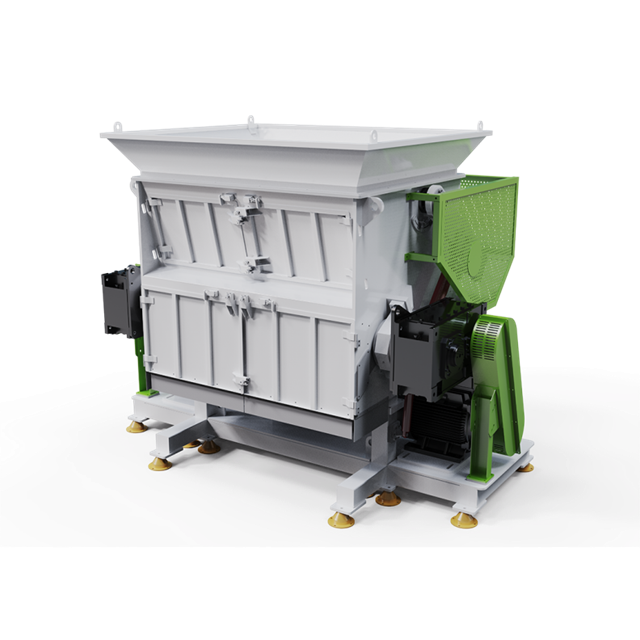
A single shaft shredder provides controlled, uniform primary reduction with minimal fines generation compared to high-speed granulators. Rotor design, knife configurations, and cutting gaps dictate the uniformity of the shredded fraction. Low-speed, high-torque shredding tears material cleanly, whereas high-speed granulation often shatters brittle plastics, creating excessive fines that disrupt downstream washing. The cutting action of a single shaft machine relies on a hydraulic ram pushing material against a rotating shaft equipped with square or rectangular cutting crowns. This controlled feeding mechanism ensures that material is sheared rather than shattered.
Granulators, operating at much higher RPMs, use a scissor-like cutting action. While excellent for secondary reduction of clean materials, using a granulator for primary reduction of contaminated plastics leads to rapid knife wear and massive fines generation. The high-speed impact shatters dirt and grit, embedding it further into the plastic matrix and creating a cloud of micro-plastics that will inevitably overwhelm the wash line's filtration system.
Internal screen geometry, including hole size, shape, and open area, governs the maximum particle size entering the wash line. There is a strict trade-off between smaller screen sizes, which offer better washability, and decreased throughput with increased heat generation. Operators must select screen configurations that balance the need for small, washable flakes against the machine's processing capacity. A screen with 40mm holes will process material much faster than a screen with 20mm holes, but the resulting flakes will require more aggressive downstream washing.
| Screen Hole Size | Throughput Impact | Fines Generation | Washability Rating | Ideal Application |
|---|---|---|---|---|
| 50mm+ | Maximum | Low | Poor | Pre-shredding bulky items |
| 30mm - 40mm | High | Moderate | Fair | Standard rigid plastics |
| 15mm - 25mm | Medium | High | Excellent | Heavily contaminated films |
| Under 15mm | Low | Very High | Optimal | Specialty food-grade lines |
Particle size interacts directly with rotor speed and screen mesh in a friction washer. Excessive fines and micro-plastics escape baseline filtration and clog the spray nozzle orifices of internal wash-water recirculation loops. This causes system pressure drops and stalls continuous mechanical wash cycles. Conversely, oversized materials risk causing rotor jams or excessive wear on the internal screens. Friction washers operate by spinning material at high speeds against a stationary screen, using the friction between the flakes themselves and the screen to scour away dirt. If the flakes are too large, they bridge the gap between the rotor and the screen, causing catastrophic mechanical failure.
The nozzle orifice clogging risk is a primary concern for maintenance teams. High-pressure spray bars rely on consistent water pressure to blast contaminants through the friction washer screens. When fines bypass the primary water filtration and enter the high-pressure pumps, they accumulate in the spray nozzles. A partially clogged nozzle creates uneven washing, while a fully clogged nozzle leaves sections of the material completely unwashed. Maintaining a consistent shred size with minimal fines is the only reliable way to protect these critical spray systems.
Uniform shred size stabilizes the hydrodynamic behavior of plastics in density separation. Micro-plastics and fines disrupt surface tension, causing heavy contaminants to float or light plastics to sink. When particle sizes vary wildly, the specific gravity separation becomes unreliable, leading to cross-contamination between the sinking and floating fractions. Sink-float tanks rely on the principle that materials with a specific gravity less than water (like PE and PP) will float, while materials with a specific gravity greater than water (like PET and PVC) will sink.
However, fluid dynamics complicate this simple principle. A very large piece of heavy plastic might trap air bubbles, causing it to float temporarily. Conversely, a microscopic piece of light plastic might become entrained in the downward current created by sinking heavy materials. Furthermore, excessive fines create a slurry that alters the overall density and viscosity of the water bath, completely throwing off the separation parameters. A uniform shred size ensures that all particles behave predictably according to their true specific gravity.
There is a direct relationship between flake size, residence time, and caustic soda concentration ratios in hot wash systems. Optimizing chemical draw rates requires calculating the optimal particle size to achieve complete glue dissolution without degrading the polymer structure. Uniform flakes allow operators to minimize chemical additives while ensuring thorough cleaning. Hot washers typically operate at temperatures between 80°C and 90°C, using a combination of thermal energy, mechanical agitation, and chemical agents to remove stubborn adhesives and oils.
If the shred size is inconsistent, operators face a difficult choice: optimize the residence time for the small flakes and risk leaving glue on the large flakes, or optimize for the large flakes and risk thermally degrading the small flakes. Thermal degradation causes the plastic to become brittle and discolored, ruining its value. By feeding the hot washer a tightly controlled particle size distribution, operators can dial in the exact temperature, chemical concentration, and residence time needed to achieve perfect cleaning without damaging the polymer.
Achieving progressively smaller shred sizes requires an exponential increase in energy consumption. Targeting an unnecessarily small initial shred size accelerates knife wear and maintenance downtime on the plastic shredder machine. Operators must balance the downstream benefits of small flakes against the upstream costs of power usage and blade replacement. Every time a rotor knife shears through a piece of plastic, it consumes electrical energy and dulls the cutting edge slightly. Forcing a shredder to produce 15mm flakes instead of 30mm flakes means the knives must make significantly more cuts per ton of material.
This increased cutting frequency leads to higher amperage draw on the main drive motors and faster degradation of the cutting crowns. When knives become dull, they stop shearing and start tearing or extruding the material through the screen. This generates massive amounts of heat, melts the plastic, and creates long, stringy particles that wreak havoc on downstream equipment. Maintaining sharp knives and selecting a reasonable target shred size are essential practices for controlling operating costs.
Evaluating the system design involves comparing a primary shredder followed by a secondary wet granulator against a single-pass reduction attempt. Two-stage systems often provide better particle consistency and lower fines generation. Single-stage systems lower equipment footprint but often increase maintenance requirements and lower overall yield. In a two-stage setup, the primary shredder is equipped with a larger screen (e.g., 40mm) to quickly break down bulky items without generating fines. The material is then fed into a wet granulator equipped with a smaller screen (e.g., 15mm).
The wet granulator uses water in the cutting chamber to cool the knives, wash the material during the cutting process, and flush the sized flakes through the screen immediately. This prevents the material from bouncing around the cutting chamber and generating dust. While a two-stage system requires more floor space and equipment maintenance, it almost always produces a superior particle size distribution and a cleaner final product compared to forcing a single shredder to do all the work.
Buyers must demand empirical testing from their plastic shredder machine manufacturer using their specific in-feed material. Metrics to track during trials include particle size distribution analysis, fines percentage, and throughput rates. Testing agricultural film requires different parameters than testing rigid HDPE or PET bottles. Never rely on generic throughput charts or standard material tests. The specific contamination levels, moisture content, and polymer mix of your actual feed stock will drastically alter the shredder's performance.
During the trial, collect samples of the shredded output and perform a sieve analysis to determine the exact particle size distribution. Weigh the fraction of material that falls below 2mm to calculate the fines generation rate. Inspect the larger flakes for signs of tearing, melting, or excessive cupping. If the output does not meet the strict requirements of your downstream wash line, work with the manufacturer to adjust the rotor speed, knife configuration, or screen geometry until the desired results are achieved.
Assessing the physical and control-system integration of a new shredder into legacy downstream equipment is vital. Operators must mitigate the risk of throughput mismatches, such as a shredder that outpaces the friction washer's capacity. Proper integration prevents spray line pressure fluctuations and ensures a continuous, stable material flow. A shredder that produces 3 tons per hour is useless if the downstream sink-float tank can only process 2 tons per hour. The system will constantly back up, requiring the shredder to stop and start, which increases wear on the drive components.
Control system integration involves linking the shredder's PLC with the wash line's central control panel. This allows the system to automatically adjust the shredder's feed rate based on the load levels of downstream equipment. For example, if the hot washer's centrifuge begins to draw too much amperage, the control system can automatically slow down the shredder's hydraulic ram, reducing the feed rate until the centrifuge clears the bottleneck. This level of integration is essential for maintaining a stable, efficient recycling operation.
The efficiency of a downstream washing line is strictly bound by the quality and consistency of the shredded material it receives. Optimizing shred size is a prerequisite for high-purity recycling. When evaluating size reduction equipment, prioritize machines that offer precise control over particle size distribution, robust screen configurations, and verifiable low-fines generation to protect downstream spray nozzles and chemical loops.
A: The ideal size depends on the specific material and downstream equipment. Typically, it ranges from 10mm to 20mm. This range provides an optimal balance, maximizing surface area for cleaning while keeping fines generation to a minimum.
A: Fines alter the fluid dynamics within the tank. They create suspension issues and disrupt surface tension, which causes heavy contaminants to float and light plastics to sink, resulting in severe cross-contamination of the separated fractions.
A: It utilizes a low-speed, high-torque cutting action. This method tears material cleanly, producing highly uniform particles with significantly fewer fines compared to high-speed granulators, which tend to shatter the plastic.
A: High concentrations of under-sized fines bypass primary separation screens. They enter wash-water recirculation loops, collect inside spray nozzle orifices, and obstruct water flow. This drops system pressure and drastically lowers washing efficiency.
A: Yes. Smaller screen sizes produce flakes with higher surface-area-to-volume ratios. This allows for faster, more predictable chemical penetration and helps operators optimize detergent draw rates for better cleaning.
A: Send sample materials directly to the manufacturer for trial runs. Request a detailed Particle Size Distribution (PSD) report to verify the output consistency and ensure the fines percentage remains within your acceptable limits.


