
- All
- Product Name
- Product Keyword
- Product Model
- Product Summary
- Product Description
- Multi Field Search
 English

Views: 0 Author: Site Editor Publish Time: 2026-08-11 Origin: Site


Capital expenditure on industrial recycling equipment carries massive risk without empirical material validation. Generic machine specifications often fail to account for the unique kinematics, thermal sensitivity, and shear requirements of specific polymers. Whether you process PET, HDPE, PVC, or mixed composites, a reliable plastic crusher machine supplier will offer a structured, transparent material testing protocol before purchase. This article provides a technical framework for demanding and evaluating these tests. Relying on brochure data for complex polymer reduction leads to undersized motors, excessive dust generation, and frequent rotor jams. Real-world testing bridges the gap between theoretical capacity and actual factory floor performance. You need hard data on throughput, blade wear, and energy consumption to justify the equipment investment and ensure seamless integration into your existing extrusion or washing lines.
Defining the operational baseline is the first step in equipment validation. Success is not just reducing size. It means achieving a uniform regrind with minimal dust, low energy consumption, and predictable maintenance cycles. Without empirical testing, operators guess at these outcomes. A proper trial establishes exact performance metrics before installation. You need to know exactly how the rotor interacts with your specific scrap.
Rated capacity on spec sheets is purely theoretical. A machine rated for 1000 kg/hr depends heavily on material bulk density, feeding methods, and screen size. Relying solely on brochure numbers leads to undersized equipment and production bottlenecks. Actual throughput varies wildly between rigid pipes and flexible films. A 50 HP motor might easily process 800 kg/hr of brittle PS trays but stall out at 400 kg/hr when fed tough, tear-resistant LDPE film.
Different plastics react uniquely to shear, impact, and compression. Real-world validation matches the rotor design to the material. Polycarbonate shatters under impact. Low-density polyethylene requires sharp, continuous shear to prevent tearing. Testing ensures the blade geometry suits the specific polymer matrix. A V-cut rotor configuration might excel for PET bottles but fail miserably on heavy PP purgings. You must observe the cutting action firsthand.
Empirical test results allow buyers to calculate the exact payback period, annual net benefit, and yield efficiency before capital allocation. Knowing the precise energy consumption per ton of regrind provides accurate operational forecasting. This data transforms a speculative purchase into a calculated investment. You can measure the exact kilowatt-hours required to process a ton of your specific scrap, giving you a clear picture of ongoing utility burdens.
Furthermore, testing reveals the hidden operational realities of the equipment. You get to see how difficult it is to change the blades, clean the screen, and access the cutting chamber. A machine that takes four hours to clean between color changes will destroy your production schedule. Testing exposes these maintenance bottlenecks before the machine ever reaches your facility.
Measure actual output per hour using your exact material. Compare the tested throughput against the machine's rated capacity. Track energy draw in kilowatt-hours per ton during the run to establish baseline operational utility costs. Short-burst testing under 15 minutes is a major red flag. It fails to account for screen blinding or chamber heat buildup over time. You need a sustained run of at least an hour to see how the machine handles continuous feeding and potential screen clogging.
During this continuous run, monitor the motor amperage. Spikes in amperage indicate the rotor is struggling to bite the material or the screen is blinding. A steady amp draw means the machine is properly sized for the task. If the supplier only runs the machine for five minutes, they are hiding the inevitable heat buildup and throughput drop-off that occurs during actual production shifts.
Assess the quality and size distribution of the regrind. Analyze particle size distribution via sieve analysis. Detail the acceptable percentage of fines versus uniform granules. Evaluate how machine kinematics, including rotor speed, cutting angle, and blade-to-screen clearance, affect the physical properties of the output. Excessive fines cause bridging in injection molding hoppers or extruder feed throats. A competent plastic crusher machine manufacturer will adjust screen sizes and rotor speeds to minimize dust generation.
The geometry of the regrind matters just as much as the size. You want clean, sharp-edged granules. Ragged, torn edges indicate dull blades or an incorrect cutting gap. These ragged edges trap air during extrusion, leading to bubbles in your final product. Sieve testing the output from the trial run gives you a mathematical breakdown of the regrind quality.
| Polymer Type | Ideal Rotor Design | Common Regrind Issues | Testing Focus |
|---|---|---|---|
| PET Bottles | V-Cut / Scissor Action | High dust generation, rapid blade wear | Fines percentage, blade edge retention |
| HDPE Pipe | Staggered / Heavy Duty | Rotor stalling, excessive noise | Amp draw stability, decibel levels |
| LDPE Film | Open Rotor / High Shear | Material wrapping, melting | Chamber temperature, rotor clearance |
| PVC Profiles | Closed Rotor / Low Speed | Thermal degradation, toxic off-gassing | Heat generation, output uniformity |
Monitor temperature rise in the cutting chamber and the discharged material. Ensure heat-sensitive plastics like PVC or low-melt-point PE do not degrade, smear, or melt onto the rotor blades. Evaluate if the supplier recommends water-cooled rotors, specialized chamber ventilation, or specific blade geometries based on this test. Excessive heat ruins material properties and causes catastrophic machine jamming.
Friction is the enemy of efficient size reduction. When blades rub against material instead of cutting it, kinetic energy turns into heat. This heat melts the plastic, which then coats the screen holes. Once the screen blinds, throughput drops to zero, and the chamber temperature skyrockets. Thermal testing identifies this failure loop before you buy the machine.
Project blade lifespan when processing abrasive materials like glass-filled polymers or dirty agricultural films. Inspect tool steel edges post-test under magnification. Look for micro-chipping, micro-cracks, or rapid dulling. High-wear applications demand premium metallurgy like D2 or SKD-11 steel. Testing validates the chosen steel grade against your specific contaminants.
Running a batch of heavily contaminated agricultural film will quickly reveal the quality of the rotor knives. Cheap steel will show visible rounding on the cutting edge after just a few hours. High-quality, properly heat-treated blades will maintain their edge. This test directly impacts your future maintenance schedule and replacement parts budget.
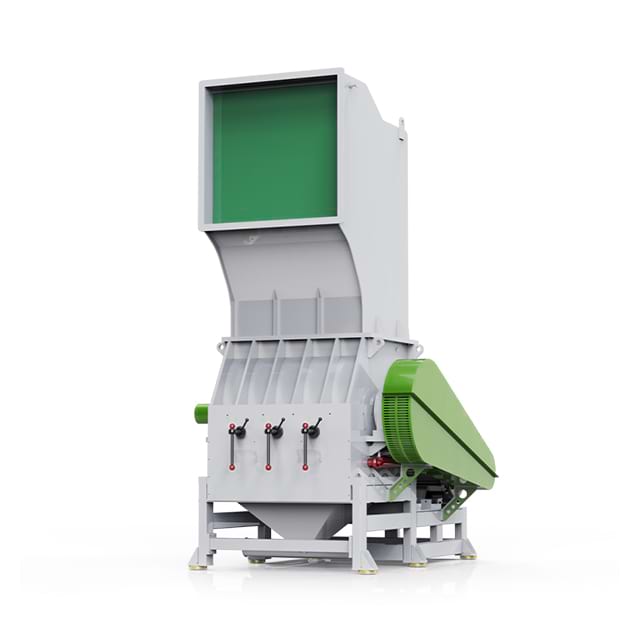
Material chemistry is only half the battle. The input shape dictates how the machine grabs and processes the scrap. Long extruded PVC profiles, bulky blow-molded HDPE containers, or ultra-thin PET bottle sheets all behave differently in the hopper. Geometry-match testing proves the machine can physically ingest the material without manual intervention. You cannot afford to pay an operator to stand over the hopper and push material down with a stick.
Feed-mechanism compatibility tests ensure the hopper configuration, pusher rams, and rotor bite-angle prevent bouncing or bridging. Hollow profiles often bounce on the rotor if the bite angle is incorrect. Testing confirms the rotor grabs the material smoothly, pulling it into the cutting chamber efficiently. A tangential feed hopper works best for large, bulky items, while a drop-feed hopper suits heavy, dense chunks.
Bulk density adjustments require testing the volumetric efficiency of the cutting chamber. Handling light, high-volume scrap demands a different chamber design than heavy, concentrated purges. The supplier must demonstrate how the machine maintains throughput regardless of the material's initial volume-to-weight ratio. Processing EPS foam requires massive hopper volume, while processing solid acrylic blocks requires massive motor torque.
Consider the challenge of processing long pipes. Standard hoppers cannot accommodate 3-meter lengths. The supplier must test the material using a specialized horizontal feed chute or a pipe-specific hopper. The trial must prove that the machine can self-feed the long profiles without the material whipping around dangerously outside the hopper.
Dense, thick-walled materials require robust handling mechanisms. Evaluate a plastic crusher with hydraulic system integration for these applications. Test the hydraulic hopper opening and hydraulic pusher rams for constant material pressure. Assess the hydraulic system's responsiveness to rotor load. It must detect amp spikes and retract the pusher to prevent stalling and motor burnout.
When processing massive extruder purgings, the rotor cannot take the entire block at once. The hydraulic ram must push the block against the rotor, let the blades nibble away at the surface, and then back off when the motor amps climb too high. The testing phase must validate the PLC programming that controls this hydraulic feedback loop. If the ram pushes too hard, the machine jams. If it pushes too lightly, throughput suffers.
Testing LDPE films, PP woven bags, or nylon fibers requires strict observation. Check for material wrapping around the rotor shaft. Look for friction-induced melting or material slipping between the stator and rotor blades without being cut. Flexible materials require tight tolerances and a precise scissor-action cut to process efficiently.
If the gap between the rotating blades and the stationary bed knives is too wide, film will simply fold over the blade instead of shearing. This leads to massive heat buildup and immediate screen blinding. The supplier must demonstrate their ability to set and maintain a blade gap of 0.1mm to 0.2mm during the trial run. You must inspect the cutting chamber immediately after the test to check for wrapped fibers behind the rotor bearings.
In-person Factory Acceptance Testing (FAT) or live-streamed trials are mandatory. Highly edited marketing videos hide jams, excessive noise, and dust generation. Live testing forces the supplier to demonstrate continuous operation, proving the machine handles the material without hidden interventions. You need to see the startup sequence, the continuous feeding, and the shutdown process.
During a live test, you can ask the technicians to stop the machine and open the cutting chamber. This allows you to inspect the screen for blinding and the blades for heat buildup. A recorded video will never show you the 20 minutes it took to clear a jammed rotor. Demand unedited, continuous footage if you cannot attend the trial in person.
Customs regulations or shipping costs sometimes prevent sending exact scrap. A professional supplier selects standardized proxy materials matching tensile strength, density, and shear modulus. Testing these proxies provides a highly accurate baseline for how your actual material will perform. If you process automotive bumpers, the supplier can test standard PP/EPDM blends to simulate the impact resistance.
The key to proxy testing is transparency. The supplier must document exactly what proxy material was used, its melt flow index, and its bulk density. You can then compare these specs to your own material data sheets. While not a perfect substitute, a well-chosen proxy material mitigates the majority of the equipment sizing risks.
A comprehensive engineering report separates professional suppliers from amateurs. This report documents the exact parameters of the trial. It provides the hard data you need to make an informed capital equipment decision. Without this report, the trial is just a visual demonstration.
| Data Point | Purpose of Measurement |
|---|---|
| Motor amperage draw (idle vs. load) | Determines energy efficiency and identifies potential motor strain. |
| Decibel (dB) readings | Ensures compliance with factory noise regulations during operation. |
| Screen size and blade metallurgy | Documents the exact configuration used to achieve the test results. |
| Photographic evidence | Shows cutting chamber and blade edges post-run to check for trapped material. |
| Estimated payback calculations | Provides financial justification based on throughput-to-power ratio. |
Scaling from a perfectly controlled 50kg sample test to a 24/7 continuous feeding environment involves trade-offs. Lab tests often use pristine material fed at an optimal rate. Production floors deal with surges, contamination, and operator fatigue. Recognizing this gap is critical for accurate equipment sizing. You must apply a safety factor to the lab results when selecting your final motor size.
Ambient factory temperature, inconsistent manual feeding, and varying material contamination levels skew real-world results away from test data. A machine running perfectly in a 20°C testing facility might overheat in a 40°C factory environment. Dust and dirt dull blades faster than clean lab samples. If your factory lacks climate control, the hydraulic oil in the pusher system will thin out, changing the ram's responsiveness.
Advise your team to send worst-case scenario materials for testing. Include mixed, slightly contaminated, or oversized pieces rather than perfectly clean, uniform samples. Testing the machine at its limits ensures it will survive daily production abuse without constant breakdowns. If your scrap occasionally contains small metal clips, leave a few in the sample batch to see how the rotor handles tramp metal.
Furthermore, consider the skill level of your operators. A lab technician knows exactly how to feed the machine to maintain optimal throughput. Your night shift operator might dump an entire gaylord of scrap into the hopper at once. The machine must be robust enough to handle this kind of surge feeding without stalling the rotor or snapping a drive belt.
A plastic crusher machine is a critical process variable, not a commodity. Pre-purchase material testing is the only empirical way to validate ROI. Disqualify any manufacturer that refuses to test specific materials or provides vague, undocumented results. Follow these steps to secure the right equipment:
A: Recommend a minimum of 50-100kg to ensure the machine runs long enough to reach operating temperature and demonstrate true throughput. For specialized profile testing like long PVC profiles, send several full-length samples.
A: Reputable manufacturers typically perform basic testing for free, though you usually cover shipping costs. Complex, multi-day trials or trials requiring custom tool fabrication may incur a fee that is credited toward the machine purchase.
A: Shredder tests focus on volume reduction and torque handling of large purges. Crusher tests focus on achieving a specific, uniform regrind size suitable for immediate re-extrusion with minimal dust.
A: Run the machine continuously for at least 30 minutes under full load. Measure the temperature of the discharged regrind and inspect the cutting chamber for melted polymer smeared on the rotor or screen.
A: Yes, if selected correctly. The proxy must match your material's tensile strength, density, and shear modulus. While not perfect, it provides a highly reliable baseline when shipping exact scrap is impossible.


