
- All
- Product Name
- Product Keyword
- Product Model
- Product Summary
- Product Description
- Multi Field Search
 English

Views: 0 Author: Site Editor Publish Time: 2026-08-07 Origin: Site


Processing post-consumer and post-industrial PP/PE waste presents a distinct mechanical challenge: balancing aggressive contamination removal with the energy-intensive requirement of moisture reduction before extrusion. High residual moisture and inadequate filtration directly degrade pellet quality, increase extruder wear, and inflate energy consumption per ton. Selecting the wrong system architecture leads to frequent downtime and compromised operational margins.
To achieve consistent, high-grade recyclate, facility operators must evaluate recycling systems based on modularity, dewatering efficiency, and integrated pelletizing capabilities. This guide provides a technical framework for evaluating and shortlisting industrial-scale PP/PE recycling lines. We focus on practical equipment configurations, material handling realities, and the mechanical forces required to turn heavily contaminated films and rigids into stable, reusable polymer melts.
Categorizing material streams by source establishes the baseline for your equipment layout. Post-Industrial Recycled (PIR) materials usually offer stable melt flows and minimal organic dirt. Post-Consumer Recycled (PCR) streams introduce severe variability. You will encounter abrasive sand, embedded oils, paper labels, and organic residue. Defining these input variables dictates how aggressive the washing phase must be and determines the necessary filtration capacity during extrusion. If you miscalculate the dirt load, you will face constant screen blinding and rapid wear on your cutting blades.
Different physical properties demand tailored mechanical approaches. Agricultural films carry high sand and grit content. This requires specialized pre-washing trommels to prevent rapid degradation of shredder blades. Woven bags and raffia possess high tensile strength, creating a severe risk of rotor wrapping if cutting geometries are not optimized. Post-consumer packaging films are extremely lightweight and retain high surface moisture, making them difficult to convey pneumatically. A robust plastic recycling machine for PP PE waste must account for these distinct physical behaviors to maintain continuous throughput.
The mathematical relationship between residual moisture in washed flakes and specific energy consumption during pelletizing is absolute. When moisture exceeds 5%, the extruder acts as a secondary dryer. It consumes vast amounts of thermal and mechanical energy to vaporize water. This phase change demands significant kilowatt-hours per kilogram, directly reducing overall operational efficiency. Effective upstream dewatering shifts this burden away from the extruder, stabilizing melt pressure and preventing hydrolytic degradation of the polymer chains.
Meeting stringent off-taker demands dictates your final equipment settings. Facility managers must define the required Melt Flow Index (MFI), tensile strength, density, and visual clarity of the final pellets. High residual contamination leads to pressure spikes, which alter the MFI and introduce structural weaknesses. Achieving a consistent output requires precise control over temperature profiles, aggressive degassing, and continuous melt filtration to remove sub-micron impurities.
The initial sizing phase sets the operational tempo. Heavy-duty single-shaft wet shredders handle heavily contaminated agricultural films by operating at lower speeds with high torque, mitigating the risk of frictional melting. High-speed wet crushers are deployed for cleaner streams or secondary sizing. Wet granulation initiates the cleaning process early by introducing water directly into the cutting chamber. This cools the material and immediately suspends loose dirt. Designing this stage correctly prevents flexible PE/PP films from wrapping on rotors.
High-speed friction washing strips abrasive contaminants and paper pulp. These units utilize high rotor speeds (often exceeding 1000 RPM) to generate intense mechanical friction between the plastic flakes, the water, and the screen casing. Analyzing rotor speeds, screen designs, and water consumption rates ensures contaminants are scoured away without mechanically degrading the polymer. A well-engineered plastic washing line balances aggressive agitation with controlled residence times.
Density separation occurs in sink-float tanks, relying on specific gravity to isolate target polymers. Polyolefins like PP and PE have a specific gravity of less than 1.0, causing them to float. Heavier plastics such as PET, PVC, and PS, along with inorganic contaminants like glass and metal, sink to the bottom where they are extracted via augers. The length and flow dynamics of these tanks determine the purity of the floating fraction.
| Equipment Type | Primary Function | Target Material | Operational Speed |
|---|---|---|---|
| Wet Shredder | Primary size reduction, dirt loosening | Baled agricultural film, thick rigids | Low RPM, High Torque |
| Wet Granulator | Secondary sizing, intensive washing | Pre-shredded film, clean rigids | High RPM, Medium Torque |
| Friction Washer | Surface scouring, paper removal | Washed flakes and films | Very High RPM |
Dewatering rigid PP/PE flakes differs fundamentally from processing flexible films. Centrifugal dewatering utilizes high-speed rotors to physically throw water through a surrounding screen. This method is highly effective for rigid materials but struggles with lightweight films, which tend to blind the screens and trap moisture.
For flexible PE/PP films, screw press dewatering offers technical superiority. These systems utilize a heavy-duty auger within a reinforced screen barrel. As the material advances, the decreasing pitch of the screw mechanically squeezes and compacts the film, forcing water out. This mechanical squeezing reduces moisture to 3-5% and generates frictional heat, which pre-conditions and densifies the material for the subsequent extrusion phase.
Integrating separation and dewatering systems for micro-plastics, reject fines, and paper pulp drastically lowers wastewater treatment burdens. Efficiently capturing and dewatering these rejects reduces the total weight of landfill-bound material, optimizing the overall environmental footprint of the facility.
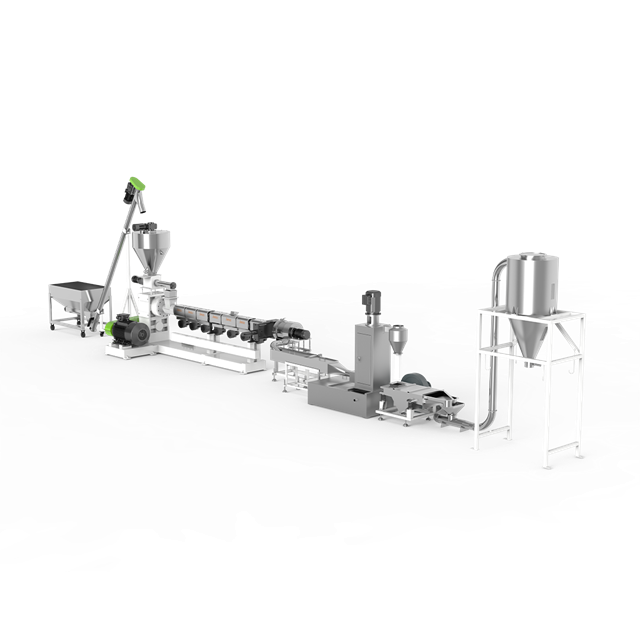
Feeding lightweight, fluffy film directly into an extruder is notoriously inefficient. Integrated cutter-compactors solve this by utilizing rotating blades at the base of a large drum to cut, mix, and frictionally heat the incoming material. This process densifies the lightweight films, ensuring a stable, surge-free feed directly into the extruder screw. This integration eliminates the need for separate agglomeration steps.
During extrusion, the polymer is melted, homogenized, and filtered. Evaluating single versus double-stage extrusion depends on the contamination level of the input. Double-stage systems provide superior filtration and degassing capabilities. High L/D (Length to Diameter) ratios are required to ensure adequate residence time for melting and mixing. Double vacuum degassing zones are essential to extract volatile gases, ink residues, and residual moisture that would otherwise cause voids in the final pellets.
Melt filtration is the final defense against contamination. Continuous hydraulic screen changers and backflush systems allow for screen replacement without halting production. For highly contaminated melt streams, continuous laser filters provide automated, uninterrupted purging of impurities, ensuring the waste plastic recycling pelletizing machine operates at peak efficiency without manual intervention.
Interpreting manufacturer claims requires critical analysis. A standard baseline capacity often assumes ideal, clean, rigid input material. Actual yield will vary significantly based on input bulk density, contamination levels, and required downtime for screen changes. Flexible films with high moisture content will process at a lower throughput than clean rigid flakes. Operators must adjust expectations and size equipment based on the specific characteristics of their worst-case feedstock scenarios.
Evaluating resource consumption involves scrutinizing the efficiency of all integrated systems. Closed-loop water recirculation systems are mandatory for minimizing fresh water intake and managing wastewater discharge. Motor efficiency ratings, specifically specifying IE3 or IE4 standard motors, directly impact electrical consumption. Proper thermal insulation on extruder barrels prevents heat loss, ensuring that the thermal energy required for melting is maintained efficiently.
Modern recycling lines rely heavily on advanced PLC systems to maintain operational stability. These control systems monitor motor loads in real-time, automatically adjusting feed rates to prevent extruder surging or compactor stalling. Automated temperature profiles ensure consistent melt viscosity. Predictive maintenance alerts integrated into the PLC warn operators of degrading screen performance or impending bearing failures, allowing for scheduled maintenance rather than catastrophic downtime.
Off-the-shelf systems frequently fail when applied to complex waste streams. A manufacturer's ability to tailor equipment is paramount. This includes modifying screw geometries to handle specific melt viscosities, upgrading metallurgy to withstand highly abrasive agricultural films, and adjusting washing tank dimensions to accommodate varying material densities. A competent plastic pelletizing machine manufacturer acts as an engineering partner, adapting their core technology to your specific operational realities.
Theoretical throughput claims must be validated. Running a substantial trial of your specific waste material at the manufacturer's facility prior to procurement is a non-negotiable step. This proof of concept reveals how the proposed architecture handles your unique contamination profile, verifies actual throughput rates, and provides physical samples of the final pellet for quality testing.
The operational lifespan of a recycling line depends on robust aftermarket support. Evaluating the manufacturer's global footprint and response times for critical spare parts is essential. Components such as screen changers, shredder blades, and specific screw segments experience high wear. The metallurgical quality of these high-wear components, combined with the vendor's ability to dispatch replacements rapidly, dictates the long-term uptime of the facility.
Fluctuating contamination levels can overwhelm standard washing lines, leading to poor pellet quality and frequent screen blinding. Designing a front-end sorting and optical inspection protocol helps stabilize the input stream. Over-engineering the washing line with modular bypass capabilities allows the system to handle worst-case contamination spikes without compromising the baseline throughput.
Inadequate water treatment leads to dirty wash water recirculating through the system, redepositing contaminants onto the plastic flakes. Integrating robust closed-loop water treatment systems, including dissolved air flotation (DAF) units and sludge dewatering presses, maintains washing efficacy. This infrastructure is vital for complying with strict local environmental discharge regulations and maintaining continuous operation.
Advanced extrusion and washing lines require specialized knowledge to operate efficiently. Incorrect temperature settings or poor screen change procedures can cause significant downtime. Mandating comprehensive, on-site vendor training during commissioning is critical. Establishing strict Standard Operating Procedures (SOPs) for startup, shutdown, and emergency protocols ensures that operators can manage the equipment safely and effectively.
A: The ideal moisture content for PP/PE film prior to extrusion is below 5%. Higher moisture levels force the extruder to consume excessive energy to vaporize the water, which leads to polymer degradation, unstable melt pressures, and voids in the final pellets.
A: Centrifugal dryers use high-speed rotation to throw water off rigid flakes effectively. However, lightweight films blind centrifugal screens. Screw presses mechanically squeeze and compact flexible films, forcing water out while simultaneously pre-heating and densifying the material for extrusion.
A: Water consumption varies by capacity, but modern systems utilize closed-loop water treatment. With integrated filtration and sludge dewatering, facilities typically recycle 80% to 90% of their wash water, significantly reducing fresh water intake and discharge volumes.
A: Yes, but it requires specific feeding mechanisms. A machine equipped with an integrated cutter-compactor is ideal for flexible films, as it densifies them before extrusion. Rigid flakes can be metered into the same system if the screw design accommodates both bulk densities.
A: For post-consumer PE waste with high moisture and volatile inks, a higher L/D ratio, typically 32:1 to 36:1 or higher, is recommended. This provides the necessary residence time for thorough melting, mixing, and effective double vacuum degassing.
A: The most common wear parts include shredder blades, granulator knives, friction washer screens, screw press augers, extruder screw flights in the compression zone, and melt filtration screens. Utilizing hardened metallurgy extends the lifespan of these components.
A: Double vacuum degassing utilizes two separate extraction zones along the extruder barrel to aggressively pull out trapped air, moisture vapor, and volatile organic compounds from inks or organic residues. This prevents foaming and ensures dense, structurally sound pellets.


