
- All
- Product Name
- Product Keyword
- Product Model
- Product Summary
- Product Description
- Multi Field Search
 English

Views: 0 Author: Site Editor Publish Time: 2026-10-07 Origin: Site


Are you struggling with inefficient material mixing on the factory floor? Poor compounding not only wastes valuable time but also drains critical resources, leading to inconsistent product quality. Upgrading your equipment can definitively solve this manufacturing bottleneck. In this comprehensive guide, you will discover the mechanics behind advanced extrusion technology and explore its vast industrial applications. For facilities aiming to optimize their workflow, investing in a robust plastic pelletizing machine is often the first vital step toward operational excellence.
When plant managers investigate this machinery, they typically search for a technical breakdown of its continuous processing capabilities. At its core, this sophisticated compounding equipment is engineered to handle complex formulations demanding intense mixing, devolatilization, and precise thermal management. Instead of a simple melting tube, think of it as a continuous thermodynamic reactor.
The operational journey of material inside the barrel is a carefully orchestrated thermodynamic and mechanical process. It functions through several distinct stages.
To fully grasp the system's capabilities, it is essential to examine its structural anatomy. The inherent modularity of these machines allows them to be custom-tailored for specific production environments. A minor adjustment in the screw profile can completely alter the mixing dynamics.
| Component | Primary Function | Technical Details |
|---|---|---|
| Feeding System | Delivers raw materials into the barrel. | Gravimetric feeders ensure precise mass-flow control, which is critical for consistent formulation accuracy and minimizing material waste. |
| Barrel and Heaters | Houses the screws and manages temperature. | Features a modular design with independent temperature zones, allowing for precise heating and cooling control across different processing stages. |
| The Twin Screws | Conveys, melts, and mixes the material. | Composed of interchangeable elements mounted on splined shafts, offering infinite customization for conveying, kneading, and mixing. |
| Motor and Gearbox | Provides rotational power and torque. | Engineered to deliver massive torque at specific RPMs, ensuring stable operation even when processing highly viscous, heavily filled melts. |
| Die Head & Cutter | Shapes the final output. | Determines the geometry of the extrudate, often integrated directly with underwater or water-ring pelletizing mechanisms. |
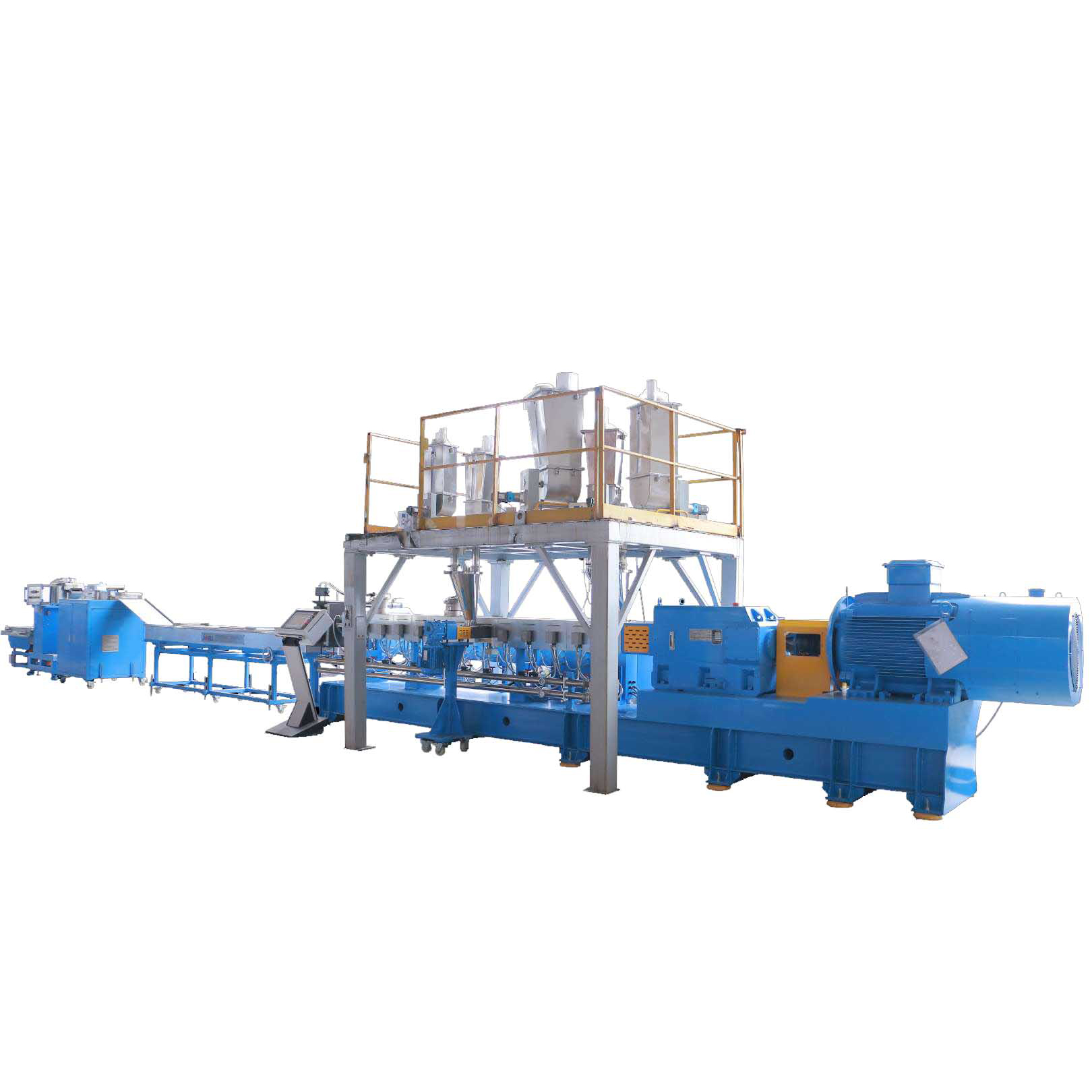
Not all extrusion machines are built with the same mechanical philosophy. The direction in which the shafts rotate fundamentally alters the physics of the mixing process. This directly dictates the machine's ideal industrial applications.
In a co-rotating configuration, both screws turn in the identical direction. This specific design allows the flight of one screw to closely wipe the root of the other, creating a highly dynamic internal environment.
The molten plastic is transferred from one screw to the other in a continuous figure-eight pattern. This movement facilitates extraordinary distributive and dispersive mixing. Furthermore, the tight intermeshing geometry ensures a constant wiping action. By preventing material stagnation, it drastically reduces the risk of thermal degradation. This setup represents the industry standard for high-speed compounding, masterbatch production, and general polymer modification. It is highly favored for formulations requiring aggressive homogenization without excessive internal pressure buildup.
Conversely, in a counter-rotating setup, the screws turn in opposite directions. They rotate either inward toward each other or outward.
The material is forcefully squeezed between the two rotating shafts, acting much like a heavy-duty rolling mill. This action generates extremely high pressure while maintaining relatively low shear. Because the melt does not easily transfer between the screws, it is propelled forward in a closed chamber. This results in strict positive displacement and a remarkably narrow residence time distribution. This configuration is strictly preferred for processing highly heat-sensitive materials. For instance, manufacturing polyvinyl chloride pipes or wood-plastic composites relies on this method, as excessive shear would inevitably cause the material to scorch or chemically degrade.
Plant managers often debate whether to upgrade from single to dual-shaft systems. While single screw machines remain cost-effective for basic melting and profile forming, dual-shaft systems offer unparalleled processing capabilities. These capabilities easily justify their higher initial capital expenditure.
A single screw primarily relies on friction between the polymer pellets, the rotating screw, and the stationary barrel wall to convey and melt the plastic. Because it is fundamentally a drag-flow device, its mixing capability is inherently restricted.
In stark contrast, a dual-shaft machine operates on the principles of positive displacement and intermeshing shear. The complex geometry forces the material through incredibly narrow clearances. This applies intense mechanical stress that effortlessly breaks down stubborn agglomerates and evenly distributes colorants.
Single-shaft platforms often struggle with complex formulations, highly filled materials, or raw inputs possessing wildly varying bulk densities. To function effectively, they frequently require pre-mixed materials. This adds an extra step to the manufacturing process.
Dual-shaft setups can handle multiple distinct ingredients simultaneously. Liquid plasticizers, solid mineral fillers, and base resins can be fed into different, isolated zones of the barrel. This flexibility eliminates the need for costly pre-mixing stages. Consequently, it streamlines the production workflow and significantly reduces manual labor costs.
Investing in advanced extrusion technology requires significant capital. However, the operational advantages quickly validate the expenditure through improved product yield and mechanical reliability.
The highly modular screw design allows process engineers to customize the shear profile exactly to a specific material's rheological needs. Combined with independent, closed-loop temperature control zones along the barrel, operators maintain absolute thermal management. This prevents localized overheating and ensures every single pellet produced meets strict quality control tolerances.
Because these machines do not rely solely on wall friction for conveying, they can operate at significantly higher speeds. This positive pumping action ensures a stable, high-volume output. It makes them the preferred choice for large-scale Industrial plastic pelletizing operations where maximizing daily tonnage is the primary objective.
Modern compounding systems are engineered for optimal energy utilization. The mechanical energy generated by the main drive motor is efficiently converted into thermal energy through internal shear. This sharply reduces the reliance on external electrical barrel heaters. Additionally, the improved heat transfer dynamics within the intermeshing zones lead to noticeably lower specific energy consumption, measured in kilowatt-hours per kilogram of processed material.
Understanding the diverse applications of this equipment is crucial for decision-makers evaluating its potential return on investment. The unique intermeshing design allows for exact control over shear, temperature, and residence time. Thus, the machine adapts easily to multiple stringent industries.
The most prominent application for this technology remains within the polymer sector. A high-performance Twin screw pelletizing line is the undisputed industry standard for complex compounding tasks. Unlike basic melting, compounding requires the homogenous dispersion of additives, flame retardants, and colorants into a base polymer matrix. Operators frequently process engineering plastics such as polyamides, polycarbonates, and thermoplastic elastomers, which require intense mixing to achieve uniform mechanical properties.
Looking at current industry trends, market data reveals a massive shift toward circular manufacturing. There is a surging global reliance on advanced extrusion technologies to process post-consumer resins. As sustainability mandates tighten worldwide, manufacturers are moving away from basic recycling setups. Instead, they are adopting high-torque dual-shaft systems equipped with advanced vacuum degassing. This specific technology is uniquely capable of extracting volatile organic compounds and tackling the molecular degradation typically found in recycled polyethylene terephthalate and polyolefins. It effectively upgrades waste into high-value manufacturing inputs.
Beyond synthetic polymers, thermo-mechanical extrusion is heavily utilized in the food and agricultural feed sectors. In food processing, the extruder essentially acts as a continuous biochemical reactor. The precise combination of thermal energy and mechanical shear triggers starch gelatinization and protein denaturation. Equipment deployed in this sector is rigorously customized with food-grade stainless steel to comply with strict international hygiene standards.
In the pharmaceutical realm, Hot Melt Extrusion heavily relies on these configurations to create solid dispersions of Active Pharmaceutical Ingredients. Compounding the drug with a polymer carrier at a molecular level dramatically enhances its bioavailability in the human body. Similarly, in industrial chemicals, these machines function as continuous reactors for processing hot-melt adhesives and advanced battery compounds.
Implementing a rigorous Standard Operating Procedure is absolutely vital for maintaining equipment longevity and ensuring operator safety on the factory floor. Improper startup or shutdown sequences can easily trigger severe mechanical failures. Fractured screw elements or destroyed gearboxes result in catastrophic downtime.
Starting a continuous compounding line requires a methodical approach to achieve thermal and mechanical stabilization.
A highly controlled shutdown is equally critical to prevent material carbonization inside the barrel. Degraded material can severely contaminate future production runs.
| Parameter | Normal Indicator | Warning Sign | Potential Cause |
|---|---|---|---|
| Main Motor Torque | Stable within 60% to 80% capacity | Sudden spikes or sustained above 90% | Overfeeding, cold spots, or material bridging in the feed throat. |
| Melt Pressure | Consistent at the die head | Rapid pressure drop or extreme high pressure | Blockage in the screen changer or highly inconsistent feeding. |
| Zone Temperatures | Stable at the setpoint | Uncontrollable exothermic temperature rise | Excessive internal shear friction or internal cooling system failure. |
| Gearbox Oil Temp | 40 to 55 degrees Celsius | Exceeding 60 degrees Celsius | Inadequate lubrication cooling or premature bearing wear. |
Procuring industrial extrusion machinery represents a major capital expenditure. Decision-makers must meticulously align the machine's engineering specifications with their specific material formulations and long-term production targets. Generic specifications will not suffice for specialized compounding.
The physical and chemical properties of your daily raw materials dictate the fundamental design architecture.
Materials like polyvinyl chloride are notoriously sensitive to shear and prone to rapid thermal degradation, making a counter-rotating configuration optimal. Conversely, polyolefins immensely benefit from the high-shear distributive mixing provided by a co-rotating configuration. If your proprietary formulation includes high percentages of abrasive fillers like glass fibers or corrosive additives, standard nitrided steel will erode rapidly. In these demanding scenarios, specifying bimetallic barrels and screw elements crafted from high-wear-resistant alloys is an absolutely necessary upfront expense.
Achieving your target throughput is not merely a function of bolting on a larger motor. It relies heavily on the geometric volume of the screws and the structural torque capacity of the gearbox. When evaluating modern equipment, pay close attention to the following parameters.
The Length to Diameter ratio directly determines the residence time of the material inside the heated barrel. A shorter ratio, such as 32, is perfectly sufficient for simple melting and standard compounding. However, highly complex tasks demand a longer ratio. For instance, advanced devolatilization or processing extreme loadings of mineral fillers often requires ratios stretching from 44 to 64 to provide adequate time for thorough mixing and venting.
Furthermore, machine capacity scales with screw diameter and speed. High-performance lines typically offer screw diameters ranging from 41mm up to 135mm, with rotational speeds safely reaching 600 revolutions per minute or higher. Modern industrial equipment is categorized by its specific torque density. High-torque machines are specifically engineered for processing high-viscosity melts at much lower temperatures, resulting in superior throughputs without degrading the polymer chains.
Advanced extrusion equipment efficiently transforms raw materials by providing unmatched mixing capabilities and precise temperature control. This machinery is undeniably vital for modern manufacturing processes across the plastics, chemical, and food industries. By upgrading your factory floor with this technology, you dramatically improve production speeds while ensuring high material flexibility and uncompromising product quality. Explore the comprehensive range of solutions at Jwell Recycling to find the exact configuration that perfectly aligns with your operational needs, and propel your manufacturing capabilities into the future.
A single shaft relies almost entirely on friction between the material and the barrel wall to convey the polymer forward. In stark contrast, a dual-shaft system utilizes the positive displacement generated by two intermeshing screws. This advanced mechanism allows for vastly superior distributive and dispersive mixing, precise control over shear forces, and the unique ability to process multiple complex additives simultaneously without pre-mixing.
Yes, it is highly effective for advanced plastic recycling operations. The design provides excellent devolatilization capabilities, pulling deep vacuums to remove moisture and volatile contaminants from post-consumer plastics. Furthermore, operators can seamlessly compound degraded recycled resins with virgin materials, chain extenders, and colorants, effectively upcycling waste into high-grade industrial pellets.
It indicates the total length of the extrusion barrel relative to the outer diameter of the screws. A higher ratio means a longer barrel, which inherently provides increased residence time for the material. This extended time is crucial for complex processes requiring multiple downstream feeding zones, intense dispersion, or extended vacuum degassing.
Residence time is controlled by a combination of the machine's geometric design and operational parameters. The primary hardware factor is the Length to Diameter ratio. Operationally, adjusting the main screw speed and the raw material feed rate directly impacts how long the polymer stays inside the heated barrel. Additionally, modifying the screw profile by adding or removing reverse-pitch kneading blocks can intentionally delay the material flow to increase localized mixing time.
Surging, or inconsistent melt flow at the die head, is a common processing issue. It is typically caused by inconsistent feeding of raw materials, bridging in the feed throat, or improper temperature settings leading to alternating melting and freezing zones inside the barrel. Ensuring accurate gravimetric feeding and maintaining stable, optimized temperature profiles across all barrel zones are the best methods to eliminate surging.
Replacement intervals depend entirely on the abrasiveness of the formulations being processed and the specific metallurgy of the machine components. Processing standard, unfilled polymers may allow components to last several years. However, running highly abrasive materials, such as heavy glass-filled compounds, can aggressively wear down standard nitrided steel in a matter of months. Utilizing specialized high-wear bimetallic alloys significantly extends component lifespans in these harsh environments.


