
- All
- Product Name
- Product Keyword
- Product Model
- Product Summary
- Product Description
- Multi Field Search
 English

Views: 0 Author: Site Editor Publish Time: 2026-08-18 Origin: Site


Procuring industrial recycling equipment is a high-stakes capital investment where the physical hardware is only as reliable as the technical documentation supporting it. Buyers frequently face installation delays, compliance failures, and prolonged downtime because vendors provide incomplete, poorly translated, or proprietary-locked engineering schematics. Evaluating a vendor's documentation standards is a mandatory step in the procurement process. This guide details the exact engineering documents, schematics, and certificates you must require from a plastic recycling machine manufacturer before signing a contract, during installation, and at final handover. Missing paperwork translates directly to lost production hours and unsafe working conditions.
Comprehensive documentation directly impacts the overall equipment effectiveness of your recycling line. When a vendor fails to deliver clear engineering documents, you risk extended commissioning timelines and severe integration bottlenecks. Missing schematics make it nearly impossible to connect new machinery with existing plant infrastructure safely. Plant managers often discover too late that their internal maintenance teams cannot troubleshoot a fault because the electrical diagrams are either missing or written in a foreign language without proper translation.
Documentation must address the entire system footprint, from initial washing and sorting to final pelletizing. This prevents integration gaps between separate components in a complex plastic pelletizing system. If the shredder's output conveyor does not physically align with the friction washer's input hopper, or if the control signals between the two machines do not communicate, the entire line halts. A manufacturer’s willingness to provide a transparent Document Deliverable List during the request for proposal stage is a primary filter for shortlisting reliable partners.
Consider the operational reality of running a plant at full capacity. When a drive faults at 2 AM on a Sunday, your shift technicians need immediate access to terminal block layouts and PLC input/output lists. If the vendor has locked this information behind a proprietary service contract, your line remains down until their technician arrives. Demanding upfront documentation eliminates this vulnerability and keeps control of the asset in your hands.
| Documentation Type | Impact of Missing Documentation | Operational Benefit When Provided |
|---|---|---|
| Process Flow Diagrams (PFD) | Inability to balance material throughput, leading to frequent bottlenecks. | Clear understanding of mass balances and yield expectations across the line. |
| Electrical Schematics | Total reliance on vendor for basic troubleshooting; extended downtime. | Rapid fault identification and internal repair capabilities. |
| Utility Consumption Schedules | Undersized power drops or insufficient cooling water, causing machine faults. | Accurate facility preparation and predictable operational expenditures. |
| Bill of Materials (BOM) | Forced to buy marked-up spare parts directly from the OEM. | Ability to source generic equivalents locally, reducing maintenance costs. |
Process Flow Diagrams are necessary for understanding material throughput, mass balances, and yield expectations. They show exactly how much raw material enters the system and how much finished product exits, accounting for moisture loss, contamination removal, and melt filtration waste. Piping and Instrumentation Diagrams map out control valves, sensors, and fluid dynamics. These are particularly necessary when integrating a complex plastic washing line that requires precise water and chemical management. Without a P&ID, your maintenance team will struggle to locate a failing pressure transmitter or understand the routing of the caustic soda dosing loop.
General Arrangement drawings play a vital role in spatial planning, operator ergonomics, and material handling logistics. You need to know exactly where the forklift will drop the raw bales and where the overhead crane needs to position itself to pull the extruder screw for maintenance. Step-files or 3D CAD models allow for accurate clash detection in existing facilities. By overlaying the vendor's 3D model onto your plant's architectural drawings, you can identify if a silo will hit a roof truss or if a conveyor blocks a fire exit before the equipment is even manufactured.
You must demand documents specifying length-to-diameter ratios, screw profiles, shear rates, and torque calculations. These calculations must be customized for specific polymer types. Processing high-contamination PET flakes requires a completely different screw geometry and degassing setup compared to processing low-bulk-density LDPE film. If the vendor uses a generic screw design, you will experience severe polymer degradation, loss of intrinsic viscosity, or frequent surging at the die head. The engineering documentation must prove that the screw profile matches your exact feedstock.
Interface diagrams must show the physical, mechanical, and electrical connections between core recycling machinery and auxiliary components. A standard line includes upstream shredders, metal separators, silos, and downstream bagging stations. The documentation must detail how the master control panel communicates with these auxiliary units. For example, if the melt pressure on the extruder spikes, the interface logic must automatically pause the upstream dosing unit to prevent overfeeding.
Require exact specifications on electrical load, chilled water requirements, and compressed air usage. These schedules heavily impact facility upgrade costs and operational expenditure calculations. You need to prepare your plant's utilities before the equipment arrives.
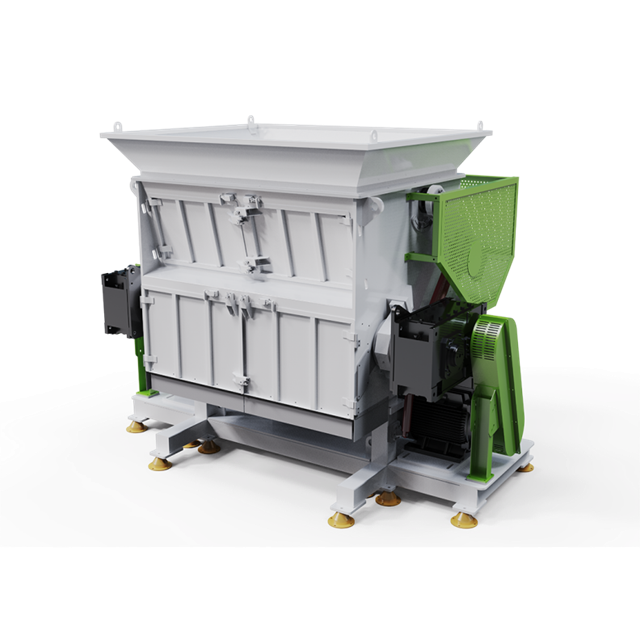
Specify the need for dynamic and static load data, anchor bolt layouts, and vibration isolation requirements. Heavy equipment like shredders and extruders require robust foundations to operate safely and maintain structural integrity over time. A large single-shaft shredder generates massive dynamic forces when chewing through purges or dense plastic lumps. If the civil engineering documents do not specify the correct concrete depth, rebar reinforcement, and epoxy anchoring procedures, the machine will literally tear itself out of the floor. Trenching layouts for water drainage and cable routing must also be provided well in advance of the delivery date.
Demand complete, unencrypted electrical wiring diagrams, terminal block layouts, and PLC input/output lists. Avoid "black box" control systems where the manufacturer refuses to share PLC logic or electrical schematics, as this creates severe maintenance liabilities. Every wire in the cabinet must be numbered, and that number must correspond exactly to the schematic. Furthermore, the documentation should detail the routing of variable frequency drive (VFD) cables, specifying the required shielding to prevent electromagnetic interference with sensitive thermocouple signals.
Technical datasheets must define acceptable input feedstock tolerances, such as maximum moisture percentage, PVC parts-per-million limits, and paper or label contamination thresholds. They must also define guaranteed output pellet specifications, including melt flow index consistency, bulk density, and filtration levels. This matrix forms the basis of your performance guarantee. If the machine fails to produce the specified output quality, this document proves whether the fault lies with the equipment design or if the input material deviated from the agreed-upon parameters.
A rigorous Factory Acceptance Test document outlines pre-agreed testing parameters, material input specifications, and performance guarantees before the equipment leaves the factory. You should never authorize shipment until the machine has run your specific material at the vendor's facility and met the throughput targets. The Site Acceptance Test protocol serves as the final validation step post-installation to trigger final payment milestones. The SAT confirms that the machine survived shipping, was installed correctly, and integrates seamlessly with your plant's utilities.
| Testing Phase | Location | Primary Objectives | Required Documentation Output |
|---|---|---|---|
| Factory Acceptance Test (FAT) | Vendor's Manufacturing Facility | Verify mechanical assembly, baseline throughput, and safety interlocks before shipping. | Signed FAT certificate, punch list of required modifications, video evidence of operation. |
| Site Acceptance Test (SAT) | Buyer's Production Plant | Validate integration with plant utilities, continuous operation under real-world conditions, and final output quality. | Signed SAT protocol, final handover certificate, operator training sign-off sheets. |
Clear, native-language operator manuals must cover startup, steady-state operation, shutdown, and emergency stop procedures. These manuals are essential for training your workforce and ensuring safe daily operations. A proper SOP does not just say "turn on the machine." It details the exact sequence: verifying water flow, bringing thermal zones up to temperature, soaking the barrel to prevent cold-starts, and gradually ramping up the screw speed. Emergency procedures must explicitly state how to safely purge the barrel during an unexpected power outage to prevent the plastic from solidifying and locking the screw.
Preventative, predictive, and corrective maintenance schedules must be specific to the stresses of the equipment, detailing tasks like screen changer maintenance and die head cleaning. Symptom-cause-solution troubleshooting matrices help operators resolve issues quickly without escalating to the engineering team.
Mandate a comprehensive Bill of Materials including OEM part numbers, generic equivalents, and expected lifespans for high-wear components. A transparent BOM reduces long-term maintenance costs and supply chain dependencies on a plastic pelletizing machine manufacturer. If a standard SKF bearing or a Siemens contactor fails, you should be able to buy it from a local distributor rather than waiting weeks for an overpriced replacement shipped from the equipment manufacturer. The documentation must clearly identify which parts are custom-machined and which are off-the-shelf commodities.
Documented risk assessments must identify pinch points, thermal hazards, and mitigation strategies, such as physical interlocks and light curtains, to protect your operators. Industrial recycling machinery is inherently dangerous, involving high-speed rotating blades, extreme temperatures, and high-pressure molten plastic. The manufacturer must provide a dossier proving they have engineered out as many risks as possible and guarded the remaining hazards according to international safety standards.
Outline specifications for off-gas ventilation and VOC emissions during extrusion. Detail water treatment, filtration, and recirculation flow charts required for a sustainable washing process. When processing heavily printed films or contaminated agricultural plastics, the extrusion process releases volatile organic compounds. The equipment documentation must specify the exhaust volume required to capture these emissions safely. For washing lines, the water loop documentation must prove that the system can filter out suspended solids and maintain the correct pH balance to prevent rapid corrosion of the machinery.
Declarations of Conformity and third-party certifications must be tailored to the destination country's electrical and safety standards. Metallurgical certificates for critical components and compliance logs for pressurized components are also necessary. If you are operating in Europe, CE marking is mandatory. In North America, UL or CSA certification for the electrical panels is required by local fire marshals and insurance inspectors. Furthermore, components subjected to high pressure, such as continuous melt filters, must come with pressure vessel certifications to ensure they will not rupture under load.
A vendor's inability to provide a standard Document Deliverable List is a major warning sign. If they cannot tell you what manuals and schematics they will provide, they likely do not have standardized engineering processes. Watch out for proprietary lock-in tactics where a vendor withholds critical schematics or PLC passwords to force expensive, exclusive service contracts. You are buying the machine; you must own the data required to run and maintain it.
Receiving generic, poorly translated manuals that do not match the custom-built machine's actual configuration poses severe operational risks. It is common for lower-tier manufacturers to send a generic manual that covers five different machine models, leaving your operators guessing which instructions apply to your specific line. If the manual references a water-cooling system but your machine is air-cooled, the documentation is useless. Demand that all manuals are serialized and matched exactly to the equipment delivered to your floor.
High-quality engineering documentation is a core component of the machinery's value and operational viability. Buyers must evaluate a vendor's documentation standards with the same rigor applied to mechanical design and throughput capacities. Without the right paperwork, even the most robustly built extruder becomes a maintenance nightmare and a safety liability.
A: A Factory Acceptance Test protocol is a documented procedure verifying that the machinery meets all contractual specifications and performance metrics at the vendor's facility prior to shipping.
A: A Piping and Instrumentation Diagram is essential for understanding the complex water flow, chemical dosing, filtration loops, and sensor placements required to operate, automate, and troubleshoot a washing line effectively.
A: A leading manufacturer should provide screw design length-to-diameter calculations, compression ratios, and torque profiles matching your specific polymer feedstocks to prevent output degradation and maximize throughput.
A: Yes. Heavy machinery generates significant static and dynamic loads. Foundation drawings are required to ensure the facility floor can safely support the equipment and mitigate vibration.
A: The list must include a complete Bill of Materials with OEM part numbers, generic equivalents where applicable, and the expected lifespan for all high-wear components.


