
- All
- Product Name
- Product Keyword
- Product Model
- Product Summary
- Product Description
- Multi Field Search
 English

Views: 0 Author: Site Editor Publish Time: 2026-08-25 Origin: Site


In high-capacity plastic recycling and processing facilities, equipment downtime directly correlates to lost revenue. While many suppliers promise continuous capabilities, the mechanical reality of continuous plastic crushing involves extreme friction, thermal stress, and unpredictable feed materials. Facility managers often face a massive disconnect between a vendor's marketing claims and the machine's actual performance under sustained load on the plant floor. Unverified continuous operation leads to thermal degradation of plastics, premature blade failure, motor burnout, and unsafe operating conditions for the crew.
To mitigate procurement risk, buyers must look far beyond standard specification sheets. This guide details the specific engineering benchmarks, Factory Acceptance Testing protocols, and mechanical safeguards a credible industrial plastic crusher manufacturer uses to prove long-term operational stability. We will examine the exact mechanical requirements needed to keep a line running smoothly shift after shift.
Defining continuous operation requires clarifying the difference between theoretical round-the-clock running and realistic high-uptime operation. On a real plant floor, realistic continuous operation includes scheduled micro-stoppages for cooling, drive belt tension checks, or visual blade inspections. You cannot run heavy rotating equipment indefinitely without looking at the wear parts. The continuous shearing of high-density polymers generates compounding heat. Running without appropriate downtime cooling or active thermal dissipation leads to material melting, screen blinding, and catastrophic rotor lockups.
A successful continuous-duty machine must demonstrate stable throughput, consistent particle size, and safe operating temperatures over an 8-to-12-hour continuous shift without manual intervention. When processing tough materials like thick-walled HDPE pipes or heavy PET lumps, the kinetic energy transferred into the cutting chamber is immense. If the machine lacks the mass and cooling capacity to absorb and dissipate this energy, the plastic will begin to smear across the screen rather than cut cleanly.
| Operational Metric | Theoretical "24/7" Claim | Realistic High-Uptime Reality |
|---|---|---|
| Maintenance Windows | Zero downtime required | Scheduled 30-minute checks every 12 hours |
| Thermal State | Runs cold indefinitely | Requires active water cooling to stabilize at 60-80°C |
| Blade Sharpness | Never needs sharpening | Requires rotation or sharpening based on material abrasiveness |
| Throughput | 100% nameplate capacity constantly | 85-90% average capacity accounting for feed variations |
Operators must understand that pushing a machine beyond its thermal limits does not increase production; it simply guarantees a catastrophic failure later in the week. The goal is sustained, predictable output that feeds downstream extruders or washing lines without interruption.
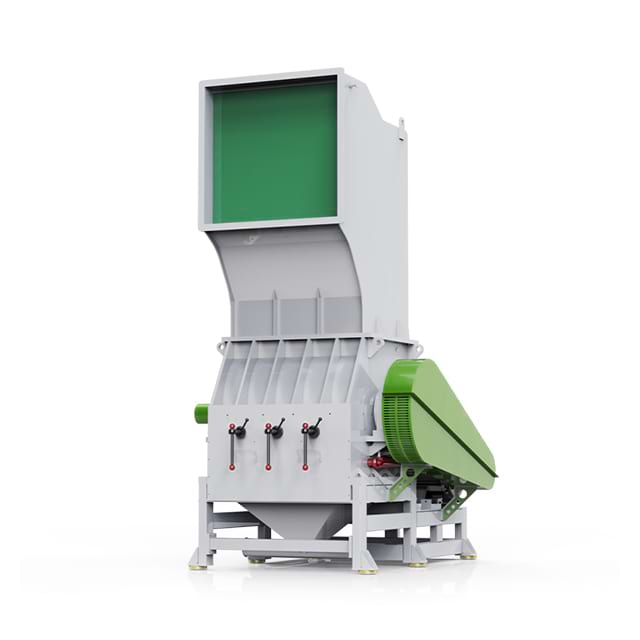
Water-cooled bearing housings and cutting chambers are necessary to prevent heat transfer to the rotor shaft. When shearing heavy plastics, the friction generates temperatures that can easily exceed the melting point of the polymer. If this heat travels down the rotor shaft into the main bearings, the grease will break down, leading to rapid bearing failure. Manufacturers should provide thermal imaging or sensor data proving temperature stabilization during extended runs. A properly designed cooling jacket around the cutting chamber absorbs this excess thermal energy, keeping the internal ambient temperature low enough to ensure clean cuts rather than melted edges.
Blade metallurgy, such as D2 or SKD-11, and precise heat treatment processes dictate how long a sharp cutting edge lasts over continuous shifts. Processing specific materials like PET, HDPE, PP, or PVC requires different blade angles and hardness ratings. The V-cut or chevron rotor design minimizes peak motor loads and reduces frictional heat compared to older flat-blade designs. By shearing the material at an angle, similar to a pair of scissors, the V-cut rotor distributes the cutting force across the entire rotation, preventing massive amperage spikes.
Evaluate the sizing of the drive motor, high-durability transmission belts, and the inclusion of heavy-duty flywheels to absorb shock loads. A massive solid steel flywheel stores kinetic energy, helping the rotor power through dense lumps of plastic without stalling the motor. Require high-efficiency motors paired with smart PLCs that monitor amperage spikes to prevent burnout. High-grade electrical enclosures with active cooling systems are necessary to protect sensitive control circuits from the fine, highly combustible plastic dust generated during continuous runs.
Hydraulic actuation for opening the heavy steel cutting chamber and dropping the screen cradle reduces routine maintenance and blade inspection times from several hours to mere minutes. On large industrial machines, the hopper and upper chamber can weigh several tons. Relying on overhead cranes or manual winches is dangerous and slow. A robust hydraulic system allows a single operator to safely open the machine, clear a jam, or swap a screen, drastically improving overall equipment effectiveness.
Hydraulic force-feeding systems ensure a constant, metered presentation of bulky materials to the rotor. When processing large items like IBC tanks, thick pipes, or heavy purgings, the material tends to bounce on top of the rotor. A hydraulic pusher arm physically forces the material into the cutting blades at a controlled rate. This prevents the motor from overloading, thereby sustaining continuous operation without manual clearing or operator intervention.
The standard FAT process involves running the machine at maximum capacity for a specified duration using the client's actual scrap material. You cannot verify a machine's capability using clean, uniform test blocks. Manufacturers must report average throughput, peak amperage, decibel levels, belt tension stability, and bearing temperatures under real-world loads.
| FAT Parameter | Measurement Method | Acceptable Range |
|---|---|---|
| Motor Amperage | PLC Data Logging | Within 85% of rated full load amps |
| Bearing Temperature | Infrared Thermography | Under 75°C after 4 hours of running |
| Vibration Levels | Casing Accelerometers | Below 4.5 mm/s RMS |
| Throughput Stability | Weigh Belt / Catch Bins | Consistent kg/hr over the test duration |
Continuous operation is only valid if the output remains usable for downstream recycling operations. Measure particle size distribution and impurity content at hour 1 versus hour 8 to prove the blades are not dulling, generating excessive fines, or melting the plastic. If the machine runs for 12 hours but produces a high percentage of dust that clogs your extruder screens, the operation is a failure. The regrind must be uniform, clean-cut, and free of thermal degradation.
Manufacturers simulate real-world conditions by introducing foreign objects or varying material densities to prove the system's automated shutdown and recovery protocols. A reliable plastic crusher machine manufacturer will demonstrate how the PLC reacts to an uncrushable object, showing the motor reversing or shutting down before the rotor shaft bends or the blades shatter.
Routine checks for operators must focus on blade wear, drive belt tension, electrical connection integrity, and lubrication of high-friction components. A structured inspection schedule prevents minor component wear from escalating into major system downtime. Ignoring a loose drive belt leads to slipping, which burns the belt and reduces rotor speed, ultimately causing a massive jam in the cutting chamber.
Manual feeding is incompatible with continuous industrial operation. Integrated conveyor belts equipped with magnetic separators or metal detectors are necessary to protect the cutting chamber from catastrophic damage. A single stray bolt or wrench dropped into the hopper can destroy a set of blades instantly, costing thousands of dollars and halting production for days.
Safety regulations are required for heavy-duty machinery running continuously. Verifiable emergency stop mechanisms, limit switches on all access panels, and vibration sensors that trigger automatic shutdowns before mechanical failure occurs are needed. The machine must physically prevent the rotor from turning if the hopper is open or the screen cradle is lowered.
A: While some machines are rated for 24 hours, best practices dictate scheduled cooling and inspection intervals every 8-12 hours depending on material density, active cooling systems, and belt transmission checks.
A: Hydraulic systems automate the opening of heavy hoppers and screen cradles, drastically reducing downtime for blade sharpening and inspection, while also assisting in force-feeding bulky materials.
A: The Factory Acceptance Test (FAT) includes running the machine under full load to monitor motor amperage, bearing temperature, output consistency, and vibration levels over several hours.
A: The friction generated by shearing tough polymers causes overheating, emphasizing the need for water-cooled chambers, proper belt alignment, and V-cut rotor designs to mitigate thermal buildup.
A: Automated metal detection, emergency stop verification, vibration sensors, thermal overload relays, and hydraulic safety locks are non-negotiable features for safe, continuous running.
A: Inconsistent particle sizes, excessive dust, or thermal degradation from overheating will clog downstream extrusion or granulation filters, disrupting the entire recycling line.


