
- All
- Product Name
- Product Keyword
- Product Model
- Product Summary
- Product Description
- Multi Field Search
 English


Views: 0 Author: Site Editor Publish Time: 2026-10-21 Origin: Site


Modern manufacturing heavily relies on advanced extrusion technology. It transforms raw materials into high-performance products reliably and efficiently. Choosing the wrong processing equipment severely hurts business profitability. Subpar machinery increases downtime, drives up maintenance costs, and creates massive material waste. Fortunately, twin screw extruder systems solve these complex processing challenges across multiple industrial sectors. In this comprehensive guide, we dive deep into how these sophisticated machines operate on the factory floor. We will explore polymer compounding, equipment selection, and operational best practices to help you optimize your production line.
Before exploring complex industrial applications, we must establish a firm understanding of the fundamental mechanics. These machines represent a massive engineering upgrade over traditional single-screw setups. They are specifically designed from the ground up to handle demanding mixing, reacting, and compounding tasks that standard equipment simply cannot manage.
At its core, the system consists of two rotating screws positioned within a precisely machined, temperature-controlled barrel. Depending on your specific processing requirements, these screws can take various configurations. The most common structural variations include intermeshing or non-intermeshing designs. You will also see co-rotating or counter-rotating setups on the factory floor.
In modern polymer compounding, the co-rotating intermeshing twin-screw extruder has firmly established itself as the industry standard. The intermeshing design allows the flight of one screw to continuously wipe the root of the other. This creates a highly efficient self-cleaning mechanism. As the shafts rotate at high speeds—often up to 600 rpm in advanced models—they capture the raw material and convey it forward. The machine melts the polymer through intense mechanical shear and precise barrel heating. It mixes the formulation thoroughly and ultimately pumps the viscous melt through a specialized die head.
Single-screw extruders rely almost entirely on friction. The friction between the material and the barrel wall conveys and melts the polymer. This mechanism works great for simple profile extrusion or basic pipe manufacturing. However, single-screw machines struggle heavily when tasked with complex mixing or handling highly filled compounds.
Conversely, twin-screw extruders operate on the principle of positive displacement. The material continuously transfers from one screw to the other in a figure-eight pattern. This unique mechanical action provides superior distributive mixing. It spreads different materials evenly throughout the polymer matrix. It also delivers intense dispersive mixing, breaking down stubborn agglomerates under high shear. Building on this mechanical foundation, twin screws offer incredibly precise temperature control. This prevents the thermal degradation of heat-sensitive materials during high-speed processing.
| Feature | Single Screw Extruder | Twin Screw Extruder |
|---|---|---|
| Primary Function | Melting, conveying, and forming pipes or profiles. | Compounding, mixing, reacting, and devolatilizing. |
| Mixing Capability | Limited; relies heavily on high friction. | Excellent; utilizes precise, customizable shear forces. |
| Material Conveying | Friction-dependent. | Positive displacement. |
| Self-Cleaning | Poor to none, requiring manual purging. | Excellent via intermeshing designs. |
| Degassing Efficiency | Low. | High through multiple integrated vacuum zones. |
The plastics and polymer industry remains the largest beneficiary of twin-screw technology. The ability to precisely manipulate shear rates, control residence time, and maintain strict temperature profiles makes this equipment indispensable for advanced material engineering.
Polymer compounding is the intricate process of mixing base polymers with various additives. Manufacturers routinely use these machines to blend raw virgin polymers with functional fillers like glass fiber, talc, calcium carbonate, or flame retardants. For instance, when an automotive supplier needs a lightweight but ultra-rigid dashboard component, operators utilize modular screw designs. They arrange kneading blocks to apply exact shear forces. This action breaks down the glass fibers and distributes them uniformly throughout the polymer matrix. Crucially, it achieves this without degrading the base resin.
Beyond physical mixing, the equipment functions as a highly efficient continuous chemical reactor. In reactive extrusion, complex chemical reactions occur directly within the highly viscous polymer melt. This happens rapidly as the material travels down the length of the extruder barrel.
This specialized process handles polymerization, polymer grafting, and chemical cross-linking. The extruder provides intense mixing, rapid heat transfer, and a tightly controlled residence time distribution. Consequently, it facilitates chemical reactions much faster and more predictably than traditional batch reactors. This continuous method is highly favored in the production of thermoplastic elastomers and modified engineering plastics.
During polymer processing, volatile substances often become encapsulated in the melt. These include ambient moisture, unreacted monomers, residual solvents, and trapped gasses. If left unchecked, these volatiles cause microscopic voids and structural weaknesses in the final molded product.
Twin-screw extruders excel at devolatilization. Engineers configure the screws to create specific zones of partial filling and rapid surface area renewal. By installing high-powered vacuum ports at these exact locations along the barrel, trapped gases are forcefully extracted. This critical step ensures a dense, pure, and defect-free final output.
Looking at recent developments across the manufacturing landscape, the global extrusion market is experiencing a massive shift toward digitalization and sustainable processing. Current market analyses indicate a strong push for bioplastics like PLA and PBAT. These biodegradable polymers are highly shear-sensitive and prone to thermal degradation. Modern extrusion platforms are adapting with advanced internal cooling circuits and optimized screw geometries to process these eco-friendly materials efficiently. Furthermore, Industry 4.0 integration is becoming standard. Plant managers now rely on smart IoT sensors to monitor real-time melt pressure, viscosity, and thermal fluctuations directly within the barrel. This drives data-driven manufacturing and minimizes unexpected downtime.
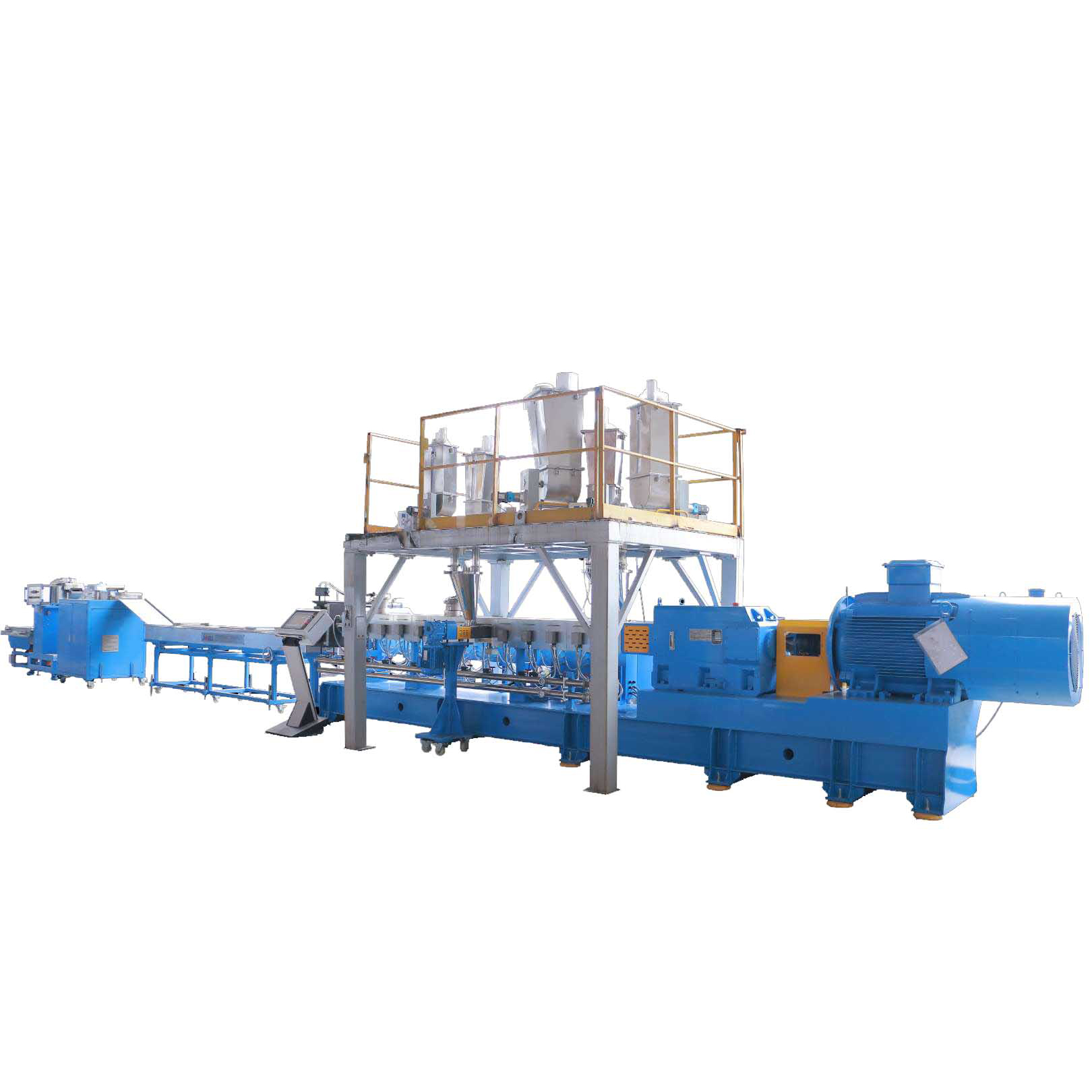
Converting a continuous stream of raw polymer melt into uniform pellets is a critical intermediary step in the global supply chain. Pellets offer high bulk density, flow seamlessly into downstream automated machinery, and melt uniformly during final product shaping.
A high-performance plastic pelletizing machine is engineered to process compounded materials or recycled plastics into standardized granules. Whether a facility is producing virgin resin blends or processing post-consumer waste, the pelletizing unit ultimately determines the final quality. High-quality pelletizing minimizes dust generation, prevents clumping, and ensures consistent volumetric feeding in all subsequent manufacturing stages.
Masterbatches are highly concentrated mixtures of pigments or functional additives encapsulated in a carrier resin. Producing vivid color masterbatches requires intense dispersive mixing. The system must ensure that microscopic pigment particles do not agglomerate. The twin-screw setup provides the necessary shear stress to break down these pigments, ensuring vibrant coloring without streaking in consumer products.
Similarly, engineering plastics like PC, PA, and PET require uncompromising thermal management. These advanced materials possess incredibly narrow processing temperature windows. Sophisticated internal cooling and heating systems integrated into the barrel maintain strict temperature profiles. This prevents polymer degradation while achieving the necessary melt homogenization.
Industrial plastic pelletizing plays a foundational role in the modern circular economy. Post-consumer and post-industrial plastic waste must be rigorously cleaned, melted, filtered, and reformed into reusable pellets. Twin-screw extruders are highly effective for recycling operations. They easily handle fluctuating material bulk densities and exceptionally high moisture contents.
Superior degassing capabilities strip away odors and residual moisture from washed plastic flakes. Moving beyond simple recycling, operators introduce impact modifiers or antioxidants directly into the extruder. This upcycles the plastic, effectively restoring its mechanical properties to near-virgin levels.
To fully grasp the application of this technology, prospective buyers must understand that the extruder is just the central engine. It sits within a much larger integrated ecosystem.
A complete Twin screw pelletizing line consists of several synchronized components working in perfect harmony.
The specific cutting mechanism utilized at the end of the line must be perfectly matched to the rheological properties of the polymer.
| Pelletizing Method | Operational Mechanism | Best Suited For |
|---|---|---|
| Strand Pelletizing | Melt is extruded into strands, cooled in a water bath, dried, and cut by a rotary rotor. | Standard compounding, rigid plastics like PP, PE, ABS. |
| Water-Ring Pelletizing | Melt is cut at the die face by rotating blades and thrown into a circulating ring of water. | High-volume production, materials with good melt strength. |
| Underwater Pelletizing | Cutting occurs directly on the die face completely submerged in a pressurized water chamber. | Sticky materials, low-viscosity elastomers, and micro-pellets. |
While polymer processing remains the most recognized use case, the fundamental principles of continuous mixing make these machines highly adaptable. Decision-makers in diverse fields leverage this technology to transition away from inefficient batch processing.
In the food processing sector, this technology produces a wide array of consumer goods. Food-grade extruders operate on the principles of high-temperature short-time processing. This method cooks, shapes, and expands raw ingredients while preserving vital nutritional value.
Typical applications include puffed snacks, breakfast cereals, and textured vegetable protein. The animal feed and aquaculture industries also rely heavily on this technology. Aquafeed requires precise density control to ensure pellets either float or sink depending on the target species. The intense mixing capabilities ensure that fats and essential micronutrients are uniformly distributed.
The pharmaceutical industry has increasingly adopted Hot-Melt Extrusion to overcome critical formulation challenges. One major issue in modern drug development is the poor water solubility of many active ingredients. By utilizing a micro-twin screw setup, drug manufacturers disperse these active ingredients at a molecular level within a polymer matrix.
Unlike traditional batch manufacturing, continuous extrusion offers superior quality control. The extruder acts as a continuous mixer where the residence time is tightly controlled. This ensures that delicate active ingredients are not subjected to excessive thermal stress.
In the broader chemical sector, these machines function as highly efficient continuous reactors. Manufacturers use them extensively to produce hot-melt adhesives, pressure-sensitive sealants, and industrial powder coatings. The processing of adhesives requires equipment capable of handling extreme viscosity variations. The intermeshing screws provide the positive displacement necessary to convey highly viscous melts without material stagnation.
Investing in advanced extrusion technology requires a clear understanding of its operational benefits. These platforms offer distinct engineering advantages that directly translate into improved product quality and manufacturing efficiency.
The most significant advantage is exceptional mixing capability. Mixing in extrusion involves distributive and dispersive actions. Distributive mixing rearranges different components to achieve a uniform blend. Dispersive mixing applies high shear stress to break down cohesive agglomerates.
Co-rotating machines excel simultaneously at both. By incorporating specialized kneading blocks along the screw profile, operators precisely manipulate the shear field. This results in a perfectly homogenous melt, eliminating structural weak points in the final extruded product.
In a high-volume production environment, every minute a machine sits idle for cleaning eats directly into profit margins. Material stagnation causes polymer degradation, leading to black specks and compromised mechanical properties. Co-rotating intermeshing screws feature a unique self-wiping mechanism. As the shafts rotate, the flight crest of one screw continuously wipes the flank of the other.
This incredibly narrow clearance ensures a very tight residence time distribution. For manufacturers running multiple color or formulation changes, this self-cleaning feature drastically reduces machine downtime and minimizes scrap generation.
Modern systems are built on a highly adaptable modular architecture. Both the barrel sections and the internal screw elements are segmented. Screw elements slide individually onto a splined central shaft.
This modularity provides future-proof flexibility. If a manufacturer decides to shift from producing standard polyolefins to compounding highly filled engineering plastics, they do not need to purchase a completely new machine. Plant engineers simply reconfigure the screw profile and adjust the barrel length to accommodate the new formulation.
Selecting the appropriate extrusion equipment is a capital-intensive decision. A standardized approach rarely works in compounding. The machinery must be precisely tailored to your specific material properties and production goals.
The foundational step is aligning the machine's mechanical specifications with your production targets. Throughput capacity is largely determined by the available free volume inside the barrel and the maximum torque the gearbox can transmit.
Buyers must rigorously analyze the specific torque density. Processing low-bulk-density materials requires a machine with a higher free volume. Conversely, processing highly viscous engineering plastics necessitates high-torque configurations. Look for systems offering high torque density, typically around 11 to 13 Nm/cm³ for demanding tasks. A machine with insufficient torque will experience constant motor strain and poor mixing quality.
Abrasive wear and chemical corrosion are the primary enemies of extrusion equipment. When processing compounds containing high percentages of glass fibers or flame retardants, standard steel components degrade rapidly.
It is critical to select the appropriate metallurgy for the screw elements and barrel liners. Processing abrasive materials requires wear-resistant bimetallic barrel liners. Screw elements should feature advanced treatments like powder metallurgy tool steel or tungsten carbide coatings. Choosing the correct wear-resistant materials upfront significantly extends the lifespan of the equipment.
Beyond the mechanical specifications, the reliability of the machinery manufacturer is paramount. Implementing a complete production line involves integrating complex subsystems, from gravimetric feeders to downstream cutting equipment.
Buyers should prioritize suppliers who offer comprehensive engineering support, from initial testing to on-site commissioning. The availability of spare parts and responsive technical service are crucial factors. In industrial settings where machines run constantly, even minor disruptions result in significant financial losses. A reliable manufacturing partner ensures sustained operational stability.
The application of twin screw extruder technology spans a vast array of industries. It drives continuous innovation in food production, pharmaceuticals, and advanced chemical manufacturing. However, its foundational role in polymer compounding and industrial pelletizing remains one of the most critical applications for global manufacturing.
Investing in a high-quality, properly configured extrusion line is a strategic business decision. These systems directly enhance product quality while slashing material waste. When meticulously matched to your specific material requirements, this equipment represents a highly secure investment. For facilities looking to upgrade their processing capabilities, exploring the extensive catalog at https://www.jwell-recycling.com will help you find the exact match for your production needs. Consulting with experienced extrusion engineers to discuss a customized setup will ensure your production line operates at absolute peak efficiency.
The primary difference lies in their mechanical function and mixing capability. A single screw extruder relies on friction between the polymer and the barrel wall to melt and convey the material. It is primarily used for forming continuous profiles like pipes. In contrast, a twin screw extruder utilizes two interacting screws to provide positive displacement. This design delivers intense shear forces, making it vastly superior for complex dispersive and distributive mixing.
Yes, these systems are highly effective for processing recycled materials. Post-consumer plastics often contain residual moisture and organic contaminants. Twin screw machines feature multiple specialized vacuum venting zones along the barrel. These zones efficiently extract volatile gasses and moisture from the polymer melt. Their superior mixing capabilities also allow operators to seamlessly blend in impact modifiers to restore the mechanical properties of the recycled plastic.
The capital investment varies significantly based on scale, output, and complexity. Costs are heavily influenced by the required output capacity, the level of automation, motor size, and specific metallurgy. Systems designed for highly abrasive materials using advanced powder metallurgy command a higher initial price. However, they offer a much lower total cost of ownership through extended component lifespans.
The replacement frequency depends entirely on the abrasiveness of the formulations being processed. Processing standard virgin polyolefins allows screw elements to last for several years. However, compounding materials with high loadings of glass fibers can wear down standard steel elements in a matter of months. The distinct advantage of the modular screw design is that operators only need to replace specific localized elements that experience the highest wear.
The Length to Diameter ratio dictates the residence time and processing capability of the machine. For standard compounding tasks, a ratio between 36 and 48 is typical. Highly complex reactive extrusion or processes requiring intense devolatilization may utilize extended barrels with a ratio of 52 to 64. The modular nature of these machines allows engineers to add or remove barrel sections to achieve the perfect ratio for specific materials.
Torque density measures the amount of rotational force the gearbox can safely apply relative to the free volume inside the barrel. High torque density is absolutely critical when processing highly viscous engineering plastics or heavily filled compounds at lower melt temperatures. A machine with high torque density can maintain high throughput rates without stalling the motor, ensuring consistent dispersive mixing and higher overall production efficiency.


