
- All
- Product Name
- Product Keyword
- Product Model
- Product Summary
- Product Description
- Multi Field Search
 English

Views: 0 Author: Site Editor Publish Time: 2026-07-24 Origin: Site


Industrial recycling facilities demand massive capital expenditure. Historical failure rates remain high due to unmanaged scope creep, delayed commissioning, and regulatory bottlenecks. Vague initial proposals often lead to mismatched equipment capacities, unforeseen utility upgrades, unaligned material handling systems, and ballooning integration costs between sorting, washing, and extrusion phases. A buyer’s primary defense against budget overruns is rigorously evaluating how a turnkey plastic recycling plant manufacturer defines, documents, and controls project scope before the contract is signed. We will break down the exact engineering frameworks, boundary limits, and acceptance testing protocols required to keep your next facility build on track and within budget.
Undersized utility requirements discovered late in the installation phase create cascading financial impacts. If power drops, water mains, compressed air lines, or water chilling capacities are insufficient, operations halt while expensive site upgrades are rushed. We often see projects stall because the initial electrical load calculations ignored the peak startup draw of heavy shredders. Misaligned software protocols between different machinery nodes force manual intervention points. This causes operational delays and increases labor requirements on the floor.
Capacity bottlenecks occur when one subsystem underperforms, dragging down the return on investment of the entire plant. If the sorting or shredding phase cannot feed the downstream equipment fast enough, the extrusion lines run idle. You cannot afford to have a high-capacity extruder waiting on wet flakes because the thermal dryer was undersized. Regulatory-driven scope creep, such as unexpected requirements for VOC emission filtration or closed-loop water discharge permits, further stalls commissioning. When local authorities demand additional scrubber systems late in the build, the project timeline extends by months.
Marketing materials frequently use the term "turnkey" loosely. This contrasts sharply with the engineering reality of EPC (Engineering, Procurement, and Construction) contracts. A true turnkey project requires rigorous definition of battery limits. Battery limits specify exactly where the manufacturer's responsibility begins and ends. This includes all utility tie-in points, ensuring no hidden integration costs fall on the buyer.
| Project Component | Poorly Defined Scope (Fragmented) | Strict Battery Limits (True Turnkey) |
|---|---|---|
| Infeed Material | "Customer provides plastic waste." | "Manufacturer accepts baled PET bottles at loading dock conveyor A1." |
| Utilities | "Requires 480V power and water." | "Manufacturer provides main breaker panel; client brings 2000A service to terminal block T-1. Client provides 50 GPM water at 60 PSI to flange W-2." |
| Wastewater | "Wash line discharges dirty water." | "Manufacturer includes DAF system; discharges clean water to municipal sewer at pH 7.0-8.0." |
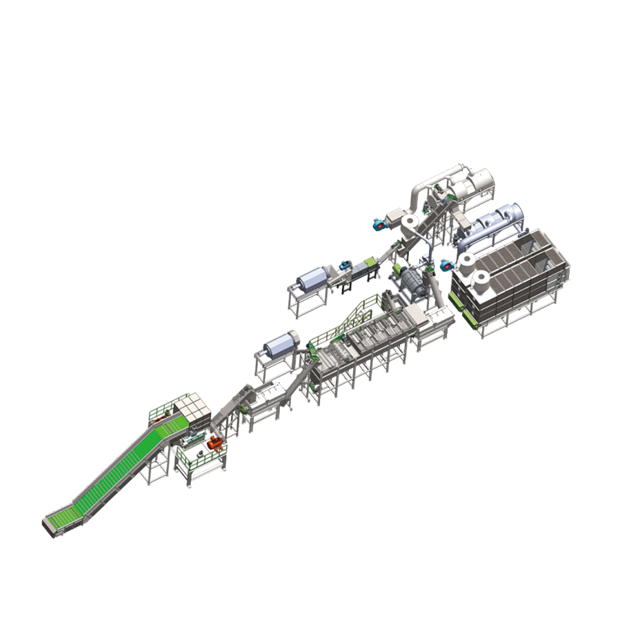
Waste stream audits are essential for identifying polymer types, contamination levels, moisture content, and the presence of foreign materials like metals or glass. You cannot design a functional plant based on assumptions. A competent manufacturer uses this empirical data to baseline the scope. This ensures the machinery is engineered for the actual material being processed. If your input bales contain 15% PVC and 5% aluminum, the sorting line must be scoped with specific near-infrared (NIR) and eddy current separators to handle that exact load.
The manufacturer must incorporate local regulatory requirements into the initial scope. This includes CE, OSHA, and local environmental agency regulations. Site footprint, floor loading capacities, and ceiling clearance audits are necessary to ensure the machinery layout prevents spatial interference. Heavy wash tanks require reinforced concrete pads. Tall silos need adequate roof clearance. The engineering team must verify these dimensions before fabricating a single piece of steel.
A FEED study locks down the process flow diagram (PFD), piping and instrumentation diagram (P&ID), and electrical single-line diagrams early in the project. This phase eliminates guesswork. A strict change order process dictates how deviations requested by the client or necessitated by site conditions are handled.
The shredding, granulating, and sorting stages preceding the wash line require precise engineering. A turnkey plastic recycling plant manufacturer prevents bottlenecks by scoping heavy-duty shredders with correct torque and screen sizes adjusted to the specific input plastic thickness. Thick-walled HDPE pipes require different rotor configurations than thin LDPE films. Integrating magnetic and optical sorting systems protects downstream machinery from damage caused by tramp metal or foreign objects. A missed bolt can destroy granulator blades in seconds, causing massive downtime.
Scope requirements for a high-performance plastic washing line focus on friction washers, sink-float tanks, hot washing units, and mechanical or thermal drying systems. The RPM of the friction washers must match the contamination level of the flakes. A critical scope boundary is wastewater treatment. The contract must clarify whether the plastic washing line manufacturer includes the closed-loop water filtration system. This covers sludge dewatering, pH adjustment, and water recycling. If it requires a third-party vendor, the integration points must be explicitly defined in the P&ID.
Engineering parameters required to scope the plastic pelletizing system include extruder L/D ratios, venting and degassing zones, and melt filtration requirements based on the washed flake quality. Highly printed films require double degassing zones to remove ink volatiles. The manufacturer must justify the selection between single-screw and twin-screw configurations within the project scope. The inclusion of exhaust air filtration and pellet cooling systems within the pelletizer scope is also mandatory. You need a robust water ring or strand pelletizing setup matched to the polymer's melt flow index.
Material movement between the plastic washing line and the plastic pelletizing system requires careful planning. Buffer silos, pneumatic conveying systems, and moisture-control storage ensure continuous, uninterrupted pelletizer feeding. Extruders hate starved feeding. Proper buffer capacity absorbs upstream maintenance stops without shutting down the extrusion line.
Integration risks multiply when a turnkey provider outsources components without uniform design guidelines. A unified SCADA (Supervisory Control and Data Acquisition) system acts as the ultimate proof of scope integration. It links all phases, from shredding and washing to pelletizing and bagging, into a single operator interface. Centralized safety interlocks ensure that if the pelletizer trips, the upstream wash line feed automatically pauses to prevent material overflow.
Metrics written into the scope of work must include target throughput in kilograms per hour. Final pellet quality parameters like melt flow index, moisture content below one percent, and bulk density must be specified. Acceptable loss and yield ratios are also critical. These metrics protect the buyer from accepting a plant that runs but fails to achieve commercial viability. If the contract says 2000 kg/hr, the plant must sustain that rate continuously, not just for a five-minute sprint.
The FAT protocol tests equipment at the manufacturer's facility before shipping. This involves dry runs, control panel verification, and component-level testing. We check motor rotations, sensor calibrations, and emergency stop circuits. The SAT protocol establishes criteria for final handover at the buyer's site. This involves running actual feedstock under continuous operational loads for a specified number of consecutive hours to validate performance.
Machinery delivery often outpaces facility readiness, creating significant friction. The manufacturer should supply foundation load drawings, trenching layouts for drainage, and electrical schematics months in advance. Heavy extruders require isolated concrete pads to dampen vibration. Wash lines require extensive floor trenching to manage water spills and facilitate washdowns. If these civil works are not completed before the containers arrive, installation stalls.
Dust explosions in size reduction zones pose severe risks. The manufacturer must integrate safety protocols, such as ATEX-certified motors and dust extraction systems. Shredding dry plastics generates fine particulate matter that is highly combustible. The scope must define responsibilities for securing local industrial licenses and operating permits. Emission stacks from the pelletizer degassing zones must meet local air quality standards.
Scope control includes the human element. Contracts must explicitly include comprehensive training for local operators, maintenance staff, and safety officers. A high-tech plant is useless if the local crew cannot troubleshoot a blocked screen changer. Localized manuals, spare parts lists, and post-commissioning technical support service level agreements are necessary for long-term success.
A: A turnkey provider manages engineering, layout planning, fabrication, installation, commissioning, and operator training. They deliver a fully integrated operational facility rather than just supplying individual machinery components. This ensures all subsystems work together seamlessly under a single warranty and performance guarantee.
A: Battery limits define physical, electrical, and utility boundaries. They specify exactly where the manufacturer's responsibility begins and ends. This prevents hidden integration costs between processing units and site infrastructure, clarifying who provides the power drops, water lines, and civil foundations.
A: Contamination levels, polymer variations, and moisture content dictate the specific design and capacity requirements of the machinery. Without empirical feedstock data, manufacturers might undersize the washing, sorting, and filtration systems, leading to frequent breakdowns and poor final pellet quality.
A: Purchasing from different vendors introduces severe integration risks. You face material transport mismatches, SCADA compatibility issues, and the loss of single-point accountability. If the plant fails to hit throughput targets, vendors will blame each other rather than fixing the problem.
A: The scope must integrate emission controls, dust explosion safety certifications like ATEX or NFPA, and wastewater management systems. The manufacturer must design the equipment to meet local environmental and industrial safety regulations to ensure you can legally operate the facility.
A: FAT validates equipment functionality at the factory before shipment through dry runs and electrical checks. SAT validates on-site operational performance using actual waste streams under continuous load conditions to prove the plant meets contractual throughput and quality metrics.
A: A formal documentation process must evaluate, cost, and approve adjustments to project parameters or site conditions. This ensures timeline and budget impacts are managed transparently, requiring client sign-off before any engineering or fabrication changes are executed.


