
- All
- Product Name
- Product Keyword
- Product Model
- Product Summary
- Product Description
- Multi Field Search
 English

Views: 0 Author: Site Editor Publish Time: 2026-07-21 Origin: Site


Deploying rigid, off-the-shelf recycling equipment for highly variable post-consumer or post-industrial waste streams consistently leads to high failure rates, lost yield, and hidden operational costs. Plant managers often face a severe disconnect between unpredictable feedstock—characterized by mixed polymers, varying contamination levels, and fluctuating moisture—and strict output requirements. Modern manufacturing demands specific Melt Flow Index (MFI) parameters, high purity for closed-loop applications, and volatile-free pellets. Standard machinery simply cannot bridge this gap without excessive manual intervention and frequent downtime.
Customization serves as a critical risk-mitigation and ROI-driving strategy rather than a luxury upgrade. A tailored approach lowers labor costs, minimizes energy consumption, and prevents premature equipment failure caused by abrasive or unexpected contaminants. Bridging the gap between input realities and output profitability requires the engineering precision of a custom plastic recycling line. By aligning the mechanical and thermal processing stages directly with the specific characteristics of the incoming waste stream, operators can guarantee consistent, high-grade output.
False assumptions about feedstock consistency inevitably lead to downstream bottlenecks, rapid equipment wear, and rejected pellet batches. A system designed for clean industrial scrap will fail spectacularly when fed heavily contaminated agricultural film. Operators must stop treating plastic waste as a monolith and start analyzing it as a complex chemical and physical input requiring specific handling parameters.
Characterizing polymer types (PE, PP, PET, HDPE, LDPE) and identifying multi-layer materials is the foundational step in system design. You must establish baseline guidelines for moisture content, ash content, PVC limits, and non-polymer impurities. Relying on material assay tests over visual inspection determines exact contamination percentages, providing the hard data needed to engineer the line effectively. Visual inspections miss microscopic degradation and chemical cross-contamination that ruin extrusion batches.
A proper audit involves taking core samples from multiple bales across different seasonal deliveries. This reveals the true variance in the material. For example, agricultural films collected in the rainy season will have drastically different moisture and mud content compared to dry season collections. Engineers use this data to size the pre-washing and drying modules appropriately.
| Polymer Type | Common Contaminants | Audit Focus Areas |
|---|---|---|
| PET Bottles | Adhesives, PVC labels, organic residue | PVC parts per million (ppm), moisture % |
| Agricultural PE Film | Sand, soil, agricultural chemicals | Ash content, abrasive wear potential |
| Post-Consumer HDPE | Milk residue, paper labels, mixed colors | Odor retention, melt flow variance |
Physical, mechanical recycling lines have distinct processing limits compared to chemical recycling or pyrolysis. Highly degraded, cross-linked, or complex multi-layered polymers often cross the tipping point where they must be diverted to chemical recycling rather than a mechanical washing and pelletizing line. Pushing heavily degraded material through a mechanical extruder results in brittle, unusable pellets.
Understanding this threshold prevents capital waste. If an audit reveals that 40% of the incoming stream consists of inseparable multi-layer films with heavy aluminum barriers, mechanical recycling will yield poor results. The system must be designed to sort and eject these materials early in the process, directing them to alternative recovery methods while keeping the mechanical line running at peak efficiency with suitable polymers.
Systems must be designed for seasonal or supplier-based feedstock shifts. Defining acceptable tolerance limits for the primary shredding and sorting stages ensures that only suitable material enters the wet processing phase, protecting downstream equipment from catastrophic damage. If a supplier suddenly changes their collection method, the primary sorting equipment must be robust enough to handle the variance.
Tolerance thresholds dictate the sizing of buffer silos and the capacity of optical sorters. A line expecting 5% contamination needs a vastly different sorting setup than one expecting 25% contamination. Over-engineering the front end of the line provides a safety net against unpredictable supplier quality, ensuring the extruder always receives a consistent, clean flake.
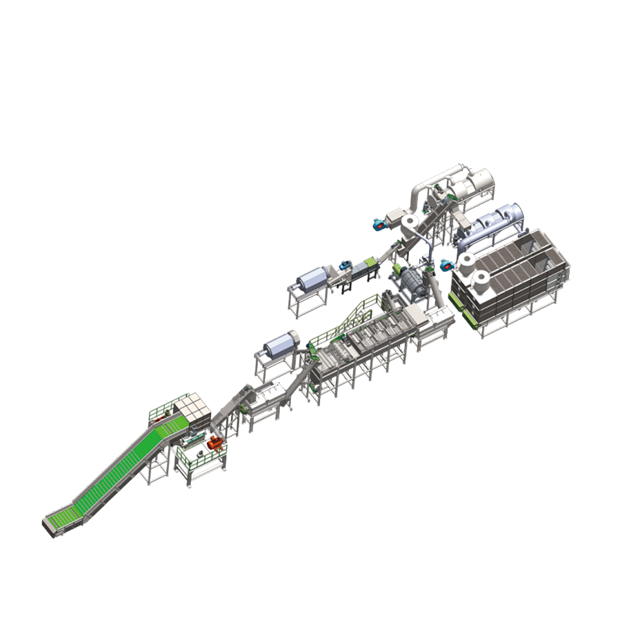
Tracing the physical transformation process of polymer waste reveals how custom engineering optimizes material flow at each stage. Every module must communicate with the next, balancing throughput rates to prevent material starvation or overflow.
Magnetic separators, optical sorters, and heavy-duty shredders prepare a uniform fraction. Cutting rotor geometry and blade metallurgy are customized for rigid plastics versus flexible films to prevent thermal softening during shredding. Rigid plastics require high-impact, staggered blade configurations, while flexible films need scissor-cut designs to prevent wrapping around the rotor.
The size reduction phase sets the stage for washing efficiency. Flakes that are too large will not clean properly in the friction washers, while flakes that are too small will be lost in the water treatment screens. Customizing the screen sizes on the granulators ensures the optimal surface-area-to-volume ratio for the subsequent chemical and mechanical washing stages.
The progression moves through pre-washing, intensive washing, separation, and mechanical drying. This stage transitions contaminated scrap into clean, damp flakes ready for extrusion compounding. The residence time in each washing module is calculated based on the adhesion strength of the contaminants identified during the feedstock audit.
Mechanical drying utilizes high-speed centrifuges to strip surface moisture from the flakes. For highly porous materials, thermal drying systems are added to bring moisture levels below 1% before the material enters the storage silos. Excess moisture entering the extruder causes foaming and degrades the final pellet quality.
Dried flakes transfer to the compounding extruder. The process involves extrusion, filtration, pelletizing (underwater, water-ring, or strand), and pneumatic transport to final packaging or direct molding silos. The choice of pelletizing method depends entirely on the polymer's melt strength and the desired pellet geometry.
Underwater pelletizing is preferred for low-viscosity melts, providing uniform, spherical pellets. Strand pelletizing is often used for engineering plastics that require specific cooling profiles. The pneumatic transport system must be designed to prevent pellet fracturing and dust generation during transfer to the storage silos.
Customization options within the washing phase are dictated entirely by the feedstock audit. Applying a generic washing process to specialized contamination results in either dirty flakes or wasted energy and water.
High-speed friction washers are specified for removing heavy dirt, clay, or oils, whereas standard mechanical agitation suits lighter contamination. Balancing aggressive cleaning shear against material yield loss is critical. Over-washing brittle polymers generates excessive fines, which are washed away with the wastewater, directly reducing the plant's overall yield.
The angle of the paddles, the rotational speed of the rotor, and the screen perforation size in a friction washer must be tailored to the specific polymer. A plastic washing line handling agricultural film requires massive friction washers to break down embedded soil, while a line processing clean post-industrial scrap might bypass friction washing entirely to save energy.
Density-based separation effectively isolates polymers. Hot washing modules utilizing caustic soda and surfactant dosing eliminate stubborn adhesives, surface inks, and organic residue for near-prime purity. The temperature and chemical concentration must be precisely controlled to break down glues without degrading the underlying polymer chains.
| Polymer | Specific Gravity | Behavior in Water (SG 1.0) |
|---|---|---|
| PP (Polypropylene) | 0.89 - 0.91 | Floats |
| HDPE | 0.94 - 0.96 | Floats |
| PET | 1.38 - 1.39 | Sinks |
| PVC | 1.30 - 1.45 | Sinks |
High freshwater consumption presents severe environmental and economic risks. Integrated wastewater filtration, sedimentation, and pH adjustment systems maximize recycled water reuse while maintaining cleaning efficacy. Operating a washing line without a robust water treatment plant is economically unviable in modern regulatory environments.
The water treatment system must handle the specific chemical load generated by the hot washing phase. Flocculants and coagulants are dosed automatically to precipitate suspended solids, allowing the clarified water to be pumped back into the pre-washing modules. This closed-loop approach drastically reduces operational overhead.
The technical configurations of the extrusion phase map directly to the desired end-product value and physical characteristics. The extruder is the heart of the recycling plant, where the physical properties of the recycled plastic are finalized.
Single-screw versus twin-screw designs impact shearing, mixing, and gas release. Matching L/D ratios and custom screw profiles to the specific polymer’s MFI prevents degradation. Thermal zone cooling systems provide precision temperature management, preventing localized overheating that causes polymer discoloration and loss of mechanical strength.
A custom plastic pelletizing system requires specific kneading blocks and mixing elements to homogenize the melt. If the feedstock contains slight variations in MFI, the screw design must provide enough distributive mixing to average out these variations, resulting in a consistent batch of pellets.
Dual-piston backflush screen changers and vacuum degassing zones are essential for removing residual moisture and volatile gases, ensuring high-quality, void-free pellets. Continuous screen changers allow operators to remove solid impurities like paper fibers or unmelted foreign polymers without stopping the extrusion process.
Vacuum degassing is particularly critical when processing hygroscopic materials or heavily printed films. The vacuum extracts ink solvents and trapped moisture before the melt reaches the die head. Failure to properly degas the melt results in foaming at the die and brittle, unusable pellets that will fail quality control checks.
To maximize the profitability and reliability of your recycling operations, implement the following actions:
A: A feedstock audit identifies exact polymer types, moisture levels, and contamination percentages. This data ensures the machinery is engineered to handle your specific material without excessive wear, bottlenecks, or catastrophic equipment failure.
A: Friction washing uses high-speed rotors to aggressively scrub heavy dirt, clay, and oils from plastics. Standard mechanical washing uses gentler agitation, which is only suitable for lighter, easily removable surface contamination.
A: Sink-float separation uses water density to separate different types of plastics. Heavy polymers like PET sink to the bottom of the tank, while lighter polyolefins like PE and PP float to the surface for easy extraction.
A: Custom screw geometry controls the shearing, melting, and mixing of the polymer. Precise design is critical for maintaining the correct Melt Flow Index and preventing thermal degradation during the extrusion process.
A: Vacuum degassing removes trapped moisture, ink solvents, and volatile gases from the melted polymer inside the extruder. This prevents voids, foaming, and structural weaknesses in the final recycled pellets.
A: Integrated water treatment removes suspended solids and balances pH, allowing the system to reuse water continuously. This closed-loop process drastically reduces freshwater consumption and lowers overall operational costs.


