
- All
- Product Name
- Product Keyword
- Product Model
- Product Summary
- Product Description
- Multi Field Search
 English

Views: 0 Author: Site Editor Publish Time: 2026-07-24 Origin: Site


Inconsistent raw material flow in continuous manufacturing processes creates a compounding financial impact that directly erodes profit margins. When plastic processing lines rely on manual material handling or poorly calibrated standalone loaders, facilities experience erratic scrap rates, frequent machine downtime, and high operator intervention costs. Process instability typically manifests through two primary threats: starvation and overfeeding. Starvation occurs when an interrupted material supply causes dry runs, short shots, or loss of extruder pressure. Conversely, overfeeding forces excess material into the throat, leading to hopper bridging, thermal degradation of stagnant resin, and gravity-induced spillage on the production floor.
To stabilize throughput and ensure product consistency, facilities must shift toward automated, sensor-driven material handling. Evaluating an automatic material feeding system represents a necessary step for modern processing plants. By removing human error and replacing outdated loaders with precise, closed-loop controls, manufacturers protect their margins and maintain continuous, optimized production cycles.
Optimal material flow requires a constant throughput rate, zero material degradation, and minimal scrap generation. Success in plastic processing hinges on maintaining a precise balance between the material entering the hopper and the material consumed by the screw. When facilities achieve this balance, they maximize machine uptime and yield consistent part weights. Any deviation from these baseline metrics indicates a structural flaw in the material handling architecture. Operators monitor specific parameters to verify system health, including melt pressure stability, screw recovery time, and ambient dust levels near the feed throat. A stable process runs continuously without manual intervention, whereas a flawed setup demands constant operator attention to clear jams or reset alarms.
Machine starvation halts production and damages equipment. Root causes often include blocked suction probes, empty gaylords, or inadequate vacuum pump sizing that fails to lift pellets over long distances. When material stops flowing, the processing machine continues to run empty. In many plants, operators discover starvation only after the machine produces a batch of defective parts. A kinked flex hose or a clogged filter screen can easily disrupt the vacuum sequence, leaving the receiver empty while the extruder pulls the remaining resin from the hopper.
The outcomes of starvation are immediate and costly. Extruders experience cavitation, leading to severe screw wear and barrel scoring. Injection molding machines produce short shots, generating unrecoverable scrap and potentially damaging the mold cavity. The loss of continuous process pressure forces operators to purge the barrel, wasting expensive resin and requiring hours to restart a stalled line. Furthermore, repeated starvation events degrade the mechanical seals on the feed screw, leading to premature equipment failure and unplanned maintenance downtime.
Material overfeeding creates bottlenecks that choke the production line. Root causes typically involve a lack of level sensors, improper timer settings on legacy loaders, or gravity-induced weeping through poorly sealed valves. Without precise cutoff mechanisms, material floods the feed throat. Legacy systems relying solely on timers often fail to account for changes in bulk density. If a new batch of resin flows faster than the previous one, the timer-based loader will pull too much material, overflowing the receiver and packing the hopper throat.
Outcomes include material bridging and ratholing, where pellets interlock and block flow entirely. Stagnant resin sitting in an overfilled hopper suffers thermal degradation, altering the polymer's physical properties and causing black specks in the final product. Overfeeding also causes material spillage, creating slip hazards on the plant floor, and places unnecessary mechanical stress on feeding motors. When a hopper bridges, operators must manually break the jam with a rod, introducing safety risks and halting production.
| Symptom | Primary Cause | Production Impact | Immediate Action Required |
|---|---|---|---|
| Short Shots / Cavitation | Material Starvation | High scrap rate, screw wear | Clear lines, check vacuum pressure |
| Hopper Bridging | Overfeeding / Compaction | Flow blockage, downtime | Break jam, adjust fill sensors |
| Black Specks in Parts | Thermal Degradation | Quality rejection | Purge barrel, reduce hopper volume |
| Pellet Spillage | Valve Weeping | Safety hazard, material waste | Inspect and replace knife gates |
Facilities typically choose between standalone hopper loaders and fully integrated automated systems. Standalone loaders operate on simple timers, lacking the feedback required to adjust to changing bulk densities. They require constant manual tweaking whenever operators switch resins or adjust regrind ratios. In contrast, an automatic material feeding system utilizes a network of sensors, valves, and controllers to dynamically match material delivery with actual machine consumption. This integrated approach removes the guesswork from material handling, ensuring the extruder receives exactly what it needs, exactly when it needs it.
Capacitive, optical, and mechanical level sensors monitor the exact volume of material inside the hopper. Capacitive sensors detect the dielectric shift when pellets cover the probe, making them highly effective for standard resins. Optical sensors use light beams to verify material presence, which works well for clear or translucent pellets. Mechanical paddles rotate until resistance signals a full hopper, providing a robust solution for heavy or abrasive materials. Selecting the right sensor depends entirely on the physical characteristics of the polymer being processed.
Closed-loop feedback automatically triggers vacuum sequencing to replenish material only when the low-level threshold is breached. This demand-driven approach inherently prevents overfilling. If a sensor fails, redundant high-level alarms halt the vacuum pump, providing a failsafe against material spills. Modern systems also incorporate time-out alarms; if the vacuum pump runs for a specified duration without the high-level sensor triggering, the system alerts the operator to a potential line blockage or empty gaylord, preventing the machine from running dry.
Gravity-induced material drift ruins batch accuracy. Positive shut-off knife gates and rotary airlocks act as tamper-proof barriers between the material supply and the processing machine. When the system is idle, these mechanical seals close completely. A pneumatic knife gate slices through the material column, ensuring a tight seal even if pellets are in the way. Rotary airlocks provide continuous feeding while maintaining a pressure differential, preventing conveying air from entering the process stream.
This prevents unwanted trickle-feeding and stops ambient moisture from entering the dried resin supply. By physically isolating the material stream, facilities eliminate the weeping effect that often leads to throat blockages and bridging. Routine maintenance on these seals is straightforward but necessary. Operators must periodically check the pneumatic cylinders for air leaks and inspect the gate blades for wear, especially when processing glass-filled or highly abrasive compounds.
Choosing the right dosing method dictates process stability. Volumetric feeding relies on screw speed and time, assuming a constant material volume. However, bulk density variations and inconsistent regrind ratios cause volumetric systems to overfeed or underfeed. If the regrind is fluffier than the virgin resin, a volumetric feeder will deliver less actual weight per revolution, starving the process and altering the final product's physical properties.
Gravimetric loss-in-weight systems continuously monitor material weight using highly sensitive load cells. The controller automatically adjusts feed screw speeds to compensate for bulk density shifts. This real-time calibration completely eliminates overfeeding. When the load cell detects a drop in bulk density, the controller speeds up the dosing motor to maintain the target mass flow rate. This continuous adjustment ensures the extruder receives a perfectly consistent blend, regardless of variations in the raw material supply.
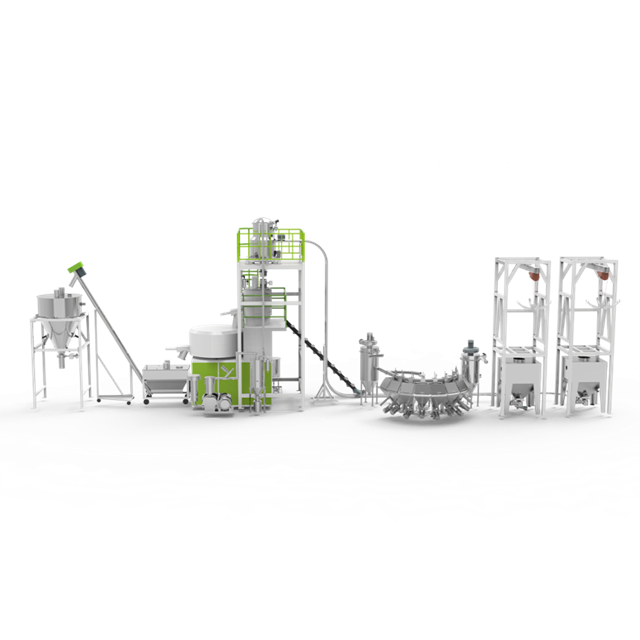
Transitioning from localized feeding to a plant-wide central feeding system requires careful architectural planning. Facilities must map out conveying distances, throughput requirements, and the number of distinct resins processed simultaneously. A scalable architecture allows manufacturers to add new machines without overhauling the entire material handling infrastructure. Engineers must calculate the total equivalent length of the piping network, factoring in vertical lifts and long-radius elbows, to determine the exact vacuum pump capacity required to maintain optimal conveying velocities.
Dilute-phase vacuum conveying pulls material through the lines, offering gentle handling of fragile pellets. This method prevents angel hair formation and minimizes dust generation, making it ideal for short to medium distances within the plant. Vacuum systems operate under negative pressure, meaning any leaks in the piping will draw air in rather than blowing dust out into the clean room. This inherent cleanliness makes vacuum conveying the standard choice for most indoor plastic processing environments.
Pressure conveying pushes material using high-velocity air. Facilities evaluate pressure systems for long-distance, high-volume bulk transfer from outdoor silos to indoor surge bins. Selecting the correct conveying method prevents material degradation during transit. Pressure systems require rotary airlocks to introduce material into the pressurized line, and they demand robust filtration at the destination to vent the conveying air safely. Combining pressure conveying for bulk transfer with vacuum conveying for machine feeding often provides the most efficient plant-wide solution.
Routing multiple distinct resins to various machines requires automated material distribution manifolds. These coupling stations use software-controlled validation, such as RFID tags or barcode scanners, to ensure operators connect the correct source to the correct destination. In a busy plant running dozens of different polymers, manual hose connections invite catastrophic errors. Pumping a high-temperature engineering resin into a machine set up for a low-temperature commodity plastic will instantly freeze the screw and cause massive downtime.
This validation prevents cross-contamination. A well-designed centralized feeding system seamlessly manages complex routing, allowing rapid material changeovers without manual purging or line clearing. When an operator initiates a material change, the central controller automatically purges the conveying line back to the source, ensuring no residual pellets remain in the pipe. The system then unlocks the manifold, allowing the operator to make the new connection, which the software verifies before starting the vacuum pump.
Remote placement of blowers and vacuum pumps reduces ambient clean-room noise. Isolating these heavy mechanical components away from the production floor also eliminates vibrational interference. High-capacity positive displacement blowers generate significant decibel levels and low-frequency vibrations that can travel through the building structure. Placing these units in a dedicated, sound-dampened pump room protects workers' hearing and complies with occupational safety regulations.
Highly sensitive gravimetric load cells require a stable environment to maintain dosing accuracy. By removing vibration sources, a centralized architecture ensures precise weight measurements and prevents false sensor readings. If a load cell vibrates, the controller receives erratic weight data, causing the dosing motor to surge and stall. Isolating the pumps and using flexible connections between the material receivers and the gravimetric blenders guarantees the load cells read only the true weight of the material.
Centralizing vacuum pumps and filters drastically reduces clean-room contamination. Instead of emptying individual dust canisters at every machine, operators manage a single, centralized dust collection point. Standalone loaders often vent dusty exhaust air directly into the production environment, coating surfaces and creating respiratory hazards. A central system pulls all conveying air back to a primary filter housing located in the pump room.
This lowers ambient noise on the production floor and simplifies maintenance routines. Automatic filter purging mechanisms keep airflow optimal, preventing vacuum loss and ensuring consistent material conveying velocities. Compressed air pulses periodically blast the filter cartridges, knocking accumulated dust into a collection bin below. Maintenance personnel only need to empty this single bin, rather than servicing dozens of small filters scattered across the plant floor.
When reviewing a vendor proposal, facilities must demand specific features that guarantee long-term viability. The chosen architecture must align with current production demands while offering seamless upgrade paths for future expansion. A generic, off-the-shelf system rarely performs well in a complex manufacturing environment. Plant managers must evaluate vendors based on their engineering capabilities, software sophistication, and experience with specific polymer types.
Partnering with a competent central feeding system manufacturer ensures the system fits the exact physical constraints of the facility. The manufacturer must conduct a thorough facility audit, calculate pressure drops across all pipe runs, and size vacuum pumps correctly. They must account for ceiling heights, structural supports, and the physical footprint of the processing machines. A poorly designed piping layout with too many sharp bends will degrade the material and wear through the pipes prematurely.
Improperly sized pumps lead to material stalling or excessive pellet velocity, causing degradation. Custom engineering guarantees that conveying speeds remain within the optimal range for the specific polymers being processed. If the air velocity is too low, the material drops out of suspension and plugs the line. If the velocity is too high, the pellets smash against the pipe walls, creating dust and angel hair. The manufacturer must provide detailed calculations proving their proposed pump sizes will maintain the correct conveying phase.
Evaluate the PLC and HMI capabilities of the proposed system. Modern controllers must offer real-time material consumption tracking and predictive maintenance alerts. Operators need clear, visual dashboards to monitor hopper levels, vacuum performance, and active material routes. The interface should allow supervisors to set user access levels, preventing unauthorized personnel from altering critical dosing parameters or bypassing safety alarms.
Seamless integration with existing ERP or MES platforms allows plant managers to track material usage against production orders. This data connectivity provides accurate inventory control and identifies process inefficiencies before they cause downtime. When the feeding system communicates directly with the plant's central database, procurement teams receive automatic alerts when raw material silos run low, ensuring the supply chain remains uninterrupted.
Ensure the manufacturer has proven experience handling the specific materials used in your facility. Abrasive glass-filled nylons require wear-resistant piping, such as ceramic-lined elbows or shot-peened stainless steel, to prevent blowouts. Hygroscopic resins demand closed-loop dry air conveying to prevent moisture regain during transit. Poor-flowing powders and high-ratio regrind require specialized hopper geometries, mechanical agitators, or bridge-breaking devices to maintain consistent flow.
Verify the integration of automatic sensor-cleaning mechanisms. Compressed air blow-back systems prevent dust blinding on optical and capacitive sensors. Clean sensors guarantee accurate level detection, eliminating the root causes of starvation and overfeeding. If a vendor proposes standard sensors for a highly dusty regrind application without offering a cleaning mechanism, they lack the practical field experience required to build a reliable system.
A: Machine starvation is primarily caused by interrupted material flow. Common culprits include blocked suction probes, empty material source containers, kinked hoses, or undersized vacuum pumps that fail to convey pellets over required distances. This interruption forces the extruder to run dry, leading to short shots and equipment wear.
A: It uses closed-loop sensor feedback to monitor hopper levels in real time. The system only triggers material replenishment when levels drop below a specific threshold. Additionally, positive shut-off valves and rotary airlocks physically block excess material from entering the throat when the system is idle.
A: Gravimetric feeding measures the actual weight of the material using load cells, automatically adjusting the screw speed to compensate for changes in bulk density. Volumetric feeding relies on speed and time, which leads to severe dosing inaccuracies whenever the material density or regrind ratio fluctuates.
A: Centralizing vacuum pumps removes heat, noise, and vibration from the production floor. It creates a cleaner environment, prevents vibrational interference with highly sensitive gravimetric load cells, and consolidates all filter maintenance and dust collection to a single, easily accessible location.
A: Coupling stations use automated distribution manifolds equipped with software validation, such as RFID tags or barcode scanning. This technology ensures operators physically connect the correct material source line to the correct machine destination before the central controller allows the conveying sequence to begin.
A: Dust and resin fines naturally accumulate inside hoppers and can coat optical and capacitive sensors, causing false full or empty readings. Automatic cleaning mechanisms, like compressed air blow-back, keep sensors clear, ensuring accurate level detection and preventing unexpected dry runs or material spills.


