
- All
- Product Name
- Product Keyword
- Product Model
- Product Summary
- Product Description
- Multi Field Search
 English

Views: 0 Author: Site Editor Publish Time: 2026-07-24 Origin: Site


The profitability of a PET recycling facility hinges entirely on output purity and operational uptime. As end-market demands shift toward high-grade rPET for bottle-to-bottle and premium fiber applications, generic equipment setups are no longer viable. Facility operators face the complex challenge of configuring a processing line that efficiently handles variable input contamination, including labels, glues, PVC, and PP/PE caps. At the same time, they must maintain strict throughput targets and manage utility costs like water and power.
Navigating the procurement of a complete system requires a modular approach to equipment configuration. This guide breaks down the technical specifications, performance trade-offs, and evaluation criteria necessary to architect a high-yield PET crushing, washing, and reprocessing line. By understanding the distinct operational stages, plant managers can specify machinery that directly aligns with their target output quality.
Establishing a highly efficient recycling operation starts with a clear understanding of your raw materials. Input material auditing is the critical first step. You must establish baseline metrics for your baled or loose PET waste. Outline the expected percentages of PVC, metal, moisture, and non-PET plastics like caps and rings. Knowing your contamination levels allows you to specify the correct sorting and washing modules.
Next, define the target output specifications. Your required flake quality metrics dictate the entire downstream process. Acceptable moisture content should typically remain below 1%. Flake size usually follows the industry standard of 12–16mm. You must also determine the maximum allowable PVC and impurity parts per million based on your buyer's requirements.
Capacity and scalability directly influence equipment sizing. Determine your baseline throughput requirements. A standard industrial configuration often ranges from 1000kg/h to 3000kg/h. Assess the available floor space to decide between linear and U-shaped line configurations. Proper spatial planning ensures safe maintenance access and efficient material flow.
To ensure your facility meets these criteria, you need a structured approach to plant design. Follow these steps when laying out your initial plant footprint:
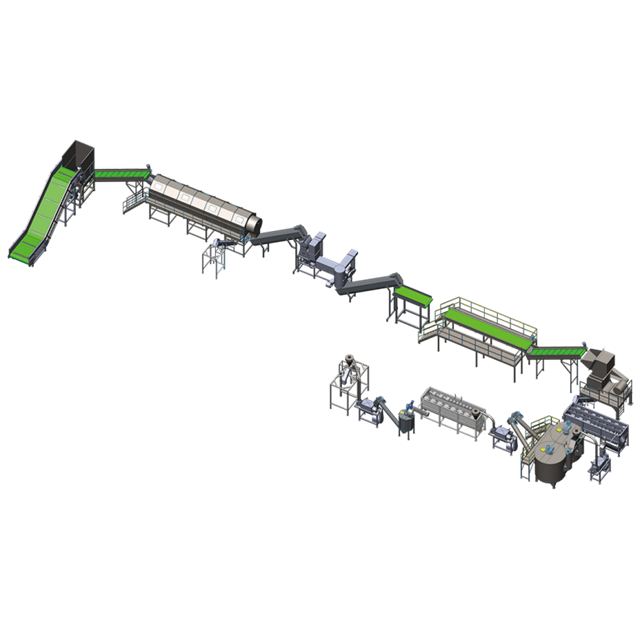
A complete plastic recycling machine for PET waste maps the operational flow from raw bale input to decontaminated flakes. Structuring the distinct stages ensures high-yield process continuity. Each module must integrate seamlessly to prevent material bottlenecks.
The pre-treatment phase prepares the material for aggressive size reduction. De-baler machines must break high-density bales without damaging the individual bottles. Trommel screens follow, sized specifically to remove loose dirt, rocks, and small debris. Mechanical label removers use friction to strip labels, but operators must balance de-labeling efficiency against acceptable bottle breakage rates.
Integrating a PET bottle pre-washing machine utilizes hot water and mechanical friction to clean whole bottles before crushing. This step softens glues and removes abrasive contaminants like sand and mud. Removing these abrasives early protects downstream cutting equipment from premature wear.
Size reduction transforms whole bottles into manageable flakes. A heavy-duty plastic bottle crusher is central to this stage. Wet crushing mechanics introduce water during granulation. This reduces friction, cools the blades, and performs an initial wash. Comparing staggered versus V-cut rotor designs helps determine the best approach for uniform 12-16mm flake generation. Screen sizing and maintenance accessibility are also vital. Hydraulic screen cradles allow for rapid maintenance and minimal downtime.
When configuring the crushing module, pay close attention to the rotor speed and blade metallurgy. High-carbon steel blades offer better wear resistance against abrasive PET materials. Maintaining a sharp cutting edge is critical to minimizing the generation of fines, which can clog downstream filtration systems and reduce overall yield.
Achieving high purity requires a specialized plastic washing line. Sink-float separation tanks utilize density separation mechanics. PET flakes sink, while PP/PE caps and residual label fragments float. Tank length and auger speed must be optimized for adequate retention time.
Hot friction washers play a critical role in thermal and chemical washing. Using caustic soda or detergents at 85°C to 90°C dissolves stubborn glues and organic residues. High-speed friction washers then apply mechanical scrubbing. Specific RPMs and screen mesh sizes ensure the removal of loosened contaminants and dirty water.
| Washing Stage | Operating Temperature | Primary Function | Key Contaminants Removed |
|---|---|---|---|
| Pre-Washing | 60°C - 70°C | Surface cleaning of whole bottles | Sand, mud, loose labels |
| Sink-Float Separation | Ambient | Density-based material separation | PP/PE caps, floating labels |
| Hot Friction Washing | 85°C - 90°C | Chemical and thermal scrubbing | Stubborn glues, oils, organic residue |
| Cold Rinsing | Ambient | Final chemical removal | Residual caustic soda, suspended dirt |
Moisture removal prepares the flakes for extrusion. Centrifugal dewatering machines use high rotor speeds to mechanically reduce moisture levels below 2%. Thermal drying systems then take over. Operators must weigh energy consumption trade-offs when using electric versus gas heaters to achieve the final moisture target. Finally, zig-zag classifiers utilize air separation technology. This removes residual dust, fines, and micro-labels before bagging or pelletizing.
Converting clean flakes into uniform pellets requires precise thermal management. Extrusion and filtration systems must handle the specific sensitivities of PET. Evaluating single-screw versus twin-screw extruders is necessary for optimal rPET melt processing. Vacuum degassing zones are essential to remove intrinsic moisture. This prevents hydrolytic degradation, which causes a drop in Intrinsic Viscosity (IV). Continuous melt filtration systems, such as laser filters or screen changers, handle microscopic impurities without halting production.
Partnering with a reliable plastic pelletizing machine manufacturer mitigates reprocessing risks. Vendor selection criteria should prioritize proven experience with PET's thermal behavior. Evaluate underwater versus strand pelletizing systems to ensure uniform pellet geometry. Always assess vendor guarantees regarding IV retention post-extrusion.
The extrusion process demands rigorous monitoring. Operators must track melt pressure and temperature across all heating zones. Sudden spikes in melt pressure often indicate a clogged filter screen, requiring immediate attention to prevent material degradation. Implementing automated screen changers can mitigate this issue by maintaining continuous flow during filter swaps.
Evaluating equipment requires looking beyond basic specifications to understand operational outcomes. Energy and utility consumption directly affect daily expenses. Calculate the kilowatt-hour per ton of processed material. Evaluate the efficiency of heat exchangers in the hot wash module to minimize thermal energy waste.
Automation reduces reliance on manual labor and improves consistency. Integrating centralized PLC systems with HMI touchscreens allows for real-time monitoring. Operators can track motor loads, temperatures, and water levels instantly.
Wear parts require continuous monitoring. Analyze the replacement frequency of crusher blades, friction washer screens, and extruder screws. Heavy-duty metallurgy extends maintenance intervals and keeps the line running smoothly.
| Technical Feature | Operational Outcome | Key Metric to Evaluate |
|---|---|---|
| Wet Crushing Rotor | Extended blade life and dust reduction | Hours of operation between blade sharpenings |
| Hot Friction Washer | Removal of stubborn glues and oils | Temperature stability at 85°C–90°C |
| Vacuum Degassing Extruder | Prevention of hydrolytic degradation | Intrinsic Viscosity (IV) retention rate |
| Centralized PLC System | Reduced labor and consistent throughput | Real-time motor load and fault detection |
Operating a high-capacity recycling line involves inherent risks. Contamination spikes, particularly from PVC and metal, can severely damage equipment. Mitigate this by integrating automated optical sorters and overband magnetic separators early in the line. These systems protect downstream equipment from catastrophic failure.
Wastewater compliance is another significant hurdle. Washing PET requires substantial water volumes. Budget for and configure a parallel water treatment plant. This system must filter, neutralize pH, and recirculate washing water to maintain environmental compliance and reduce utility draw.
Equipment bottlenecks occur when machine capacities are mismatched. Ensure volumetric matching between the crusher output, washing line retention capacity, and extruder feed rates. Proper synchronization prevents material bridging or starvation, ensuring a continuous operational flow.
A: Standard capacities typically start at 500kg/h for entry-level operations. High-volume industrial plants usually scale from 1000kg/h up to 3000kg/h or more, depending on the facility's footprint and target output.
A: Wet crushing provides continuous blade cooling, which extends blade lifespan. It significantly reduces dust and fines while initiating the washing process by removing loose dirt during granulation.
A: Pre-washing removes surface dirt, sand, and labels from whole bottles. This protects the crusher blades from abrasive wear, extending service life and reducing maintenance downtime.
A: It uses a sink-float tank mechanism based on specific gravity. PET has a density greater than 1.0 and sinks. PP/PE caps and light label fragments have a density below 1.0, causing them to float so they can be skimmed off.
A: The industry standard for PET flake size is 12-16mm. This size optimizes both the washing efficiency in friction washers and the feeding process into the extruder.
A: Water consumption varies by capacity and contamination levels. However, integrating a closed-loop water filtration system is critical to minimize fresh water intake, reduce operational costs, and meet environmental regulations.
A: Look for proven expertise in vacuum degassing and continuous melt filtration. The manufacturer must understand PET's thermal sensitivities and provide guarantees on preserving Intrinsic Viscosity during extrusion.


