
- All
- Product Name
- Product Keyword
- Product Model
- Product Summary
- Product Description
- Multi Field Search
 English


Views: 0 Author: Site Editor Publish Time: 2026-10-30 Origin: Site


The global demand for efficient plastic recycling and sustainable manufacturing is accelerating at an unprecedented rate. At the very heart of this industrial transformation lies the extrusion process. This critical mechanical operation dictates the quality, consistency, and financial viability of recycled polymer products. Plant managers and recycling facility operators constantly face a complex decision-making process when selecting the core equipment for their production lines. Selecting the wrong machinery does more than waste capital; it inevitably leads to severe operational bottlenecks and unacceptable downtime.
Recent market intelligence highlights a massive pivot in the global plastics sector. Driven by stricter environmental regulations and a relentless push for a circular economy, manufacturers are heavily investing in advanced recycling technologies. Specifically, the industry trend shows a sharp move away from overly complex, energy-draining setups for standard recycling tasks. Instead, facility operators now favor robust, streamlined single-screw systems. These modern machines guarantee massive throughput, lower carbon footprints, and simplified maintenance routines.
To make a truly informed purchasing decision, engineering teams must understand the foundational technology. This comprehensive guide explores the exact mechanics of this equipment, how it handles continuous operational stress, and why it remains the undisputed champion for standard recycling applications.
In the realm of polymer engineering, this equipment is a heavy-duty mechanical device built to convert solid plastic raw materials into a continuous, homogeneous molten profile. These raw materials typically include post-consumer flakes, industrial regrind, or virgin granules. Operating on a straightforward thermodynamic principle, the machine features an Archimedes-style screw rotating within a precisely machined, stationary heated barrel. As the heavy-duty motor turns the screw, it conveys the solid polymer forward. The material experiences intense mechanical shear friction combined with external thermal energy. This massive energy input forces the plastic to transition from a solid state into a viscous melt. Finally, the system pumps this melt under extreme pressure through a specialized die head.
Within any standard recycling facility, this equipment acts as the absolute core of the operation. Think of it as the central processing unit of a complete plastic pelletizing machine setup. When workers collect, wash, and shred post-consumer waste, the material remains in a fragmented state. You cannot feed these irregular flakes directly into an injection molding machine. The single screw system bridges this critical manufacturing gap. It melts the jagged flakes, filters out residual impurities via a hydraulic screen changer, and extrudes the clean polymer into uniform, continuous strands. Downstream equipment then cuts these strands into standardized pellets, successfully transforming raw waste back into a high-value industrial commodity.
Screw design is not just a uniform spiral. Metallurgical engineers strategically divide the internal screw into three distinct functional zones. Each specific segment performs a vital thermodynamic task during the melting process.
Mechanical shear generates a significant portion of the necessary melting energy. However, precise thermal management remains absolutely vital for quality control. Electrical heater bands wrap tightly along the barrel to establish specific temperature profiles across the different zones. In contrast, excessive shear friction can easily overheat and degrade heat-sensitive polymers. To combat this, engineers integrate closed-loop water cooling jackets or high-speed centrifugal fans into the barrel design. This dual heating and cooling capability ensures the polymer melt stays strictly within its optimal processing window.
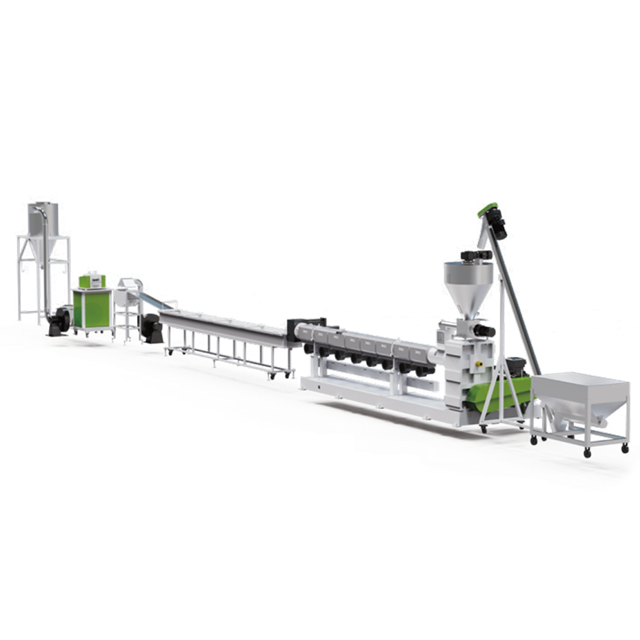
Continuous, profitable production relies entirely on the synchronized operation of several heavy-duty mechanical components. A failure in any of these parts will halt the entire line.
When allocating capital for new equipment, plant managers frequently face the decision between single and twin-screw technologies. Understanding their technical distinctions is crucial for optimizing your return on investment.
Twin-screw systems utilize two intermeshing screws rotating within a figure-eight-shaped barrel. They offer exceptional dispersive mixing capabilities. However, their complex mechanics inevitably lead to much higher initial costs, require specialized operator training, and demand highly expensive gearbox rebuilds.
In contrast, single screw systems operate on a reliable drag flow principle. They offer an unmatched cost-to-performance ratio, operational simplicity, and vastly lower replacement part costs. For standard plastic recycling facilities focused on processing washed flakes or uniform regrind, the single screw configuration is the undisputed champion.
| Feature | Single Screw Extruder | Twin Screw Extruder |
|---|---|---|
| Primary Mechanism | Drag flow and friction | Positive displacement and intermeshing shear |
| Initial Capital Cost | Low to Moderate | High to Very High |
| Maintenance & Wear | Simple maintenance, lower replacement costs | Complex gearbox maintenance, expensive screw rebuilds |
| Mixing Capability | Good distributive mixing, limited dispersive | Excellent dispersive and distributive mixing |
| Best Application | Standard recycling, pelletizing, pipe/profile extrusion | Color compounding, heavy filler addition, heat-sensitive PVC |
These machines are highly versatile. Engineers can tailor the specific screw geometry and barrel configuration to meet the exact thermodynamic demands of vastly different polymers.
One of the most common industrial applications is the processing of Polypropylene and Polyethylene. Facilities source these materials from rigid containers, detergent bottles, and injection-molded scraps. After washing and crushing, a dedicated PP PE Pelletizing Line takes over. These specific systems typically feature a Length-to-Diameter ratio between 30:1 and 36:1, perfectly optimized to handle polyolefin melting behavior. High-performance models can easily achieve stable throughputs ranging from 300 kg/h up to 1000 kg/h. The machine efficiently melts the rigid flakes, filters out residual dirt, and produces highly uniform pellets ready for injection molding.
Polyethylene Terephthalate presents unique processing challenges due to its highly hygroscopic nature. It absorbs moisture rapidly and is extremely susceptible to hydrolytic degradation during the melting phase. This degradation severely drops the Intrinsic Viscosity of the final product. To combat this, specialized equipment like a high-performance plastic granulation line engineered for PET incorporates advanced double-vacuum degassing zones. These high-suction zones aggressively extract moisture and volatile compounds directly from the melt, ensuring the recycled polymer maintains its structural and mechanical integrity.
To maintain a balanced engineering perspective, operators must evaluate both the strengths and inherent limitations of this machinery before finalizing a purchase order.
First and foremost, these machines deliver massive output rates designed for continuous, 24/7 high-volume production. Their relatively simple mechanical design keeps both initial capital expenditure and long-term operational costs remarkably low. With significantly fewer moving parts than twin-screw systems, they require far less specialized training for floor operators. Troubleshooting becomes a straightforward process. This simplified mechanics also results in less intense wear on the gearbox, leading to a much longer operational lifespan for core components.
Because they rely heavily on drag flow, these machines struggle with intensive dispersive mixing. They are not the right tool for compounding raw polymers with high volumes of liquid additives or heavy mineral fillers. Furthermore, they can face severe feeding constraints when dealing with highly moisture-laden or heavily contaminated materials, unless you pair them with specialized pre-conditioning equipment like an integrated cutter-compactor.
For procurement officers ready to invest, selecting the exact machine specifications is a critical decision. A poorly specified machine will inevitably lead to production bottlenecks, poor pellet quality, and frequent downtime.
An extruder represents a massive capital investment for any facility. Implementing a rigorous, uncompromising preventive maintenance schedule is the only way to protect this asset and ensure consistent output quality over years of harsh operation.
Ultimately, the single screw extruder stands as a highly reliable, cost-effective workhorse within the modern plastic recycling industry. By efficiently melting, mixing, and pumping polymer materials, it forms the very core of a highly profitable recycling operation.
Understanding the deep mechanical nuances, from specific screw geometry to thermal temperature profiles, empowers plant managers to make highly informed purchasing decisions. Upgrading your facility with the correct extrusion technology tailored exactly to your material types will ensure long-term profitability, slash your maintenance costs, and guarantee consistently premium pellet quality.
If your facility is experiencing bottlenecks or you are planning to expand your recycling capacity, selecting the right partner is crucial. Evaluate your current material streams, define your target throughput, and explore advanced, energy-efficient extrusion solutions designed specifically for heavy-duty industrial recycling.
For post-consumer recycling, engineers highly recommend an L/D ratio between 32:1 and 36:1. This extended barrel length provides the necessary residence time to thoroughly melt inconsistent flakes and allows enough physical space to incorporate dual vacuum degassing zones, which are critical for removing moisture and ink volatiles.
Power consumption varies heavily based on machine size and throughput. A mid-sized recycling line producing 500 kg/h typically requires a main drive motor between 132 kW and 160 kW, plus an additional 40 kW to 60 kW for barrel heating and downstream equipment. Modern systems utilize variable frequency drives to optimize this energy draw based on real-time load.
Yes, processing flexible plastic films is entirely possible. However, because light agricultural or packaging films possess a very low bulk density, they will bridge and block a standard gravity hopper. Processing films effectively requires a specialized cutter-compactor or agglomerator integrated directly into the feeding system. This heavy-duty pre-conditioning step increases the material density, ensuring a consistent, surge-free feed directly into the screw flights.
The operational lifespan depends entirely on the abrasiveness of your specific material stream and the metallurgical treatment of the steel components. Processing clean, standard polymers can easily yield a lifespan of 3 to 5 years. In contrast, if your material consistently contains abrasive contaminants like sand, metal dust, or glass fibers, even a premium bimetallic-coated screw may require professional refurbishment or total replacement within 12 to 18 months.
A single-stage system, utilizing one long extruder, is perfectly adequate for processing clean, dry, and relatively uniform industrial scraps. A double-stage system, often referred to as a mother-baby configuration, is highly recommended for heavily contaminated post-consumer waste. If your material contains high moisture levels, heavy ink prints, or significant solid impurities, the two-stage process provides a critical secondary filtration point and superior degassing capabilities, guaranteeing a defect-free final pellet.
Surging, or output instability, is a notorious operational issue frequently linked directly to the feed zone. It is typically caused by improper temperature settings at the feed throat causing premature material melting, inconsistent bulk density of the raw material, or a screw design fundamentally mismatched to your specific polymer's melting characteristics. Adjusting the feed throat water cooling and ensuring a highly consistent volumetric material feed rate usually resolves the pressure instability.


