- All
- Product Name
- Product Keyword
- Product Model
- Product Summary
- Product Description
- Multi Field Search
 English

Views: 0 Author: Site Editor Publish Time: 2026-09-15 Origin: Site


How can bulky rigid plastic waste become reusable material? It first needs proper size reduction and processing.
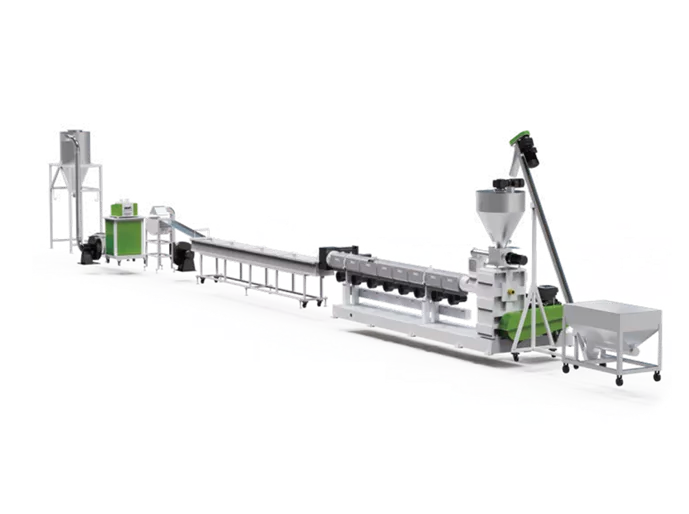
A rigid plastic pelletizing line converts prepared flakes and regrind into consistent recycled pellets.
This guide explains its process, feeding systems, main components, pelletizing methods, and equipment selection.
A rigid plastic pelletizing line is an extrusion-based recycling system. It processes prepared hard plastic flakes or regrind.
Its main purpose is straightforward. It converts irregular rigid waste into more consistent recycled pellets.
A typical system handles several connected processes:
Feeding → Melting → Plasticizing → Filtration → Degassing → Pelletizing → Cooling → Collection
Pelletizing usually follows earlier waste preparation. The exact preparation depends on feedstock cleanliness and material source.
A rigid plastic pelletizing machine uses heat and mechanical energy to melt prepared thermoplastic waste.
The screw transports material through the heated barrel. It compresses and plasticizes the material during this process.
The melt then passes through a filtration system. This stage removes many remaining solid contaminants.
Degassing may remove moisture or volatile substances. The filtered melt then reaches the pelletizing section.
The final result is recycled plastic pellets.
Many thermoplastics can enter a suitable pelletizing process.
Common materials include:
PP
HDPE
ABS
PS
PC
PA
PP and HDPE are common rigid recycling materials. They appear in containers, crates, buckets, and molded products.
ABS and PS often appear in appliance components. PC and PA may occur in engineering plastic applications.
PET and PVC require more careful process selection. Their thermal and moisture characteristics create different processing demands.
There is no universal setting for every polymer.
Temperature, screw geometry, drying, filtration, and cutting should match the actual material.
A rigid plastic recycling pelletizing line can handle many prepared waste forms.
Typical examples include:
Bottle flakes
Crushed containers
Plastic crates
Buckets
Pipe regrind
Injection molding scrap
Automotive plastic scraps
Appliance plastic regrind
Factory production waste
Large products normally require size reduction first.
A complete recycling process may therefore include shredding or crushing before pelletizing.
Plastic regrind is mechanically size-reduced plastic material.
It usually comes from rejected products, production scraps, or recovered plastic goods.
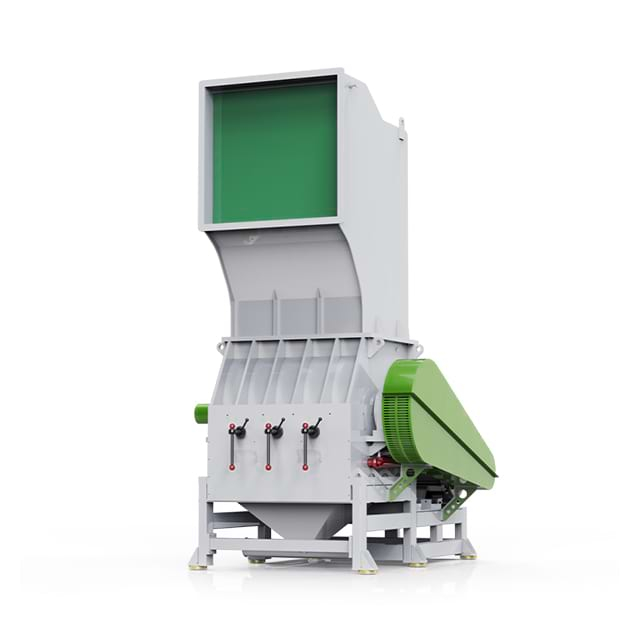
A crusher or granulator reduces larger pieces into smaller particles.
The basic route is:
Rigid product → Crushing → Regrind/flakes → Pelletizing → Recycled pellets
Regrind is easier to feed into an extruder than complete rigid products.
Consistent particle size also supports more stable material flow.
The final product is recycled plastic pellets.
Pellets provide a more standardized physical form than irregular flakes.
They are generally easier to:
Package
Store
Transport
Meter
Blend
Feed into downstream equipment
However, pelletizing does not automatically restore virgin material properties.
Final quality still depends on polymer purity and degradation. Moisture and contamination also remain important factors.
These processes serve different functions.
Process | Main Function |
|---|---|
Crushing | Reduces rigid waste into flakes or regrind |
Washing | Removes dirt and surface contamination |
Drying | Reduces moisture before extrusion |
Pelletizing | Melts and reforms plastic into pellets |
A complete rigid plastic recycling line may include every stage.
A pelletizing line mainly handles material after suitable preparation.
Rigid plastic and film behave differently during feeding.
Factor | Rigid Plastic | Plastic Film |
|---|---|---|
Feedstock | Flakes and regrind | Loose films and bags |
Bulk density | Generally higher | Generally lower |
Feeding behavior | More stable | More difficult |
Compaction | Often unnecessary | Often useful |
Typical feeding | Screw or force feeder | Cutter-compactor |
Main challenge | Sorting and contamination | Low bulk density and feeding |
Rigid flakes usually contain less trapped air.
They therefore tend to flow more consistently through suitable feeding equipment.
Note: Polymer type alone cannot determine machine configuration. Feedstock form and condition are equally important.
A rigid plastic pelletizing process usually begins before extrusion.
The material must first reach a suitable size and cleanliness.
The overall route can be summarized as:
Sorting → Crushing → Washing → Drying → Feeding → Extrusion → Filtration → Pelletizing
Large plastic products cannot normally enter the extruder directly.
They first pass through suitable size-reduction equipment.
Crushing converts products into manageable flakes or regrind. Washing may follow when contamination is present.
Drying then reduces excess moisture before extrusion.
Consistent preparation supports stable feeding and processing.
Prepared material enters the extrusion system.
Common feeding equipment includes:
Material hoppers
Screw feeders
Force feeders
Side force feeders
Rigid flakes often have higher bulk density than film.
This property can support more stable screw filling.
Some commercial rigid-flake systems use side force feeders. These feeders actively push prepared material toward the main extruder.
The screw rotates inside a heated barrel.
It moves the plastic forward while applying compression and shear.
Barrel heaters provide controlled thermal energy. Mechanical shear also contributes to melting.
The polymer gradually becomes a homogeneous melt.
Processing temperature must suit the polymer.
Excessive temperature can increase degradation. Insufficient heat can cause poor plasticization.
The molten polymer passes through a filtration system.
Filters remove many remaining solid impurities.
Vacuum degassing can remove moisture and volatile compounds. Its importance depends on the feedstock.
Commercial rigid-flake pelletizing equipment may combine degassing and repeated filtration. Such configurations target more demanding recycled materials.
After filtration, the process becomes:
Filtered melt → Die → Cooling → Cutting → Pellet collection
Tip: Ask suppliers whether quoted capacity was tested using your polymer and flake condition.
Feeding behavior is a major difference between these recycling applications.
Rigid flakes usually have higher apparent bulk density.
They also contain less trapped air than loose film.
Bulk density affects how much material enters the feeding system.
Loose film occupies substantial volume while providing limited mass.
Rigid flakes behave differently.
They generally settle more effectively inside the hopper.
The relationship can be simplified as:
Higher bulk density → Better hopper flow → More stable screw filling
Stable screw filling supports consistent extrusion.
However, rigid material is not automatically easy to process.
Particle geometry influences feeding behavior.
Problems can occur when flakes contain:
Oversized pieces
Very irregular shapes
Excessive fines
Sharp fragments
Mixed particle sizes
Oversized pieces may create bridging.
Too many fines can also change feeding behavior.
Consistent crushing therefore improves material preparation.
Crusher screen size should match the downstream pelletizing system.
Both feeding methods can process rigid materials.
Their suitability depends on material behavior.
Factor | Screw Feeding | Force Feeding |
|---|---|---|
Feedstock | Free-flowing flakes | Irregular regrind |
Feeding force | Moderate | Higher |
Main purpose | Controlled feeding | Active feeding |
Typical use | Consistent flakes | Difficult-flow scraps |
A side force feeder can improve material delivery when gravity feeding becomes unstable.
Tip: Give suppliers the actual flake dimensions and bulk density before selecting the feeding system.
A complete line contains several coordinated modules.
Each module affects production stability.
The feeding section delivers prepared material to the extruder.
It may include:
Storage hopper
Screw feeder
Force feeder
Side feeder
Metal separator
Stable feeding supports consistent extruder loading.
Metal separation may also protect downstream components from unwanted metallic contamination.
The extruder is the core processing unit.
Important parameters include:
Screw diameter
L/D ratio
Screw speed
Motor power
Heating zones
Cooling design
Temperature control
Larger screw diameter can support higher throughput.
However, screw size alone cannot predict real production.
Feedstock properties and feeder performance also affect output.
Recycled rigid plastic can contain residual contamination.
A screen changer filters the polymer melt.
Melt pressure monitoring helps operators track filter loading.
Vacuum degassing can remove unwanted moisture and volatile materials.
Post-consumer feedstock may require more demanding filtration than clean factory scrap.
The downstream section converts filtered melt into pellets.
It may contain:
Extrusion die
Pellet cutter
Cooling system
Dewatering equipment
Pellet dryer
Conveyor
Storage silo
PLC controls
These systems must operate together.
Poor downstream control can interrupt otherwise stable extrusion.
Note: A larger motor does not automatically mean higher usable output. Feeding, filtration, and cutting can become production bottlenecks.
The cutting method depends on polymer behavior and production requirements.
Strand and water-ring systems are common options.
Strand pelletizing follows a simple sequence:
Melt extrusion → Strand formation → Water cooling → Cutting → Collection
The polymer exits through multiple die holes.
Continuous strands then enter a cooling section.
After cooling, a cutter converts them into pellets.
This process is straightforward and widely applicable to suitable thermoplastics.
A water-ring system cuts the polymer close to the die face.
Rotating blades form pellets as the melt exits.
Water then cools and transports the pellets.
This arrangement avoids long strand handling.
It can also create a more compact production layout.
However, material behavior must suit the cutting method.
Factor | Strand Pelletizing | Water-Ring Pelletizing |
|---|---|---|
Cutting point | After strand cooling | Near die face |
Layout | Longer | More compact |
Strand handling | Required | Not required |
Operation | Straightforward | More integrated |
Main selection factor | Polymer and output | Melt behavior and output |
Neither method is universally better.
Machine suppliers should evaluate the polymer before recommending one.
Tip: Ask for pellet samples produced by both methods when your material can use either configuration.
Pelletizing gives prepared rigid waste a more standardized form.
It also provides additional melt processing.
Crushed waste can become secondary manufacturing feedstock.
This supports mechanical recycling.
For example:
Rejected PP parts → Crushing → Pelletizing → Recycled PP pellets
The pellets may then enter suitable downstream production.
Their final use depends on material quality and product requirements.
Regrind has irregular shapes and particle sizes.
Pellets offer a more consistent physical form.
They are easier to package and transport.
They can also improve dosing and downstream feeding.
This matters in continuous manufacturing environments.
Pelletizing does more than reshape plastic.
The extrusion process melts and homogenizes the material.
Filtration removes many solid contaminants.
Degassing can remove moisture and volatile components when needed.
These processes can improve recycled feedstock consistency.
They cannot reverse every form of polymer degradation.
Manufacturers can also pelletize clean production waste.
For example:
Injection scrap → Crushing → Pelletizing → Recycled feedstock
Another example is:
Pipe scrap → Crushing → Pelletizing → Secondary pellets
This approach can reduce material waste.
However, actual reuse ratios depend on product specifications.
Note: Recycled pellets should be evaluated against downstream processing requirements, not only visual appearance.
A machine should be selected around the feedstock.
Starting from machine size can lead to poor decisions.
Before contacting suppliers, define:
Polymer type
Flake dimensions
Regrind shape
Waste source
Moisture
Contamination
Fillers
Additives
Also identify whether the material is post-industrial or post-consumer.
Clean factory scrap often requires less intensive preparation.
Post-consumer waste can create greater filtration demands.
Different rigid materials behave differently.
HDPE bottle flakes do not behave exactly like ABS appliance regrind.
Filled PP can also create different processing conditions.
The feeder should match material flow.
The screw should match polymer properties and processing goals.
Do not assume one configuration works equally well for every rigid polymer.
Capacity is usually stated in kilograms per hour.
Commercial rigid-flake systems can span broad output ranges.
For example, one referenced product family lists approximately 150–1,000 kg/h across different screw configurations. This figure is supplier-reported and should be verified under the buyer's actual material.
Ask these questions before comparing capacity:
Which polymer was tested?
What was the flake size?
Was it washed and dried?
What was its contamination level?
Was production measured continuously?
Two machines cannot be compared fairly under different feedstocks.
Review the entire configuration.
Important items include:
Filter design
Screen-changing method
Vacuum degassing
Pelletizing method
Cooling system
Pellet drying
PLC control
Maintenance access
Also ask how often screens require replacement under your material.
Tip: Compare guaranteed performance under defined feedstock conditions instead of advertised maximum kg/h.
A quotation provides specifications.
A material test provides stronger purchasing evidence.
Send representative flakes or regrind whenever possible.
Do not send only your cleanest sample.
The test material should represent normal production conditions.
Evaluate:
Feeding stability
Actual throughput
Melt pressure
Filter-change frequency
Pellet consistency
Continuous operation
Longer tests can reveal issues missed during short demonstrations.
Pellet appearance alone provides limited information.
A smooth pellet may still contain unsuitable contamination.
Evaluate:
Pellet size consistency
Moisture
Remaining contamination
Melt processing behavior
Downstream processability
Where relevant, test properties required by your downstream product.
Operating cost continues after installation.
Review components such as:
Screw
Barrel
Cutting blades
Filter screens
Heaters
Motor
Gearbox
Also inspect maintenance access.
Filled or abrasive regrind can increase component wear.
Ask suppliers about recommended inspection intervals and spare parts.
Confirm exactly what the quotation includes.
Important services can include:
Installation
Commissioning
Operator training
Spare parts
Remote support
Technical service
Machine customization
Also determine whether the quotation covers only pelletizing equipment.
A complete rigid plastic recycling line may require crushing, washing, drying, and material handling equipment.
Tip: Put feedstock specifications, target output, pellet requirements, and service scope into the purchase contract.
A rigid plastic pelletizing line converts prepared flakes and regrind into reusable pellets. Stable feeding, filtration, and controlled pelletizing help improve processing consistency.
JWELL provides rigid plastic pelletizing solutions for different recycling needs. Its configurable systems support efficient processing, stable pellet production, and practical technical service.
A: A rigid plastic pelletizing line converts prepared plastic flakes and regrind into reusable pellets.
A: A rigid plastic pelletizing line uses feeding, extrusion, filtration, degassing, cooling, and pellet cutting.
A: A rigid plastic pelletizing line improves material consistency, handling, feeding, and recycling efficiency.
A: Rigid plastic pelletizing line prices depend on capacity, feeding, filtration, automation, and pelletizing methods.
A: A rigid plastic pelletizer handles dense flakes, while film systems often require specialized compaction.
A: Irregular plastic regrind size, unstable feeding, contamination, or filter blockage can cause output fluctuations.