
- All
- Product Name
- Product Keyword
- Product Model
- Product Summary
- Product Description
- Multi Field Search
 English


Look around the factory floor. Everyday items, from the durable pipes inside your walls to the recycled containers sitting in your refrigerator, begin their manufacturing life through a single, powerful process. That process is extrusion. If you are wondering what this term actually means in a modern context, you are looking at the beating heart of industrial polymer processing.
While these complex machines shape everything from breakfast cereals to aluminum window frames, their most vital and transformative role today lies in plastics recycling. In this technical guide, we will explore the core mechanics of extrusion. We will break down how these robust vessels operate from an engineering perspective. Furthermore, we will examine how they serve as the central engine for advanced recycling facilities, turning mountains of scrap into high-value raw materials.
To fully grasp the manufacturing landscape, we must first define the terminology. The word originates from the Latin term extrudere, which translates to thrust out or push out. In its most basic mechanical sense, the equipment shapes material by forcing it through a specially designed opening known as a die. The geometry of this die dictates the final profile of the output.
However, when addressing this concept within an industrial recycling context, the definition expands significantly. Industrially, it is a heavy-duty piece of equipment utilizing a precise combination of thermal energy and mechanical pressure. It melts, homogenizes, and pumps raw polymers in a continuous flow. Material is constantly fed into one end, undergoes a complete phase change, and emerges as a reshaped product from the other.
Looking at current industry trends, market analysts note a massive shift in extrusion technology. Driven by global sustainability mandates and the aggressive push for a circular economy, modern facilities are no longer relying on basic melting pots. The industry is rapidly moving toward highly calibrated, data-driven processing units. Today's advanced systems must handle complex, mixed-waste streams and heavily contaminated post-consumer plastics that legacy models simply could not process. This shift demands superior degassing capabilities, higher torque capacities, and intelligent automation to maintain profitability.
The operation relies on precise thermodynamic and mechanical engineering. Because the process is continuous, it requires strict control over temperature, pressure, and motor speed to ensure a uniform melt. The core mechanics operate through three distinct phases.
The journey begins at the feeding phase. Picture a massive funnel-like hopper located at the rear of the machine. Jagged, dusty flakes of scrap plastic are dumped here. Gravity pulls this chaotic mix down into the feed throat, often assisted by a mechanical force-feeder. The raw material meets the rotating screw. The deep hum of the heavy-duty gearbox signals the start of the transformation.
Once inside the heated cylindrical barrel, the material enters the melting and conveying phase. The screw is the absolute most critical component here. It is typically divided into three geometric zones. First, the deep flights of the feed zone grab the solid material and pull it forward. Next, in the compression zone, the depth of the screw threads gradually decreases. This reduction in volume squeezes the plastic tightly.
The intense mechanical friction generated by the plastic rubbing against the barrel walls is known as shear heat. This friction actually provides the majority of the thermal energy needed to melt the polymer. External ceramic heater bands merely provide supplementary temperature control. Finally, the metering zone acts as a pump. It homogenizes the viscous molten plastic and builds the necessary pressure.
In the final extruding phase, the highly pressurized melt is forced through a breaker plate housing filtration screens. It is then pushed through the die. This continuous mechanical flow is precisely what makes the process highly efficient for mass production.
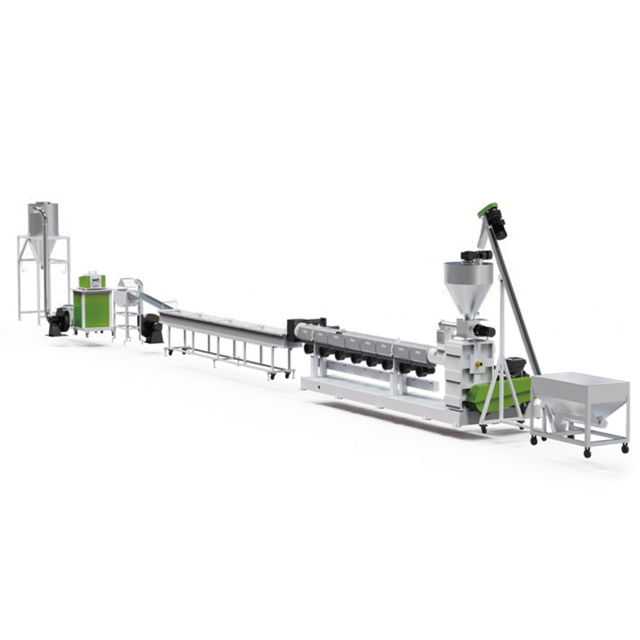
While a standalone unit can produce finished goods like PVC pipes, its function in the recycling sector takes on a different character. Here, it acts as the central engine driving a complete plastic pelletizing machine.
Pelletizing is the industrial process of converting irregular scraps, flakes, or crushed films into small, uniform granules. These pellets are the standard raw material format required by plastic manufacturers worldwide. Without them, feeding injection molding machines to create new products would be impossible.
The workflow of this system is a marvel of synchronized engineering. After the polymer is melted and filtered, the clean material is pushed through a die head featuring multiple small holes. The molten plastic emerges as continuous, glowing strands. These blazing hot threads are immediately dragged through a long, churning water bath. You can hear the water hissing as it rapidly drops their temperature, solidifying the plastic in seconds. Finally, the cooled strands are pulled into a high-speed rotary cutter. This device chops them cleanly into uniform pellets typically measuring 2mm to 4mm in length, ready for drying and storage.
When evaluating technology for a recycling facility, understanding the different mechanical configurations is essential. The design of the screw directly dictates the processing capabilities of the entire line. To clarify the engineering differences, refer to the comparison below.
| Feature | Single-Stage System | Double-Stage System |
|---|---|---|
| Best Material Fit | Clean, dry, post-industrial scrap | Washed, wet, printed post-consumer waste |
| Mechanical Layout | One main extruder (L/D ratio typically 32:1 to 36:1) | Primary extruder connected to a secondary smaller unit |
| Filtration Capability | Single pass filtration | Dual pass filtration for heavy contamination |
| Degassing Efficiency | Standard single vacuum zone | Deep vacuum degassing across two stages |
Single-screw setups remain the industry standard for processing clean and predictable materials. Thanks to their straightforward mechanical design, they are highly cost-effective and easier to maintain. In stark contrast, post-consumer recycling deals with materials contaminated by moisture and printing inks. In these demanding scenarios, a pelletizing system for rigid plastic utilizing a double-stage configuration is deployed. The first stage performs coarse filtration and heavy melting, while the second stage operates at a lower temperature to stabilize the melt and execute deep vacuum degassing.
To fully grasp the industrial application, we must examine specialized configurations based on material physics. Processing hard, bulky materials presents unique mechanical challenges. Items such as crushed shampoo bottles, detergent containers, heavy industrial pipes, and battery cases require immense torque.
Standard units designed for uniform virgin resins often struggle with the variable bulk density of recycled rigid flakes. Crushing and melting these heavy-duty plastics places extreme mechanical stress on the equipment. A standard machine would quickly choke on these irregular shards. Therefore, processing these hard materials requires a specifically engineered Rigid Plastic Pelletizing Line.
A dedicated rigid line incorporates several critical engineering adaptations. First, the screw geometry is optimized for high shear and deep melting. It is manufactured from highly wear-resistant bimetallic alloys to withstand the abrasive nature of rigid flakes that often carry residual dirt. Second, the gearboxes must be exceptionally heavy-duty. Melting high-density polymers like HDPE requires massive torque. The gearbox must handle high thrust loads without overheating during continuous operation. Additionally, force-feeders cram the hard flakes into the screw, preventing material bridging and ensuring a consistent fill rate.
For plant managers and investors, selecting the correct machinery is a critical capital expenditure decision. The operational cost and final product quality depend entirely on matching the equipment specifications to the reality of your raw material supply chain. Buyers should conduct a systematic assessment based on three primary criteria.
First, assess your material condition. The contamination level and moisture content dictate the required complexity. If your facility processes clean rigid scrap with zero moisture, a single-stage unit is the most economical choice. Conversely, if your business model relies on washed waste that retains moisture, a double-stage system is mathematically necessary to achieve the required degassing levels.
Second, determine your output capacity needs. Industrial facilities must calculate their expected monthly throughput to avoid rapid equipment wear from under-sizing or wasted energy from over-sizing. For instance, high-performance series equipment offers varying configurations. A 90mm screw diameter might yield 200 to 300 kilograms per hour. Meanwhile, a large-scale operation requiring 1000 kilograms per hour will necessitate a 150mm or 160mm screw coupled with a proportionally larger motor.
Finally, evaluate filtration technology. High-quality pellets command premium market prices. To achieve top-tier output, the system must feature advanced non-stop hydraulic screen changers. This allows operators to replace clogged filter screens without halting production. Insufficient degassing leaves trapped moisture, leading to porous and brittle pellets that downstream manufacturers will reject.
Relying on legacy equipment can severely bottleneck a recycling facility's profitability. Advancements in polymer engineering and machine automation have made modern units significantly more capable than models produced just a decade ago. Upgrading brings immediate commercial value.
Modern screw designs provide superior mixing and thermal distribution. This prevents the plastic from degrading or yellowing due to uneven heat. The result is uniform, dense, and visually clean pellets with a stable Melt Flow Index. In the commodities market, this consistency directly translates to higher selling prices per metric ton.
Beyond product quality, energy consumption constitutes a major portion of operating costs. Contemporary systems integrate advanced technologies such as infrared barrel heating and permanent magnet synchronous motors. Replacing outdated DC motors with modern Variable Frequency Drive controlled systems can slash electricity consumption by up to 25 percent.
Automation is another transformative benefit. Facilities are rapidly ditching manual controls in favor of smart lines governed by Programmable Logic Controllers. These systems monitor melt pressure, barrel temperatures, and motor loads in real-time. This dramatically reduces the reliance on highly skilled manual labor, minimizes the risk of human error, and allows a single technician to oversee multiple production lines.
Understanding the core mechanics of extrusion is the first step toward mastering the modern manufacturing and recycling landscape. Far from being simple melting pots, these sophisticated machines utilize precise thermodynamic engineering to reshape waste into highly valuable materials.
As the global push for a circular economy intensifies, the efficiency of your business depends entirely on the quality of your machinery. Upgrading your equipment improves pellet quality, maximizes energy efficiency, and dramatically reduces labor costs through smart automation. Ready to optimize your production? Evaluate your raw material stream and explore high-performance, customized extrusion solutions tailored to your capacity needs at Jwell Recycling to ensure long-term profitability.
Modern industrial systems are highly versatile but are typically engineered for specific polymer families. Common materials include Polyethylene like HDPE and LDPE, Polypropylene, PET, PVC, and Polystyrene. Advanced setups can also be configured to handle engineered plastics like ABS and PC, provided the screw geometry and heating profiles are customized for those specific melting points.
Vacuum degassing physically extracts trapped moisture, volatile gases, and ink residues from the molten polymer before it reaches the die head. Without this crucial step, gases remain trapped inside the plastic, resulting in hollow, brittle, or foaming pellets. Proper degassing ensures the final granules are dense, structurally sound, and ready for high-end injection molding.
In simple terms, it is an industrial machine that uses a rotating screw inside a heated barrel to melt raw materials and force them through a shaped die to create a continuous new form. This form is subsequently cooled and cut into usable fragments.
The core unit is the specific component responsible for the melting, mixing, and pushing of the polymer. A complete pelletizing line refers to the entire integrated production system. This includes the feeding mechanism, the melting unit itself, the cooling infrastructure like a water bath, and the rotary cutting equipment that chops the plastic into uniform granules.
While highly versatile machines exist, it is standard engineering practice to use dedicated systems. Rigid plastics have a high bulk density and require strong mechanical feeding and high shear. Flexible plastics, like thin films or bags, are light and fluffy, usually requiring a built-in compactor before entering the barrel. Mixing these inputs in a single standard machine often leads to inconsistent feeding and poor output quality.
A two-stage system connects a primary melting unit to a secondary, smaller unit. This design is engineered specifically for processing heavily contaminated or wet post-consumer waste. The first stage performs the heavy melting and initial coarse filtration. The material then transfers to the second stage, which operates at a slightly lower temperature to allow for finer filtration and highly effective vacuum degassing.


