
- All
- Product Name
- Product Keyword
- Product Model
- Product Summary
- Product Description
- Multi Field Search
 English


Views: 0 Author: Site Editor Publish Time: 2026-10-26 Origin: Site


Ever stare at a mountain of post-consumer plastic scrap and wonder how it actually becomes valuable resin again? The extrusion process is the unsung hero of the modern plastics and recycling industry. Whether a facility is manufacturing continuous PVC pipes or giving washed HDPE flakes a second life, this heavy-duty machinery sits at the very heart of the operation.
Yet, the internal mechanics often seem like a black box to those outside the engineering department. How exactly does raw solid plastic transform into a continuous uniform product or perfectly shaped pellets? Plant managers, B2B buyers, and recycling entrepreneurs need clear objective data to make smart equipment choices. In this engineering deep dive, we will break down the thermodynamics and mechanical shear principles of plastic extrusion. We will strip away the jargon and look at the exact industrial systems that power modern profitable recycling facilities.
To grasp the reality of industrial manufacturing, one must first understand the primary machinery. Think of an extruder as a highly advanced heavy-duty pump for thermoplastics. Its primary function is to convert solid raw plastic into a uniform continuously flowing melt. This molten polymer is then forced under immense pressure through a machined tool called a die. The die acts as the final mold giving the plastic its continuous structural shape.
To comprehend the complex thermodynamics at play, we need to examine the essential components of the system.
The hopper serves as the entry point. It is a funnel-like receptacle where raw material is loaded before gravity or a forced-feeding mechanism introduces it into the barrel. The barrel itself is a thick hardened bimetallic steel cylinder housing the screw. It is wrapped in multiple electrical heater bands. These bands provide the initial thermal energy required to soften the plastic upon startup.
Arguably the most critical component is the screw. This precisely machined helical shaft dictates the entire process. As it rotates, its specific geometric flight design conveys, compresses, melts, and mixes the polymer. Driving this massive steel shaft is the motor and gearbox assembly. These heavy-duty components provide the immense torque and rotational speed control required to push against the extreme backpressure of molten plastic.
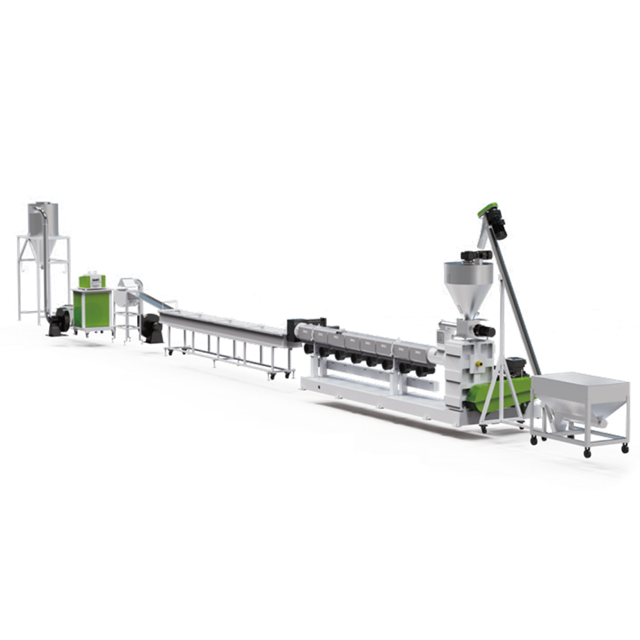
Following the journey of the plastic from start to finish reveals a delicate continuous balance of temperature, pressure, and mechanical shear. It is never just about applying heat.
The extrusion process begins at the hopper. Solid plastic flakes or virgin pellets drop into the feed throat and enter the rotating flights of the screw. For materials with low bulk density like fluffy plastic film or bulky rigid flakes, standard gravity feeding often fails. In these scenarios, a vertical force-feeder physically crams the material into the barrel. This prevents bridging blockages and ensures a highly consistent throughput.
Once inside the barrel, the rotating screw pushes the plastic forward through the feed zone. As the material progresses into the transition zone, the root diameter of the screw gradually increases. This geometric change reduces the available space for the plastic and creates intense compression.
A common engineering misconception is that external barrel heaters melt the plastic entirely. In reality, mechanical friction drives the vast majority of the melting process. Known in fluid dynamics as viscous dissipation or shear heat, this energy generates rapidly as the plastic is aggressively squeezed between the rotating screw and the stationary barrel wall. The electric heaters primarily serve to bring the machine up to temperature during startup and maintain a stable thermal profile across different zones.
As the plastic enters the compression zone, it transitions from a solid bed of friction-heated particles into a homogenous melt. Proper mixing ensures uniform color distribution and structural integrity.
During this stage, degassing becomes an absolute necessity for post-consumer materials. Imagine processing washed detergent bottles. Residual moisture and volatile organic compounds from inks expand rapidly when exposed to extreme heat. Modern extruders feature specialized venting zones utilizing liquid-ring vacuum pumps. These pumps aggressively extract trapped gases through a port in the barrel. Failure to remove these volatiles results in microscopic voids in the final product, which severely compromises its mechanical tensile strength.
The final section of the screw is the metering zone. Here, the channel depth remains constant to stabilize the internal pressure and guarantee a uniform output rate. Before reaching the die, the molten plastic is forced through a hydraulic screen changer. This robust filtration system captures unmelted particles, microscopic metal fragments, and residual dirt. Finally, the clean pressurized melt pushes through the die and takes on its new continuous shape.
Choosing between a single and twin-screw setup depends entirely on your feedstock and desired output. Neither is inherently superior without context. Each serves highly specific industrial applications.
The single-screw design operates on a straightforward principle utilizing one rotating shaft. It is highly cost-effective, easy to maintain, and exceptionally efficient at pumping clean uniform materials. This makes it the standard choice for pipe profile manufacturing and basic recycling operations.
In contrast, a twin-screw machine features two interlocking screws rotating together within a figure-eight-shaped barrel. Because the screws intermesh, they are largely self-cleaning. Twin-screw machines offer massive shear force, superior additive compounding, and excellent devolatilization. They are the go-to solution for processing heavily contaminated materials or producing high-end color masterbatches.
| Specification | Single Screw Extruder | Twin Screw Extruder |
|---|---|---|
| Primary Function | Melting, conveying, and pressure building | Intense mixing, compounding, and degassing |
| Shear Force | Low to Medium | Extremely High |
| Maintenance Cost | Low straightforward part replacement | High requires precise alignment |
| Best Used For | Standard recycling, pipe, blown film | Masterbatch, complex PCR polymers |
While extruders are famous for creating continuous profiles like window frames, they serve a slightly different purpose in the recycling sector. Instead of forming a final consumer product, the machine acts as the core engine of a robust plastic pelletizing machine.
In this specific application, the die at the discharge end is a thick steel plate populated with multiple small orifices. The system pushes the homogenized plastic melt through these holes to create forms that can be easily cut into uniform granules. These standardized pellets become the raw material for injection molding facilities worldwide.
The method of cutting the molten plastic generally falls into two distinct engineering categories. Strand pelletizing pulls continuous spaghetti-like polymer strands through a long water cooling bath before a rotary cutter chops them into precise cylinders. This method is highly reliable for high-melt-strength materials like PET. Alternatively, water-ring die-face pelletizing utilizes high-speed rotating blades flush against the die plate. The blades instantly slice the extruded melt into small droplets. Centrifugal force flings these droplets into a circulating ring of water to cool them into spherical pellets. This method is exceptionally space-efficient for PE and PP resins.
Analyzing recent market data reveals a massive shift in the recycling landscape. Global sustainability mandates are forcing major consumer brands to incorporate 20% to 30% recycled content into new packaging. This regulatory shift drastically changes the requirements for extrusion equipment.
Processors are no longer dealing with clean predictable industrial scrap. Today's post-consumer resin feedstock is highly contaminated. Plant operators face unpredictable melt flow indices, severe moisture variations, and mixed polymer batches. Consequently, the demand for advanced devolatilization and multi-stage filtration has skyrocketed. To process these complex materials profitably, operations now rely on a specialized Rigid Plastic Pelletizing Line.
For hard plastics like HDPE detergent bottles or ABS electronic waste, the extrusion phase must account for heavy microscopic impurities.
A single-stage setup utilizes one long barrel with multiple degassing zones. It is suitable only for rigid flakes that have been exceptionally well-washed and thoroughly dried. However, industry standards heavily favor a double-stage mother-baby setup for challenging post-consumer rigids.
In a double-stage architecture, the primary mother extruder operates at a high temperature and high torque to melt the rough flakes. It performs the initial heavy-duty screen filtration and primary degassing. The hot melt then transfers directly into a secondary baby extruder. Operating at a lower speed and reduced temperature, this second machine allows for ultra-fine melt filtration and deeper vacuum degassing. This dual-step process guarantees that even heavily contaminated inputs yield premium bubble-free pellets.
Building a highly efficient Pelletizing system for rigid plastic requires integrating several specialized peripheral modules around the core extruder. Each component mitigates a specific process variable.
Rigid plastic flakes often suffer from inconsistent bulk densities. Standard gravity feeding leads to uneven output. Advanced volumetric or gravimetric force feeders equipped with internal agitators ensure a constant metered flow of material into the screw. This maximizes throughput stability and prevents motor amperage spikes.
Because post-consumer flakes inevitably contain trace amounts of foreign matter like aluminum foil or microscopic sand, robust melt filtration is non-negotiable. Continuous dual-piston hydraulic screen changers allow operators to swap out clogged filter meshes without stopping the production line. Advanced models feature hydraulic backflush technology to clean screens automatically. This drastically reduces costly operational downtime.
Once the pellets are cut and cooled, they must be completely dried. Residual surface moisture causes major defects during later injection molding. High-speed centrifugal dryers use intense airflow to strip away water droplets before the dry pellets are pneumatically conveyed to storage silos.
Investing in an extrusion line is a massive capital expenditure. Plant managers must evaluate machinery based on objective performance metrics rather than superficial marketing features.
First, evaluate production capacity versus screw diameter. The output is largely dictated by the screw diameter and its Length to Diameter ratio. A standard 120mm single-screw machine might yield 500 kg/h, whereas a robust 160mm screw can exceed 1000 kg/h. You must perfectly match the extruder's specifications to your upstream washing line capabilities. Over-sizing leads to material degradation due to excessive residence time. Under-sizing bottlenecks your entire plant's profitability.
Furthermore, scrutinize the energy efficiency. Electricity is the highest ongoing operational cost in plastic recycling. Demand the Specific Energy Consumption metrics from the manufacturer measured in kWh/kg. Look for equipment featuring permanent magnet synchronous motors and advanced ceramic barrel insulation covers to minimize thermal loss.
Finally, insist on customized screw geometry. Plastics behave vastly differently under heat and pressure. The screw profile required for high-melt-flow PP will fail if used for low-melt-flow HDPE. Ensure the manufacturer engineers custom barrier flights or Maddock mixers tailored strictly to your specific feedstock.
Understanding the mechanical and thermal principles of extrusion is vital for anyone scaling a plastics manufacturing or recycling operation. It is the transformative engine that turns solid waste into workable profitable materials. By perfectly balancing shear friction, vacuum degassing, and precise filtration, modern extruders drive the circular economy forward.
Whether you are processing clean industrial scrap or tackling highly contaminated post-consumer rigid plastics, deploying the correct extrusion architecture is the only way to maximize operational efficiency. Stop losing money on excessive energy bills and frequent maintenance downtime. Investing in high-quality customized machinery ensures your output meets the strictest global market standards.
Are you ready to upgrade your facility's throughput and pellet quality? Evaluate your current feedstock, determine your target capacity, and integrate a commercial-grade pelletizing line engineered for your exact operational needs.
The L/D ratio stands for Length to Diameter ratio. It represents the flighted length of the screw divided by its outside diameter. A higher L/D ratio like 36:1 provides a longer residence time for the plastic inside the barrel. This allows for better melting, superior mixing of additives, and more space for multiple vacuum degassing ports. Lower L/D ratios like 24:1 are typically used for clean easily melted polymers where excessive heat history could cause degradation.
Cleaning an extruder screw requires a specific procedure to prevent contamination between different polymer batches. Operators typically run a commercial purging compound through the machine. Purging compounds are highly viscous heat-stable resins designed to scrub carbonized plastic and colorants from the screw flights and barrel walls. For a deep mechanical clean, engineers must pull the screw out of the barrel entirely while it is still hot and manually clean the flights using brass wire brushes and specialized copper mesh pads.
Temperatures inside the barrel vary heavily depending on the specific polymer being processed. Generally, the temperature profile ranges from 150°C to 300°C. It is critical to note that this heat is not solely provided by the external electrical heater bands. A significant portion of the thermal energy generates internally through the mechanical friction and shear forces created as the rotating screw compresses the plastic.
The primary difference lies in the continuity of the process. Extrusion is a continuous steady-state process that forces molten plastic through an open die to create long uniform shapes like pipes, sheets, or strands. Injection molding is a cyclical start-and-stop process. It injects molten plastic under extreme pressure into a closed three-dimensional steel mold to create individual discrete parts like bottle caps or automotive dashboard components.
Post-consumer rigid plastics retain microscopic levels of moisture and volatile organic compounds from inks and labels even after rigorous washing. When the plastic melts, these substances vaporize into expanding gases. If the extruder lacks a proper liquid-ring vacuum degassing zone to vent these gases, the vapor remains trapped inside the molten polymer. This results in the formation of air bubbles inside the final pellets, rendering them structurally weak and unmarketable to high-end injection molders.


