
- All
- Product Name
- Product Keyword
- Product Model
- Product Summary
- Product Description
- Multi Field Search
 English


Views: 0 Author: Site Editor Publish Time: 2026-10-23 Origin: Site


Walk onto any modern recycling plant floor, and you will immediately hear the steady hum of plastic extrusion. It serves as the foundational driving force behind industrial recycling worldwide. Yet, many plant operators and facility managers still struggle to fully grasp the complex internal mechanics of these machines. This knowledge gap often makes choosing the right machinery for specific polymer streams a daunting and expensive task.
If you are wondering how the extrusion process actually transforms rigid scraps into valuable resources, you need to look beyond the basic textbook definitions. This comprehensive guide breaks down the entire journey from raw material intake to the finished product from an engineer's perspective. Ultimately, mastering these thermodynamic principles is absolutely crucial when investing in specialized equipment to scale your operations.
Fundamentally, plastic extrusion is a high-volume continuous manufacturing process. It is explicitly designed to process raw thermoplastic materials like rigid flakes, crushed pellets, or regrind. The machine melts these solids and forms a continuous profile. Unlike injection molding, which creates discrete individual parts by forcing molten resin into a closed cavity, extrusion produces continuous lengths of material with a consistent cross-section. Think of it as an endless ribbon of molten plastic.
Every extrusion engineer chases one primary goal: achieving a perfectly homogeneous melt. The polymer must reach a uniform consistency and temperature profile throughout the entire mass. If the internal barrel temperature remains too low, un-melted particles will cause severe structural weaknesses in the final product. Conversely, if the heat is excessive, the polymer chains will degrade. This inevitably leads to brittle plastics and a catastrophic loss of mechanical properties.
In the context of industrial recycling, the extruder acts as the central processing unit. It is not merely used for creating PVC pipes or window profiles. It is the beating heart inside advanced recycling machinery. By melting down rigid plastic scraps and systematically filtering out impurities, the extruder prepares the molten polymer for the final stage of the circular recycling loop: pelletization.
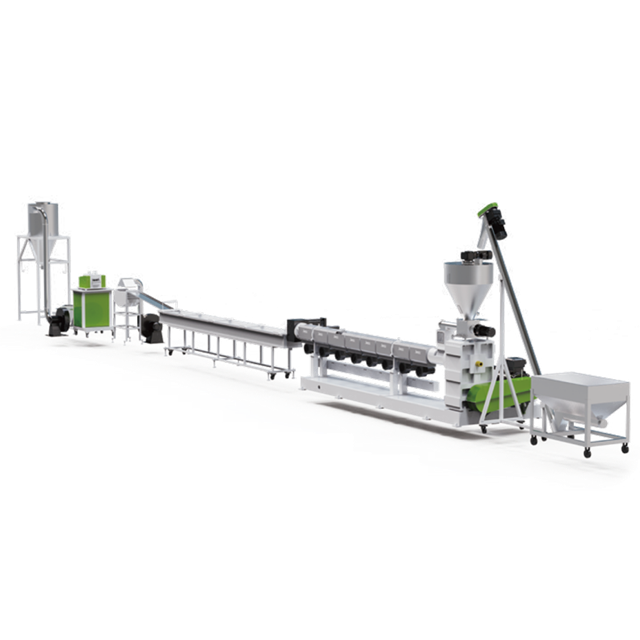
Understanding the internal journey of the polymer is essential for floor operators and engineers alike. The extrusion process is a carefully orchestrated sequence of mechanical and thermal events.
The process initiates at the hopper, the intake funnel located at the rear of the apparatus. Raw plastic—often in the form of rigid flakes, regrind, or virgin resin—is loaded into this reservoir. For standard rigid plastics possessing a high bulk density, gravity alone is usually sufficient to draw the material down into the feed throat.
However, operators on the factory floor often face challenges with lightweight materials or flakes prone to bridging. Bridging occurs when particles interlock and completely block the flow. In these scenarios, force-feeding mechanisms such as crammer feeders or mechanical agitators are deployed. The consistent, uninterrupted flow of material from the hopper into the barrel is absolutely critical. Any fluctuation in the feed rate will cause pressure variations downstream, leading to an unstable final product.
Once the plastic drops through the feed throat, it enters the heated barrel and encounters the rotating extrusion screw. As the most complex and vital component of the machine, the screw is typically divided into three distinct geometric zones.
First is the feed zone. Located directly under the hopper, this section features deep flights. Its primary function is to capture the solid plastic and rapidly convey it forward into the heated sections of the barrel.
Next comes the compression zone. As the material moves forward, the root diameter of the screw gradually increases. This effectively decreases the space between the screw and the barrel wall. This intense compression forces the plastic particles to rub aggressively against each other and the metal surfaces. This friction generates immense mechanical shear. In industrial extruders, up to eighty percent of the energy required to melt the plastic comes from this internal mechanical shear. The external barrel heater bands merely provide supplementary thermal energy.
Finally, the melt reaches the metering zone. In this final section of the screw, the flight depth becomes shallow and constant. The plastic is now completely molten. Here, the metering zone acts as a high-pressure pump. It builds the necessary force to push the homogeneous melt through the filtration system and out of the die at a consistent volume.
When processing recycled materials, the plastic frequently contains residual moisture, surface inks, or volatile organic compounds. If left untreated, these elements will vaporize under high heat. This causes voids, bubbles, and structural defects in the final pellets. To combat this, specialized extruders feature dedicated venting zones. A heavy-duty vacuum pump connects to an opening in the barrel. When dealing with washed flakes, this vacuum zone emits a sharp hiss as it aggressively extracts vaporized moisture and volatile gases before the plastic reaches the die.
Following degassing, the molten plastic must be thoroughly filtered. Recycled rigid flakes often harbor microscopic contaminants like paper, dirt, aluminum fragments, or un-melted rubber. The melt is forcefully pushed through a screen changer, which is a robust filtration device containing fine wire meshes. Advanced systems utilize continuous hydraulic screen changers. This allows technicians to swap out dirty filters without halting the entire extrusion line.
After passing through the screen changer, the pressurized, clean, and homogeneous melt reaches the die head. The die is a precisely machined block of metal that acts as a mold. It gives the continuous plastic stream its final shape. In a pelletizing operation, the die typically features multiple small circular orifices. The plastic is forced through these holes, emerging as long, continuous strands. These glowing strands are then ready for rapid cooling and cutting.
To maintain stable operations and high throughput, an extruder relies on several heavy-duty components working in perfect synchronization. Understanding these parts helps facility managers schedule preventative maintenance effectively.
| Component | Primary Function | Engineering Characteristics |
|---|---|---|
| Motor & Gearbox | Provides the rotational force required to turn the screw against immense backpressure. | Requires high torque capacity and robust thrust bearings to absorb the backward force generated by pushing the heavy melt. |
| The Hopper | Holds and regulates the intake of raw plastic materials. | Often equipped with drying units or automated gravimetric dosing systems for precise material blending. |
| The Barrel & Heaters | Houses the screw and provides supplementary thermal energy to the polymer. | Constructed from hardened steel alloys. Equipped with electrical heater bands and cooling fans for precise zoned temperature control. |
| The Extrusion Screw | Conveys, compresses, melts, and pumps the plastic forward. | Typically treated with bimetallic coatings to resist abrasive wear. This is especially critical when processing recycled rigid plastics. |
| The Die Head | Shapes the molten polymer into its final continuous profile. | Must maintain uniform temperature and pressure distribution to ensure a consistent strand diameter. |
When evaluating extrusion technology for a plant upgrade, it is paramount to understand the mechanical differences between single screw and twin screw configurations.
Single screw extruders remain the absolute industry standard for most basic conveying, melting, and pumping applications. They feature one rotating screw housed within a cylindrical barrel. Because of their relatively straightforward design, they are highly reliable, easier for floor staff to maintain, and highly cost-effective. They rely primarily on friction and pressure to melt the resin. For processing clean, uniform rigid plastics, a single screw setup is often the most efficient choice.
Twin screw extruders, in contrast, utilize two intermeshing screws that rotate either in the same direction or in opposite directions. This complex design provides exceptional mixing and compounding capabilities. The intermeshing action forces the plastic through tight clearances, generating exceedingly high shear rates. This makes them ideal for blending different polymers, dispersing colorants, or heavily devolatilizing highly contaminated plastics. However, twin screw machines demand a significantly higher capital investment and incur steeper maintenance costs.
Looking at the broader manufacturing landscape, the plastic extrusion sector is rapidly evolving to meet stringent global sustainability mandates. Recent market shifts highlight a definitive move toward automation and energy efficiency. Specifically, modern facilities are moving away from purely mechanical setups and embracing smart extruders integrated with industrial internet of things sensors.
This digital transformation allows operators to monitor real-time melt pressure and temperature profiles directly from control room dashboards. Engineers can now predict wear and tear before a catastrophic failure halts production. Furthermore, as the circular economy drives demand for higher-quality recycled resins, processing heavily contaminated post-consumer waste has become the new industry standard.
To maintain profitability amidst rising utility costs, equipment manufacturers are increasingly equipping extrusion lines with permanent magnet synchronous motors. These advanced drives significantly lower the energy consumption per kilogram of processed flake. Consequently, mastering the thermodynamic balance within the extruder is no longer just a technical requirement. It is a critical business asset for maximizing operational margins.
The extrusion process alone does not produce a finished, transportable raw material. To fully close the recycling loop, the continuous molten profile must be converted into discrete, manageable granules. This is where the extruder integrates seamlessly into a complete plastic pelletizing machine.
Once the extruder forces the molten plastic through the strand die, the high-temperature strands must be rapidly solidified. This is typically achieved by drawing the glowing strands through a long, temperature-controlled water cooling bath. High-velocity air knives then strip the residual moisture from the strands. Finally, the cooled solid plastic strands are fed into a pelletizer. This specific unit uses a high-speed rotary cutting rotor to chop the continuous strands into uniform cylindrical pellets. These pellets are visually and physically similar to virgin plastic resin, making them ready to be packaged, sold, and fed into injection molding machines to create brand-new products.
Rigid plastics like high-density polyethylene bottles, polypropylene battery cases, injection-molded crates, and structural scraps present unique processing challenges. Unlike flexible films, rigid flakes possess a higher bulk density and are highly abrasive. Consequently, they require specialized processing lines engineered to handle immense mechanical stress while providing superior filtration.
Depending on the condition and source of your feedstock, facility managers must choose between two primary machinery configurations.
A single-stage system consists of one main extruder that handles the conveying, melting, degassing, filtering, and pumping in a single continuous pass. This configuration is highly efficient. It serves as the optimal choice for processing rigid plastic scraps that are relatively clean, dry, and uniform in composition.
Because the material only passes through one heating cycle, the thermal degradation of the polymer chains is minimized. Single-stage systems require a smaller facility footprint, consume less electrical power, and are easier for operators to maintain. For example, systems designed for capacities ranging from 300 to 1000 kilograms per hour utilize optimized length-to-diameter ratios to ensure thorough melting without excess shear. If your facility processes clean post-industrial regrind, investing in a high-quality Rigid Plastic Pelletizing Line ensures high throughput with streamlined maintenance protocols, delivering a rapid return on investment.
Post-consumer rigid plastics present a vastly different set of thermodynamic challenges. Materials recovered from municipal waste streams are frequently contaminated with heavy printing inks, organic residues, paper labels, and high residual moisture from the washing process. A single-stage extruder often struggles to adequately vent these trapped gases and filter heavy impurities without causing severe pressure instability.
To solve this, engineers utilize a double-stage system, commonly referred to in the industry as a mother-baby configuration. This setup connects two separate extruders in a sequential line. The primary extruder performs the initial melting, heavy degassing, and coarse filtration. The partially filtered melt is then transferred directly into a smaller secondary extruder. Operating at a lower rotational speed, the second stage provides a crucial round of ultra-fine filtration and stabilizes the melt pressure before it reaches the die. For facilities handling highly contaminated post-consumer waste, a specialized Pelletizing system for rigid plastic engineered with a double-stage design is standard equipment required to achieve commercially viable, defect-free resins.
Attempting to process rigid plastic flakes through extrusion equipment designed for flexible films or general-purpose compounding often results in suboptimal throughput, frequent machine blockages, and poor pellet quality. Investing in a dedicated system provides measurable advantages in operational economics, material quality, and equipment longevity.
Efficiency and Automation: Modern industrial recycling relies heavily on minimizing manual intervention. Dedicated rigid plastic lines are engineered with advanced gravimetric feeding systems that precisely control the intake of heavy flakes, preventing hopper bridging. Furthermore, sophisticated programmable logic controllers continuously monitor barrel temperatures and melt pressure in real-time. If the pressure at the screen changer spikes—indicating a full filter—the automated system triggers a hydraulic screen change without stopping the extrusion process. This drastically reduces costly downtime.
Superior Output Quality: Plastic manufacturers who purchase recycled granules demand they behave exactly like virgin resins during injection molding. Dedicated systems ensure this high-quality output through precise thermodynamic control. By utilizing optimized screw designs specifically cut for rigid polymers, the extruder achieves a homogeneous melt without excessive shear heat. Advanced vacuum degassing systems remove microscopic air bubbles, ensuring the final pellets are dense, structurally sound, and highly valued in the commodities market.
Durability and Long-Term Value: Processing post-consumer rigid plastics is inherently abrasive. Materials like crushed battery cases often carry residual dirt, sand, and microscopic metal fragments. Over thousands of hours, these abrasive particles cause severe wear on internal components. Dedicated machinery combats this via specialized metallurgy. The extrusion screws and internal barrel linings are typically treated with bimetallic coatings, such as tungsten carbide alloys applied via plasma transferred arc welding. This bimetallic armor significantly extends the lifespan of the equipment, reducing the frequency of costly replacement parts and safeguarding your long-term return on investment.
Understanding the internal mechanics of a plastic extruder is the foundational step in optimizing any modern recycling facility. It is the critical engine that turns raw, contaminated waste into valuable, uniform granules. While the basic physics of heat, pressure, and shear remain constant, the specific configuration of the machinery must adapt to the unique physical properties of your feedstock. By selecting dedicated rigid plastic processing equipment tailored to your material's contamination and moisture levels, you can maximize throughput and ensure premium pellet quality. To explore advanced extrusion solutions and find the exact machinery match for your plant's capacity needs, explore the engineering solutions provided by JWELL Machinery to secure a sustainable, profitable future in plastics processing.
It varies by plastic type, but generally ranges from 200°C to 275°C for common plastics like polypropylene and polyethylene.
An extruder pushes melted plastic continuously through a die to create long shapes like pipes or strands for pelletizing. Injection molding forces plastic into a closed mold to create individual, discrete parts.
Recycled plastics often contain moisture or ink. Degassing vents remove these volatile gases during the extrusion process, preventing hollow or brittle pellets.
While possible with specialized screw designs, it is highly recommended to use dedicated lines because rigid flakes and flexible films have vastly different bulk densities and melting behaviors.
Thickness is controlled by balancing the speed of the extruder screw, which determines material volume, and the speed of the downstream pulling equipment. The die design also plays a major role in the final dimensions.
Surging, or unstable output flow, is typically caused by inconsistent feeding in the hopper, bridging of lightweight materials, uneven barrel heating, or a mismatched screw design for the specific polymer being processed.


