
- All
- Product Name
- Product Keyword
- Product Model
- Product Summary
- Product Description
- Multi Field Search
 English


Modern recycling relies heavily on one specific, highly engineered machine. Without this core equipment, processing industrial waste into reusable materials remains physically impossible.
Whether you are manufacturing food products, operating a polymer lab, or managing a massive materials recovery facility, understanding the extrusion process is critical. In this comprehensive guide, we explore everything from fundamental mechanical principles to the vital role these machines play as the beating heart of a modern plastic recycling line.
By the time you finish reading, you will understand how these complex thermodynamic systems operate, the key components involved, and how to select the ideal machinery for processing tough, contaminated plastics without destroying your profit margins through excessive downtime.
Key Takeaways
- Definition: An extruder is a robust industrial machine that forces raw material through a shaped die to create continuous profiles or uniform pellets.
- Core Mechanism: The entire process relies on a delicate balance of heat, intense pressure, and mechanical friction. The rotating extruder screw drives this reaction.
- Recycling Application: Extruders act as the central nervous system of any recycling line, turning bulky plastic waste into high-value reusable resin.
- System Selection: Choosing between a single-stage and double-stage setup depends heavily on the moisture content, printing inks, and contamination levels of your raw plastic scrap.
To truly understand this equipment, one must look at the fundamental principles of mechanical engineering and material science. At its core, an extruder is a specialized piece of heavy manufacturing equipment designed to process, melt, and shape raw materials. It achieves this by utilizing a rotating screw housed within a highly heated, thick-walled cylindrical barrel. This mechanism forces the viscous material through a specifically engineered opening known as a die.
The term extrusion refers to this exact dynamic process of shaping material by forcing it through a restricted cross-section. Consequently, the result is a continuous profile that perfectly takes the shape of the die. Within polymer processing, the extruder transforms solid, irregular plastic flakes or granules into a smooth, homogeneous molten state. It applies consistent, immense pressure to ensure the final output is dense, uniform, and completely free of structural air voids.
While this guide focuses heavily on the mechanics of plastic recycling, the extrusion process remains incredibly versatile. The core sequence of mixing, heating, and shaping stays consistent across various global industries, even though the machine's specific geometry and operating parameters shift dramatically.
Understanding operation requires breaking down the complex thermodynamic and mechanical phases of the extrusion cycle. Because the process is continuous, raw material enters one end while the finished product exits the other simultaneously. Let's walk through the exact sequence from an operator's perspective.
The journey begins at the feed throat, located at the rear of the extruder. Operators or automated systems load raw materials into a large metal hopper. This material can be virgin polymer pellets, post-industrial regrind, or thoroughly washed plastic flakes. The hopper relies on gravity to feed the bulky material down into the rotating screw below. In advanced industrial setups, gravimetric or volumetric feeders sit above the hopper to guarantee a highly precise, consistent feed rate. Maintaining this steady flow prevents pressure surges inside the barrel.
Once the solid material drops into the barrel, the rotating flights of the extruder screw forcefully convey it forward. This introduces the most critical phase: melting. Contrary to popular belief, the external heater bands wrapped around the barrel do not provide the primary source of heat for melting the plastic.
Instead, the vast majority of the thermal energy comes from mechanical shear and friction. As the hard plastic gets aggressively compressed between the screw flights and the inner wall of the barrel, the intense friction generates massive amounts of shear heat. The external barrel heaters primarily serve to bring the machine up to operating temperature during initial startup and to maintain a precise temperature profile across different zones. During this violent mechanical phase, the solid plastic transitions into a viscous, thoroughly mixed homogeneous melt.
As the molten polymer reaches the final section of the screw, it enters the metering zone. Here, the material undergoes final mixing to ensure uniform temperature and viscosity. The screw then acts as a powerful hydraulic pump. It generates the necessary head pressure to force the thick, molten polymer through a breaker plate and into the die. This precisely machined metal block acts as a continuous mold. In recycling applications, the die typically features multiple small circular holes, pushing out long strands of glowing, molten plastic.
Because the plastic exits the die in a highly viscous, nearly liquid state, it requires rapid cooling to retain its new shape. The freshly extruded strands are immediately drawn through a long, circulating water cooling bath. Once the strands have sufficiently solidified, a puller feeds them into a pelletizer. This high-speed rotating cutting mechanism chops the continuous strands into uniform, cylindrical pellets. Finally, these pellets are dried, vibrated to remove dust, and packaged as premium raw material for new plastic manufacturing.
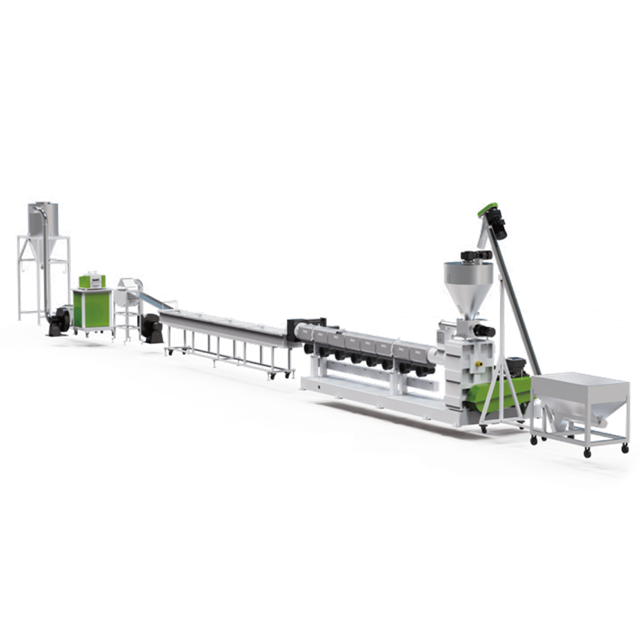
To fully grasp the immense capabilities of a modern extrusion line, one must examine its individual mechanical components. Engineers design each part to withstand extreme internal pressures, blistering temperatures, and continuous abrasive wear from tough materials.
The hopper acts as the primary holding receptacle for the raw material. Industrial-grade hoppers often include internal agitators to prevent material bridging. This frustrating scenario occurs when irregular flakes clump together and block the feed throat. Many hoppers also feature hot-air drying mechanisms to strip away surface moisture before the plastic ever enters the barrel.
Directly below sits the barrel. This heavy-duty, thick-walled steel cylinder houses the screw. Because recycled plastics often contain abrasive impurities like trace metals or dirt, manufacturers typically line the internal surface of the barrel with bimetallic alloys or nitrided steel. This specialized coating fiercely resists wear and corrosion over thousands of hours of relentless operation.
Ask any seasoned plant operator, and they will tell you the screw is undeniably the heart of the extruder. Its specific geometric design dictates the machine's overall throughput, its mixing capability, and the exact types of materials it can successfully process. A standard single screw divides into three distinct geometric zones:
Temperature regulation remains non-negotiable in extrusion. A fluctuation of just a few degrees can ruin a production batch. Cast aluminum or ceramic heater bands clamp tightly around the exterior of the barrel. They operate in multiple independent zones, allowing operators to set a highly specific temperature gradient from the cold feed throat to the hot die.
Embedded deeply into the barrel wall are thermocouples. These high-precision temperature sensors communicate real-time thermal data directly to the central PLC control panel. If a specific zone becomes dangerously hot due to excessive internal friction, automated cooling fans or internal water-cooling jackets activate instantly to stabilize the process.
When processing recycled materials, encountering foreign contaminants like paper labels, aluminum foil, wood splinters, or un-melted rubber is an unavoidable reality. Before the molten plastic can safely reach the die, it must pass through a robust filtration system known as a screen changer. This hydraulic device holds fine woven wire mesh screens that trap microscopic impurities. Advanced continuous screen changers allow operators to replace clogged filters on the fly without stopping the extrusion process. This specific feature significantly boosts overall production efficiency.
The industrial extrusion market divides primarily into two main categories based on the rotor configuration. Selecting the correct type depends entirely on the rheological properties of your specific plastic and the exact processing requirements of your facility.
Single screw extruders serve as the undisputed workhorses of the plastic recycling industry. They are highly efficient, surprisingly cost-effective, and mechanically straightforward. For standard rigid plastics like clean Polypropylene or Polyethylene regrind, a single screw provides ample melting and pumping capacity. Their inherent simplicity translates directly to lower operational costs, easier troubleshooting, and drastically reduced downtime for maintenance.
Twin screw extruders feature two parallel screws operating side-by-side. They can be co-rotating or counter-rotating. Engineers specify these complex machines when a process requires intense mixing, a procedure known as compounding.
If a recycling facility needs to blend color masterbatches, glass fibers, or chemical additives into the recycled plastic, a twin-screw extruder provides the aggressive distributive and dispersive mixing required. Their self-wiping nature prevents sticky or heat-sensitive materials from stagnating on the screws. However, this performance comes with a significantly higher initial capital cost and a more demanding maintenance schedule.
To fully grasp the industrial importance of extrusion, we must look at its most critical application in the modern circular economy: recycling. In this vital context, the extruder becomes the foundational engine of a much larger, interconnected system.
When plastic products reach the end of their lifecycle, facilities collect, wash, and crush them into small, irregular flakes. Manufacturers cannot feed these irregular flakes directly into injection molding machines to make new products. The material must be completely homogenized, filtered, and standardized.
This is exactly where the extrusion process proves indispensable. By integrating an extruder with smart feeding systems, melt filtration units, and downstream cutting mechanisms, you create a complete plastic pelletizing machine. This equipment takes inconsistent, bulky flakes, melts them down, removes residual impurities, and produces clean pellets that mirror the properties of virgin plastic.
Looking at the current landscape of polymer processing, the recycling sector is experiencing a massive technological shift driven by global sustainability mandates. Modern extrusion lines are rapidly adopting smart IoT integration. Plant managers now utilize sensors that monitor melt pressure, viscosity, and thermal degradation in real-time, feeding data to AI-driven control panels that adjust screw speeds automatically to prevent material degradation.
Alongside automation, as the push for processing highly contaminated Post-Consumer Resin intensifies, there is a distinct industry trend toward equipping extruders with ultra-high vacuum degassing zones. Traditional extruders struggle with wet or heavily printed plastics, often producing porous, brittle pellets. Today's advanced vacuum systems extract volatile gases and moisture mid-barrel. These engineering advancements allow facilities to process previously unrecyclable plastics without compromising the structural integrity of the final pellet, pushing the true circular economy closer to reality.
The journey from crushed flake to uniform pellet involves several precise engineering steps at the end of the extrusion barrel. How the molten plastic gets cut ultimately determines the specific type of pelletizing system being used. The two most common methods in industrial recycling are Strand Pelletizing and Water-Ring Pelletizing.
Operators quickly learn that not all plastics behave equally inside a heated barrel. Soft plastics require vastly different handling compared to rigid plastics. Rigid materials include High-Density Polyethylene from milk jugs, Polypropylene from automotive parts, and Acrylonitrile Butadiene Styrene from electronic waste.
These rigid materials boast a higher bulk density and demand robust, high-torque extrusion machinery. For facility managers and investors, selecting the correct Pelletizing system for rigid plastic stands as the single most critical decision in ensuring plant profitability and long-term product quality.
The primary challenge in processing rigid plastics lies in managing contamination and moisture. Rigid plastics often carry residual moisture from the washing line, alongside heavy printing inks or trace amounts of foreign polymers. If left unmanaged, these contaminants cause internal voids and severe discoloration in the final pellets. Manufacturers must carefully choose between two primary equipment architectures.
| Feature | Single-Stage Extrusion System | Double-Stage Extrusion System |
|---|---|---|
| Configuration | One main extruder (Typical L/D ratio: 30:1 to 36:1) | Two extruders in sequence (Mother L/D: 36:1, Baby L/D: 12:1) |
| Ideal Material | Clean, dry post-industrial scrap | Contaminated, wet post-consumer waste |
| Moisture Tolerance | Below 3% | Up to 5% - 8% |
| Filtration & Degassing | Single screen changer, standard venting | Dual screen changers, aggressive high-vacuum degassing |
| Energy Consumption | Lower operational cost | Higher operational cost, but yields premium PCR pellets |
Single-Stage Extrusion Systems: A single-stage system utilizes one main extruder. The crushed rigid plastic enters the hopper, travels down the heated barrel, passes through a single filtration screen, and is immediately cut into pellets. Single-stage systems are the optimal, cost-effective choice for processing clean, relatively pure scrap. If your rigid plastic regrind has low moisture and minimal surface contamination, this setup provides excellent throughput with lower energy consumption.
Double-Stage Extrusion Systems: Conversely, a double-stage system connects two independent extruders in sequence. The first, larger extruder handles the primary melting, mixing, and initial coarse filtration. The molten plastic then drops seamlessly into a second, smaller extruder, which operates at a lower speed to provide secondary fine filtration and extensive degassing before reaching the die.
Investing in a Rigid Plastic Pelletizing Line featuring a double-stage design is absolutely essential when processing post-consumer plastics. The transition zone between the two extruders acts as a natural pressure-release point, allowing trapped gases and volatile ink compounds to escape easily through vacuum vents. This aggressive degassing prevents foaming, while the dual filtration ensures a remarkably pure, high-value final pellet.
Understanding the full scope of extrusion requires an objective look at its operational realities. While extrusion forms the unbreakable backbone of polymer processing, it naturally comes with specific engineering trade-offs that plant operators must actively manage.
Extruders represent the very core of modern plastic recycling and polymer manufacturing. By applying precise combinations of heat, pressure, and mechanical shear, they seamlessly transform bulky, inconsistent waste into highly valuable, uniform raw materials.
Choosing the right equipment for your facility ensures vastly better operational efficiency and significantly reduces long-term maintenance costs. You must evaluate your input material carefully before purchasing machinery. Matching your specific recycling needs with the appropriate single-stage or double-stage line guarantees higher quality pellets, smoother daily operations, and ultimately, better profit margins.
If you are upgrading your facility or building a new recycling plant, selecting robust, engineered-to-order machinery is non-negotiable. Evaluate your material's moisture and contamination levels, and explore the advanced extrusion solutions at Jwell Recycling to find the exact pelletizing line that fits your production goals.
While industrial extruders process tons of plastic every hour, a 3D printing extruder is a micro-scale version of the exact same concept. It utilizes a small stepper motor and a geared mechanism to push a solid filament of plastic through a precisely heated nozzle. The melted plastic is then deposited meticulously, layer by layer, to build intricate three-dimensional objects. Despite the massive difference in physical size, the core physics of thermal melting and pressure-driven shaping remain completely identical.
The operating temperature depends entirely on the specific polymer being processed. For low-melting-point plastics like LDPE, the barrel temperature typically ranges from 160°C to 190°C. For rigid plastics like Polypropylene or HDPE, temperatures hover between 200°C and 240°C. Engineering plastics like PET or Polycarbonate require much higher thermal profiles, often exceeding 260°C to 280°C. Operators set different temperatures across various barrel zones to ensure a smooth melt transition without degrading the material.
An extruder is designed for continuous production, constantly pushing molten material through a die to create endless, uniform profiles like long strands for pelletizing, water pipes, or plastic film. In stark contrast, an injection molding machine utilizes a cyclic, discrete process. It uses a reciprocating screw to melt the plastic, but instead of pushing it continuously through an open die, it injects a specific volume of molten plastic under incredibly high pressure into a closed, cooled metal mold. This creates a specific, standalone 3D object, such as a bottle cap or a car bumper.
In industrial recycling, a clogged extruder usually results from a blocked screen changer or a cold die. First, operators must check the melt pressure sensors. If pressure spikes, the hydraulic screen changer is activated to swap in a clean filter mesh. If the die itself is clogged with un-melted contamination or degraded plastic (black specks), operators must safely raise the die temperature slightly, reduce the screw RPM, and purge the machine with a high-viscosity commercial purging compound or clean cast acrylic to push the blockage out.
While theoretically possible, it is highly inefficient and strongly discouraged without major mechanical modifications. Rigid plastics have a high bulk density and gravity-feed easily into a standard hopper. Soft plastics, like LDPE agricultural films or grocery bags, are extremely light and fluffy. If fed into a rigid plastic line, they will bridge or simply float in the hopper, failing to engage with the screw. Processing soft plastics requires a specialized feeding mechanism, such as an integrated cutter-compactor or an agglomerator, to properly densify the material before it ever enters the extrusion barrel.


