
- All
- Product Name
- Product Keyword
- Product Model
- Product Summary
- Product Description
- Multi Field Search
 English

Views: 0 Author: Site Editor Publish Time: 2026-07-20 Origin: Site


Processing post-consumer plastic waste presents severe operational challenges compared to post-industrial scrap, primarily due to unpredictable contamination levels, mixed polymer streams, and stubborn residues like adhesives, organic matter, and labels. Facility operators and investors must balance the high capital expenditure of advanced sorting and washing machinery with the strict purity requirements of the Post-Consumer Resin (PCR) market. Substandard equipment leads to excessive downtime, high utility costs, and low-value output, often resulting in negative value waste. Selecting the right equipment requires a rigorous technical evaluation of the entire system architecture. From initial ballistic and optical sorting through aggressive washing and final extrusion, every component must be optimized. This guide provides a framework for evaluating system capabilities, mitigating implementation risks, and shortlisting equipment partners to build a reliable post consumer plastic recycling line.
There is a stark contrast between clean, uniform post-industrial scrap and highly contaminated post-consumer bales. Post-consumer materials often originate from curbside collection or material recovery facilities, bringing unpredictable variations in quality. The upstream collection method directly dictates the level of sorting and washing intensity required. Deposit Return Schemes generally yield cleaner inputs compared to single-stream curbside collection or mixed municipal solid waste. Operators face primary operational threats from abrasive contaminants like glass, sand, and metal. Chemical and organic residues, such as food and oils, complicate the cleaning process. Multi-layer packaging further challenges separation efficiency, requiring robust mechanical and thermal interventions.
| Parameter | Post-Industrial Scrap | Post-Consumer Bales |
|---|---|---|
| Contamination Level | Low (mostly dust or minor mixed polymers) | High (organics, adhesives, metals, glass) |
| Polymer Consistency | Highly uniform, single-stream | Mixed, requiring advanced NIR sorting |
| Washing Requirement | Minimal (often cold wash only) | Intensive (hot wash, friction, chemical dosing) |
| Equipment Wear Rate | Low to moderate | High (requires hardened steel components) |
Maximizing recovery of the primary target polymer, such as clear PET or HDPE milk jugs, secures premium market prices. This high-value intended plastic forms the core revenue stream. Isolating secondary polymers, like PP tubs in a PET line, allows for separate baling and alternative revenue streams rather than losing these materials to landfills. Managing negative-value waste residues is critical for operational efficiency. Unavoidable waste streams, including PVC, multi-layer films, paper labels, dirt, and treatment sludge, drag down total line yield. Discounting the cost of disposing of these materials requires precise sorting and robust waste management protocols.
Acceptable parts-per-million limits for organic, metallic, and cross-polymer contamination depend on target end-markets. Achieving an FDA letter of no objection for food-grade applications requires significantly lower PPM limits than construction-grade materials. Throughput stability frames success better than peak capacity. Sustained, continuous throughput metrics over a 24-hour operational cycle indicate true system reliability. Establishing operational expenditure baselines is essential. Measuring energy consumption in kilowatt-hours per ton and water usage in liters per ton provides primary success indicators. Efficient resource utilization directly impacts the profitability of the recycling operation.
Mechanical separation utilizes trommels, ballistic separators, and magnetic or eddy current separators. These components remove fines, 3D/2D materials, and ferrous or non-ferrous metals before they enter the main processing stream. Near-Infrared sorting assesses polymer identification, effectively separating PET from HDPE or PP, and provides color sorting capabilities. Crushing and size reduction rely on heavy-duty shredders and granulators. Wet granulation introduces water into the cutting chamber to initiate label and dirt removal while reducing blade wear. This method often proves superior to dry granulation when handling highly contaminated post-consumer materials.
High-speed friction washers mechanically strip paper labels, dirt, and loose organics from plastic flakes. Thermal and chemical washing using caustic soda or detergents dissolves stubborn adhesives, oils, and odors. Density separation relies on specific gravity to isolate target polymers. Sink-float tanks allow PET to sink while polyolefins float. Tank length and agitation mechanisms are vital for effective separation. Mechanical centrifugal dryers and thermal pipeline drying systems reduce moisture levels. Achieving strict moisture thresholds is required before the flakes enter the extrusion phase. Proper drying prevents defects in the final pelletized product. A well-configured plastic washing line dictates the final quality of the flake.
Cutter-compactor systems manage low-bulk-density post-consumer flakes more effectively than standard force-feeding hoppers. Single-screw and twin-screw extruders feature continuous, self-cleaning screen changers necessary for handling residual micro-contaminants. Double or triple vacuum degassing zones extract moisture and volatile organic compounds, preventing voids and brittleness in the final pellets. Pelletizing methods include strand pelletizing, water-ring pelletizing, and underwater pelletizing. The choice depends on the polymer type and desired pellet uniformity. Underwater pelletizing often yields the most consistent results for high-grade PCR when integrated with a robust plastic pelletizing system.
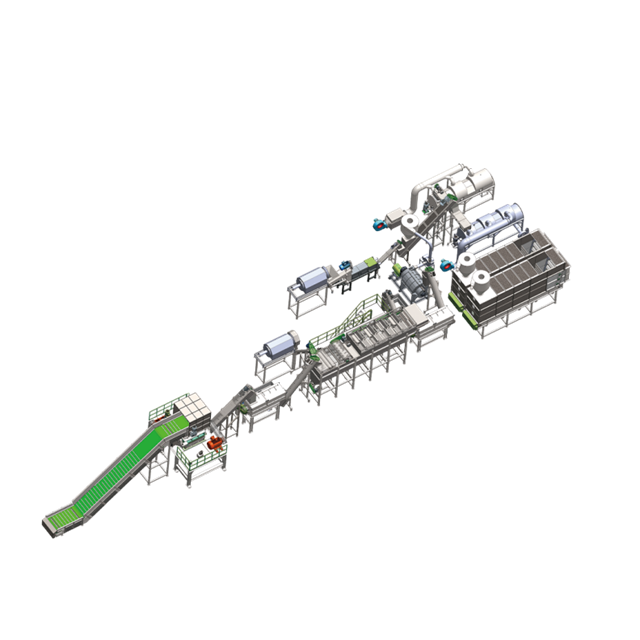
Assessing metallurgy and wear resistance is critical. Hardened steel alloys, tungsten carbide coatings on rotor blades, and stainless steel components ensure durability in corrosive washing environments. System architecture must allow for future retrofitting, such as adding an additional hot wash module, without requiring a complete line redesign. You must evaluate the plastic washing line manufacturer based on their engineering tolerances and material selection.
A viable vendor must offer or integrate seamlessly with dissolved air flotation systems and sludge presses for effective water recirculation. Automated monitoring and replenishment of pH levels and detergents in hot wash tanks maintain consistent cleaning efficacy while minimizing chemical waste. Proper water management prevents environmental compliance issues and reduces operational overhead.
Equipment design must prioritize maintenance access. Hydraulic screen changers, easy-access centrifuge screens, and quick-change shredder knives minimize downtime. Supply chain transparency, regional parts warehousing, and guaranteed response times for critical component failures are essential evaluation criteria. When a bearing fails or a motor burns out, you need parts on-site within 24 hours, not weeks.
Facilities with constrained square footage must analyze the trade-offs between linear line configurations and multi-level setups. High-efficiency motors and variable frequency drives carry a capital expenditure premium but offer significant long-term operational savings. You have to map out the physical footprint before committing to a specific layout.
Centralized, automated control systems reduce manual labor and prevent catastrophic equipment damage through automated fault detection. Real-time monitoring for throughput, motor load, and temperature profiles maintains strict quality control for PCR buyers. Investing in SCADA systems upfront pays dividends when troubleshooting complex line blockages.
Unexpected surges in highly contaminated or missorted bales cause system blockages, blade damage, or off-spec output. Implement strict inbound material auditing and invest in robust pre-shredding metal detection. Design buffer silos between sorting and washing stages to normalize material flow.
Project delays occur due to extended manufacturing lead times, shipping bottlenecks, or prolonged commissioning phases. Structure vendor contracts with clear milestones. Mandate factory acceptance testing using your specific material before shipping, and require on-site engineers for site acceptance testing and operator training.
Successfully processing post-consumer plastic waste requires a fully integrated, continuous system where sorting, washing, and pelletizing stages are perfectly synchronized. Prioritize manufacturers who demonstrate transparent engineering data, offer robust closed-loop water management, and possess a proven track record with your specific polymer streams.
A: Water consumption varies based on contamination levels and system design. Advanced closed-loop systems with dissolved air flotation can reduce fresh water intake to less than 1-2 liters per kilogram of processed material, heavily relying on continuous filtration and recirculation.
A: Mixed polymers are separated using a combination of Near-Infrared optical sorting for initial identification and sink-float tanks for density-based separation. Sink-float tanks effectively separate heavy plastics like PET from lighter polyolefins like HDPE and PP.
A: The pelletizing system melts the washed flakes, filters out residual micro-contaminants through continuous screen changers, and removes moisture and volatile organic compounds via vacuum degassing. It then forms uniform pellets suitable for manufacturing new plastic products.
A: Floor space requirements depend on throughput capacity and system configuration. A standard 2,000 kg/h line typically requires between 1,500 and 3,000 square meters. Multi-level mezzanine setups can reduce the linear footprint in constrained facilities.
A: Cold friction washing uses high-speed mechanical action and ambient water to strip loose dirt and paper labels. Hot washing utilizes thermal energy and chemical detergents, typically caustic soda, to dissolve stubborn adhesives, oils, and organic residues.
A: Adhesives and labels are removed through a multi-stage process. Initial dry or wet granulation breaks down the material. High-speed friction washers mechanically strip labels, while hot washing tanks dissolve residual glues using heat and chemical agents.
A: High-throughput lines require regular maintenance, including daily inspections of shredder and granulator blades, frequent cleaning of centrifuge screens, and routine replacement of melt filters. Automated lubrication systems and quick-change components help minimize operational downtime.


